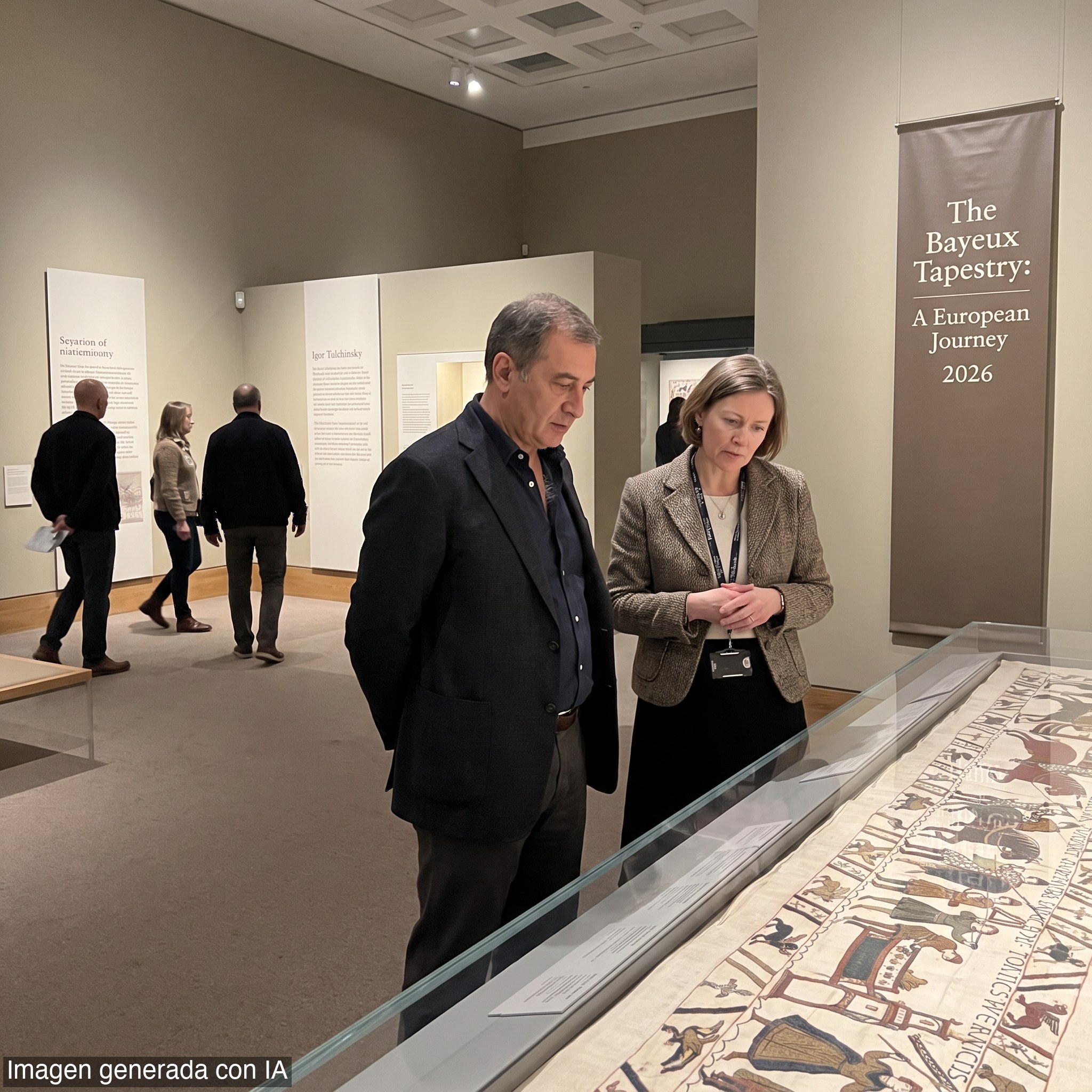
The numbers come first. Igor Tulchinsky has donated £5 million ($6.8 million) to the British Museum to support its Bayeux Tapestry exhibition, which opened in London in September 2026 and has already sold out through the end of the year. More than 65,000 people queued online for tickets on the day of release. Organizers expect more than 1 million visitors to view the 70-meter-long embroidery — the first time it has been seen in the United Kingdom.
The exhibition has been described by King Charles as a 'remarkable artwork.' For Tulchinsky, the $6.8 million commitment is not charity in the conventional sense. It is capital allocation with a permanent return.
From one ruble to $1.7 billion. Tulchinsky was born in what is now the Republic of Belarus and left at the age of 11 during the 1970s, when Cold War tensions were at their peak. His parents, both accomplished musicians, were allowed to leave with 1 ruble — worth between 20¢ and 50¢ at black market rates, far below the official Soviet rate of $1.30 to the ruble. His father spent it on a piece of Polish gum the moment the family crossed the border.
The risk his parents took was not abstract. Under Soviet rules, applying to emigrate meant potential denial, loss of employment, and social ostracism. The family traveled to Italy, applied for refugee status in the United States, and received it within four months.
'It puts you in a place where you're okay taking risks,' Tulchinsky says, 'and understanding that sometimes big risks should be taken because even if you don't try to take them, they can take you.'
Algorithmic capital, ancient artifact. Tulchinsky built his fortune in quantitative finance. He founded WorldQuant, a hedge fund spun out of Millennium, Israel Englander's U.S. quant business. His estimated net worth stands at $1.7 billion. He says artificial intelligence will soon deliver a 100-fold leap in productivity for WorldQuant as the firm invests heavily in structuring presently unstructured financial data.
The juxtaposition — a man at the frontier of AI writing a nine-figure check for a 1,000-year-old tapestry — is deliberate. 'It takes you away from the war of the world of Instagram and TikTok and all that stuff,' he says of the physical, ancient object.
Maximum impact per dollar. Tulchinsky applies the same return-on-investment logic to philanthropy that he applies to trading. 'When you give somebody a skill, the skill stays with them their whole life, and maybe a part of it gets transferred across generations,' he says. 'I look for maximum output per dollar spent. In philanthropy, I also look for maximum impact for dollar spent.'
The WorldQuant Foundation funds WorldQuant University, which offers free online education programs in financial engineering and applied AI. His thesis: talent is distributed equally around the world, but opportunity is not.
CEO Times take. Tulchinsky's story is the American immigration compact at its most legible — a family that arrived with nothing, accepted the rules of a free market, and built durable wealth through discipline and risk tolerance. His philanthropy follows the same logic: no diffuse grants, no bureaucratic intermediaries, just skills that compound. In an era when corporate giving too often chases progressive optics over measurable outcomes, his framework — maximum impact per dollar, permanent skills over cash transfers — is a model worth studying. The market for human talent is global; the question is always whether institutions create the conditions for it to flourish. Tulchinsky is betting they can.