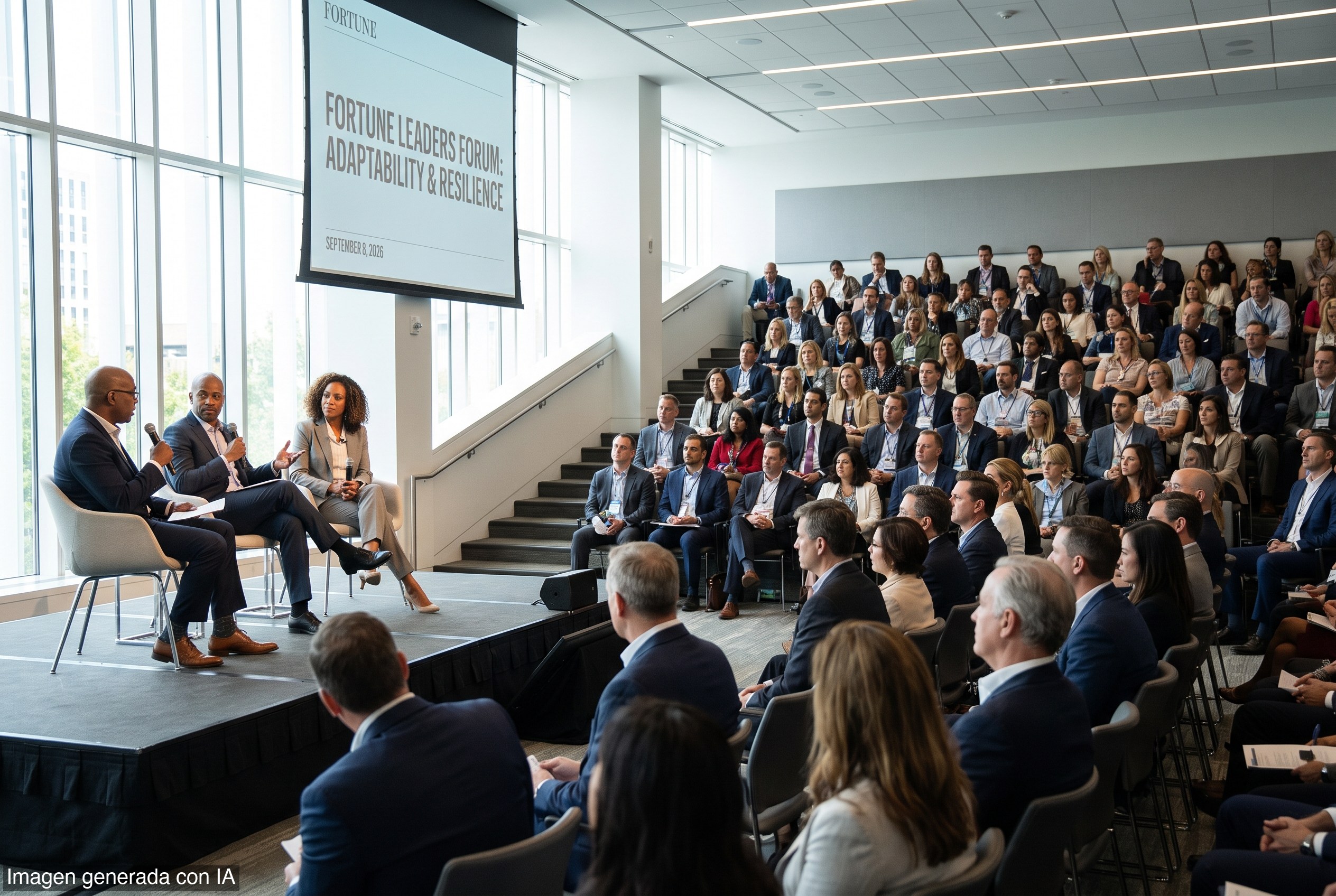
HONG KONG — Business leaders can no longer predict their way through today's turbulent environment — and should stop trying. That was the consensus at the Fortune Leaders Forum on September 8, 2026, where three senior executives delivered a blunt message to the corporate world: flexibility is the only durable competitive advantage.
'Instead of trying to predict the future, it's probably better off to really enhance the muscle of adaptability,' said Carol Liao, chair of BCG Greater China. In an era when AI is commoditizing knowledge, she added, 'judgment does have a premium.'
Liao spoke alongside Chanda Beppu, president of Starbucks Asia Pacific, and Feroz Sheikh, chief information and digital officer at Syngenta Group. All three arrived at the same prescription: focus less on forecasting and more on building organizations that can change course quickly.
Failure as data, not disgrace
Sheikh made the case for institutional tolerance of risk. 'It's safe to fail, and it's not a blip on your career,' he said, urging companies to create a 'culture of experimentation' and treat short-term setbacks as learning inputs. Failure, in his framing, is simply 'a data point.'
The stakes are concrete. Sheikh noted that heat stress in Europe wiped out almost 2 billion euros — roughly $2.3 billion — of agricultural production in 2026. 'These are shocks that companies have to be prepared to absorb,' he said.
Beppu offered a complementary view from the consumer side. 'We can't always create certainty about what's to come,' she said. 'We can create clarity about what matters most to our business and to our teams.'
China's multinationals grow up
Liao pointed to a structural shift underway among Chinese companies navigating both a generational handover and the demands of true multinational operations. Using China's EV sector as an example, she noted that companies like BYD are building factories around the world and assembling global supply chains — either bringing Chinese suppliers with them or cultivating local ones.
'Globalization has been going on for Chinese companies for 20, 30 years. But for a long time, it's been a trading model,' she said. Now, she argued, 'globalization, in a way, has become localization,' requiring a fundamentally more flexible leadership posture — a shift she described as moving from 'command and control, symphony-type leadership to a more jazz leadership — more distributed decision making, more experimentation, more tolerance for failure.'
AI: the easy part
All three panelists addressed artificial intelligence, but with notable restraint. Liao cautioned that technology is not the hard problem. 'Seventy percent [of AI transformation] is really about people: changing organization, ways of working, incentives, dealing with organizational inertia,' she said. 'Technology often is not the problem. The problem is often how you run this human transformation.'
Beppu framed AI's value in operational terms: 'Where it enhances our culture and our purpose, where it removes friction for our baristas, it's valuable to us.'
CEO Times take
The message from the 2026 Fortune Leaders Forum is one free-enterprise readers should absorb: the companies that will win are not the ones with the best five-year plan, but the ones with the most resilient internal markets for ideas and decisions. Distributed decision-making, tolerance for failure and rapid course-correction are not soft cultural values — they are structural advantages that no regulator can mandate and no bureaucracy can replicate. The market has already voted on rigidity. The verdict is not kind.