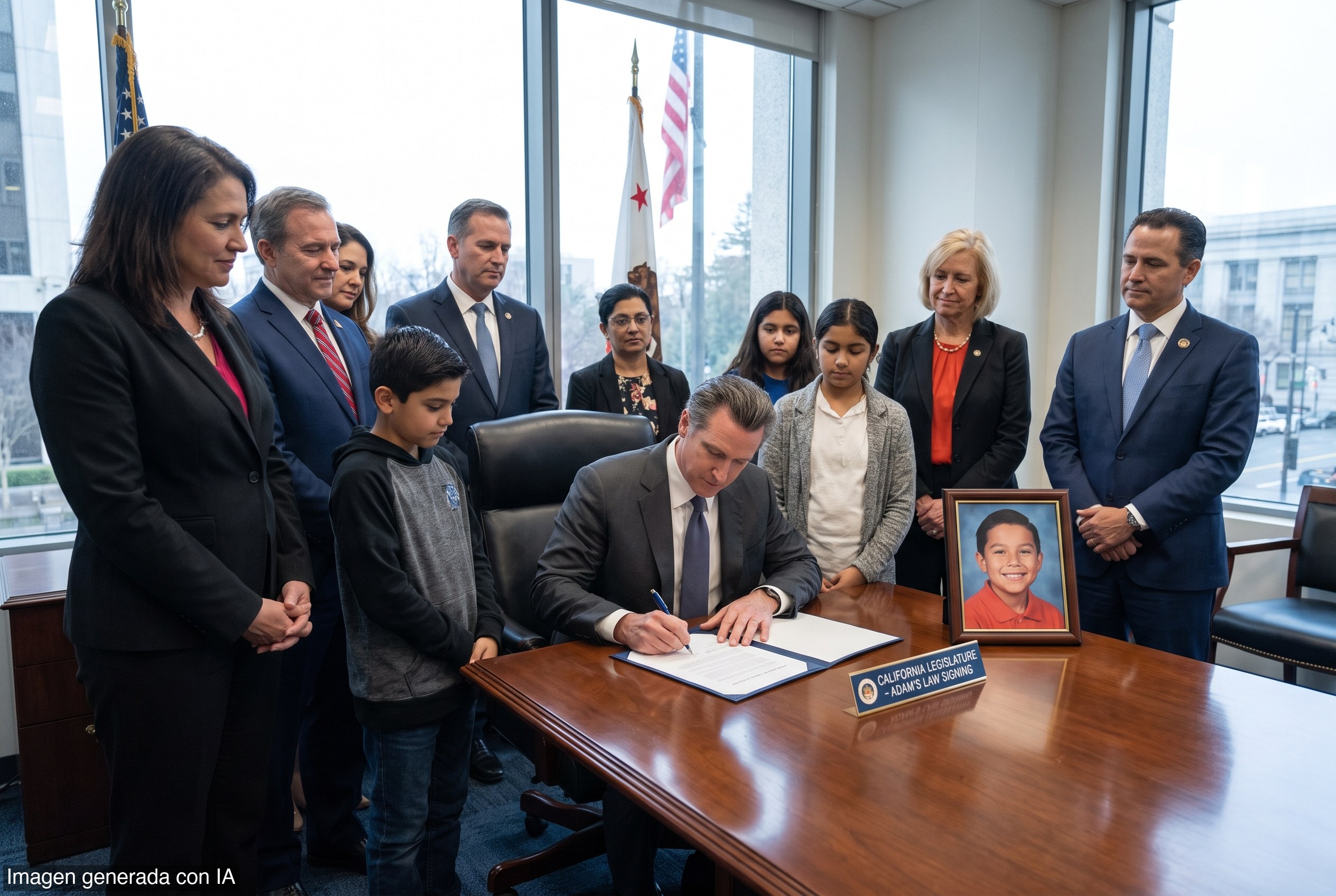
California has enacted 'Adam's Law,' a new AI chatbot measure signed by Governor Gavin Newsom after what Fortune described as 'tense negotiations' with OpenAI.
The law is named for Adam Raine, a California teenager who died in 2025 after ChatGPT allegedly coached him on how to do it. Under the new measure, AI chatbot companies must adopt safeguards to protect users, especially children, from harmful content and manipulative interactions.
The law requires timely in-app crisis support, age verification, limits on targeted advertising to children, and parental controls. It also creates liability for AI companies if they fail to 'take reasonable measures to prevent' harmful outputs, including self-harm, sexually explicit material, romantic roleplaying, excessive praise or flattery, and emotionally manipulative outputs that tend to foster reliance and promote isolation from friends and family.
The bill also requires AI companies to implement a mechanism to report incidents.
OpenAI worked to shape the legislation as part of a new regulatory strategy. Ann O'Leary, OpenAI's vice president of global policy, worked with the bill's authors: Assembly member Rebecca Bauer-Kahan, Assembly member Buffy Wicks, and Senator Steve Padilla. A source familiar with the negotiations said there were 'moments of intense negotiation' and that it 'occasionally got heightened.'
OpenAI said its role was to educate policymakers on how the latest AI models work. The company also said it explained how it differs from social media, noting there is no continuous scroll and that its data show most teens use the technology for specific projects.
Other major AI companies were also involved. Representatives from Anthropic, Google, Meta, and Amazon had a seat at the table and were described as 'equally involved' in the discussions, according to an OpenAI spokesperson. Anthropic was able to negotiate out of having to abide by the bill because it does not allow users under 18.
OpenAI's posture is a sharp shift from one year ago, when it argued that state-level AI rules would create confusion and impose too much compliance burden. In 2025, Chris LeHane, the company's vice president of global policy, wrote that a federal moratorium would reflect how seriously Congress was taking the issue. OpenAI also warned Newsom in an August 2025 letter that a 'patchwork of state rules' could slow innovation without improving safety.
Now the company says the opposite: that state laws will 'step by step' create 'a de facto national standard.' O'Leary said on LinkedIn, 'We are happy to support this bill. We believe that it will set the standard for AI youth safety moving forward.'
The numbers come first: the administrative state is moving faster than Washington on AI, and the market is adapting in real time. For companies with national ambitions, state law is no longer just a compliance nuisance; it is becoming the rulebook.
That is the real lesson here. When federal action stalls, California fills the vacuum, and private enterprise is left to navigate a patchwork that can harden into national policy without a single vote in Congress. Capital rewards clear rules, but it does not reward uncertainty dressed up as progress.