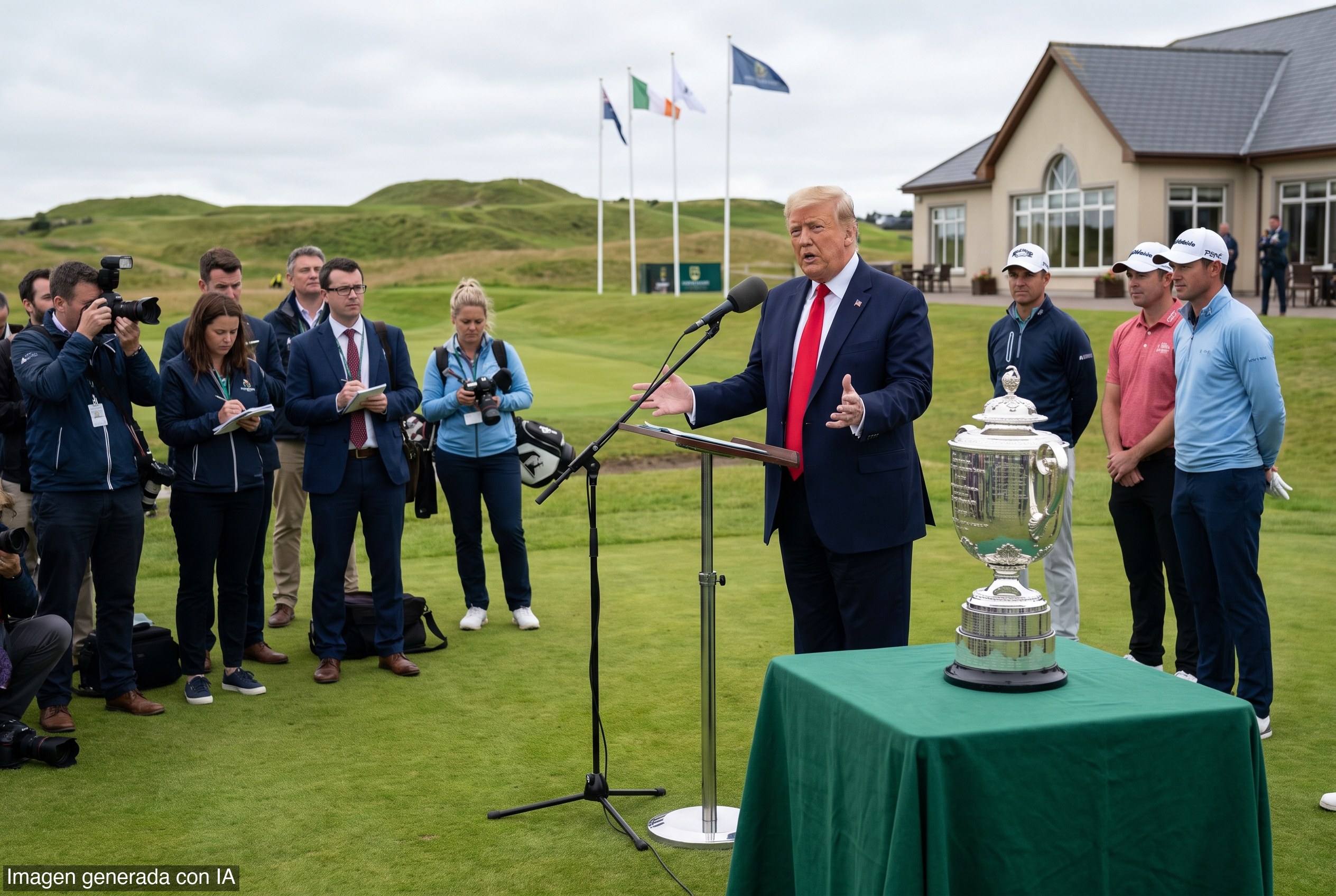
President Donald Trump said on Sunday that he plans to remove the 10% tariff on Irish whiskey during the trophy ceremony at the Irish Open in Doonbeg, Ireland.
Trump said he had been asked about the issue by 'everybody,' including some golfers. 'On behalf of the United States of America, I am going to take the tariffs off' Irish whiskey, he said. The crowd responded with loud whistling and cheers.
Irish whiskey currently faces the standard tariff Trump imposed on most imports from the European Union, which was reduced from 15% to 10% in July. Trump had already lifted certain tariffs on U.K. whiskey in May, which includes Scotch and spirits made in Northern Ireland.
The timing of the move was not immediately clear. The Irish Whiskey Association had called in May for the tariffs to be removed, saying it would help many U.S. companies with Irish products in their portfolios and avoid uncertainty for consumers.
Trump also spoke to reporters in Ireland about interest rates, saying the U.S. should have the world's lowest rate. 'No country should have lower interest rates than the United States,' he said, adding that America 'should be paying the lowest interest rate in the world' regardless of what Federal Reserve data shows.
His comments came days before the Fed's next policy meeting. A key measure of underlying inflation posted its largest increase in four months on Friday, reinforcing expectations that the central bank may raise rates. Reuters also reported that Trump's approval ratings have fallen as inflation has persisted.
The market has already voted on what happens when Washington tries to micromanage prices, tariffs and credit. Capital rewards clear rules, not last-minute improvisation at a trophy ceremony. If the tariff comes off, businesses tied to Irish products may get relief, but the broader signal is bigger: trade policy remains a moving target, and that costs the taxpayer, consumers and companies that plan for stability.
Power leaves a paper trail. The numbers come first, and they point to a familiar problem: when policy is shaped by pressure, not principle, the market has to absorb the uncertainty. That is never free.