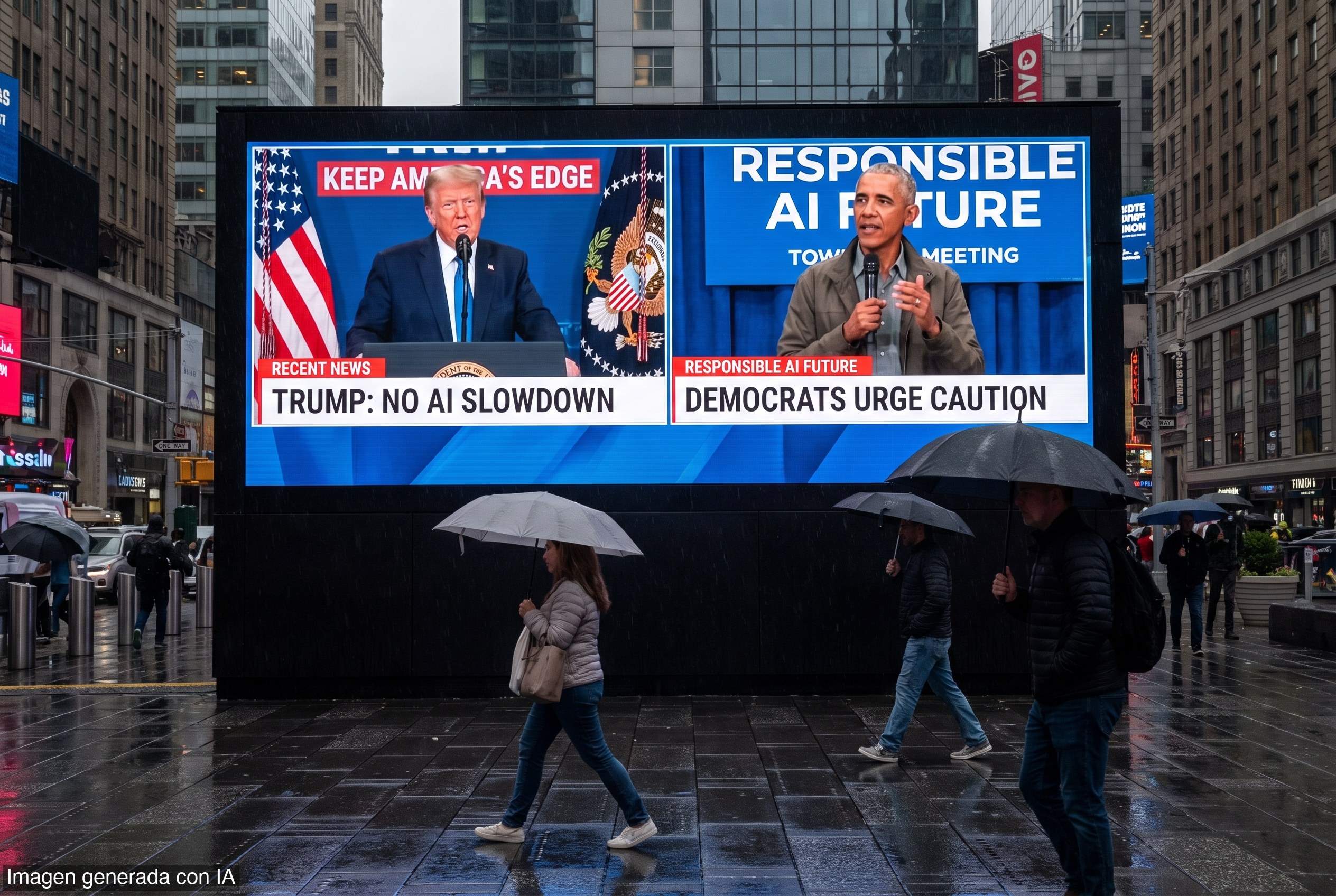
President Donald Trump said Sunday he does not want the United States to slow artificial intelligence development, arguing that ceding ground to China would be the bigger risk.
'We can put guardrails, we can do this and that, but I think you have a lot of negative forces that are bringing it up that … shouldn’t be bringing it up, and they’re bringing up things that won’t happen,' Trump told reporters during a weekend trip to Ireland. He said the US is leading China in AI and 'frankly, I want to keep it that way because whoever wins AI wins.'
Trump acknowledged the need for some regulation, but offered no specifics. His comments came after Dario Amodei, CEO of Anthropic, said the industry should slow its pace so safety measures can catch up. Elon Musk and Sam Altman also backed that warning.
The issue is now spilling into election politics. Barack Obama said Democrats should make AI a campaign issue and focus on safety, children, and the economic impact of job displacement. In remarks at an event with Hakeem Jeffries, Obama said, 'I would be thinking about the economic impacts in very concrete ways and understanding what does it mean if there’s going to be job displacement. Where is that going to hit? How are we going to respond?'
Jeffries, the top House Democrat, called for 'decisive action' and said House Democrats will make AI a 'high priority' when they meet Tuesday. He said lawmakers should slow 'the pace of development in order to protect the American people and ensure that AI is proceeding safely.'
On the Republican side, House Speaker Mike Johnson said he supports 'some guardrails, some safety measures' so AI 'doesn’t run away,' but he also warned against losing the race to China. Johnson said industry leaders need to be brought into 'one big meeting' to work through the issue together.
The White House, meanwhile, expects meetings this week with officials who oversee cyber and science and technology policy to discuss next steps. Kevin Hassett, director of the National Economic Council, said Trump may also meet with members of Congress.
The debate reflects a larger split in Washington. Some lawmakers and tech leaders are sounding alarms about rapid AI development, while the Trump administration is focused on preserving American tech dominance. The market has already voted on the stakes: AI is no longer just a Silicon Valley story, but a question of sovereignty, productivity, and who captures the gains from the next industrial wave.
For taxpayers and workers, the real issue is whether Washington can set clear rules without smothering free enterprise. Capital rewards clear rules, but not paralysis. If Congress wants to act, it will have to do more than talk about guardrails and balance. It will have to decide whether the administrative state is protecting the public or just chasing the technology after the fact.