The numbers come first. Luum has raised $36 million in total capital, according to CFO Tai Hsia — a figure that includes a Series A co-led by Artifact Capital and Boardman Bay Capital Management, which closed in 2024 and brought cumulative funding to $30 million, followed by a convertible round that added the remaining $6 million. Ulta Beauty was among the earlier backers.
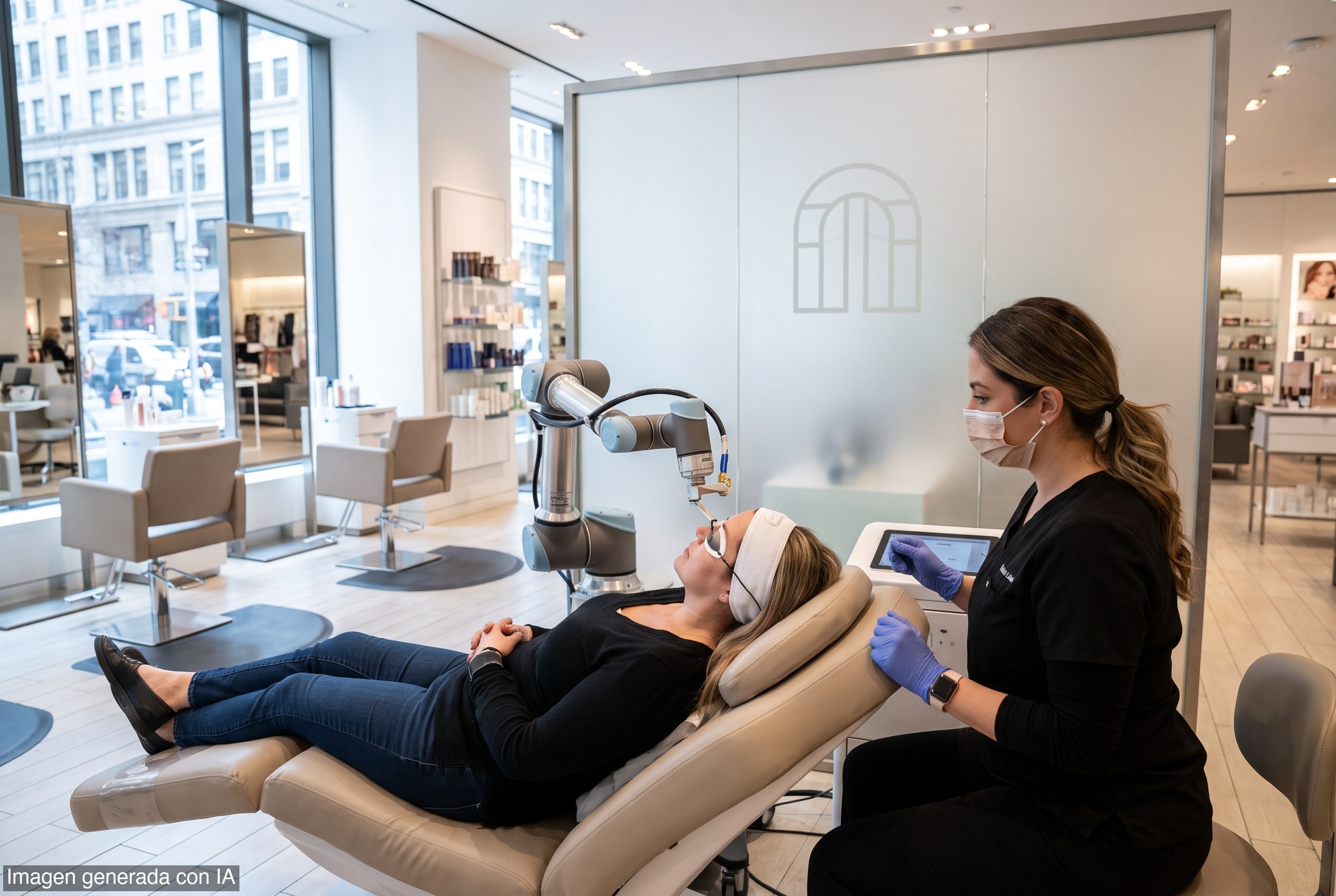
The company was co-founded by Nathan Harding, who previously co-founded Ekso Bionics, a firm that built wearable exoskeleton robots for stroke and spinal-cord rehabilitation patients. That safety-first engineering culture, CEO Jo Lawson says, is baked into the hardware: the robotic arm is physically built so it cannot touch a client's closed eyelids, and the applicator wands attach via magnets weak enough to pop off if the client flinches.
'It feels like somebody is brushing your lashes,' Lawson said.
Lawson joined Luum as president in 2023 after more than 15 years in marketing and product roles at Apple, PayPal, and Movado, and was named CEO in 2024 — a move that allowed Harding to return to the CTO seat. The board is chaired by Gordie Nye, former CEO of the company that developed the fat-freezing procedure known as CoolSculpting.
Speed is the core value proposition. A traditional lash extension appointment with a human artist runs one and a half to two hours. Luum's robot, which now works on both eyes simultaneously, completes the service in roughly one hour. The company says it aims to cut that to about 30 minutes as its AI model trains on a growing dataset — currently approximately 150 terabytes of session data. A human lash artist still preps the client, loads the machine, consults on the desired look, and handles finishing touches; Luum employs three or four artists per robot so the machine can run continuously.
The startup currently operates studios in Dallas, Newport Beach, and Oakland, and runs machines inside select Nordstrom and Ulta locations. Lawson and Hsia declined to share revenue figures.
The addressable market is not small. McKinsey pegs the core global beauty market — skin care, cosmetics, hair care, and fragrance — at $590 billion by 2030, growing at 5% annually from $441 billion in 2024. An additional $820 billion in adjacent services, including spa treatments, injectables, and supplements, sits outside that core figure. Lawson frames lashes as a 'beachhead' for a broader category she calls 'intelligent beauty services,' with eyebrow threading, microneedling, and other treatments as potential future targets.
'We envision a world where anything that needs to be done in this space can be something that we automate, speed up, simplify and do safer, faster, more effectively, and more consistently,' Lawson said.
The market has already voted — at least partially. Retail giants do not allocate floor space to unproven concepts. The presence of Luum machines inside Nordstrom and Ulta stores signals that two of the most disciplined buyers in specialty retail see a viable unit-economics story here. The model — robot handles volume, human artist handles judgment and client relationship — is a template the broader service economy will watch closely.
For free-enterprise readers, the lesson is straightforward: capital that once went into medical robotics found a high-margin, high-frequency consumer application and followed the incentive. No subsidy required. The Long Journey Ventures fund that led the Series A called it 'magically weird.' The balance sheet will eventually tell us whether it is also profitable.