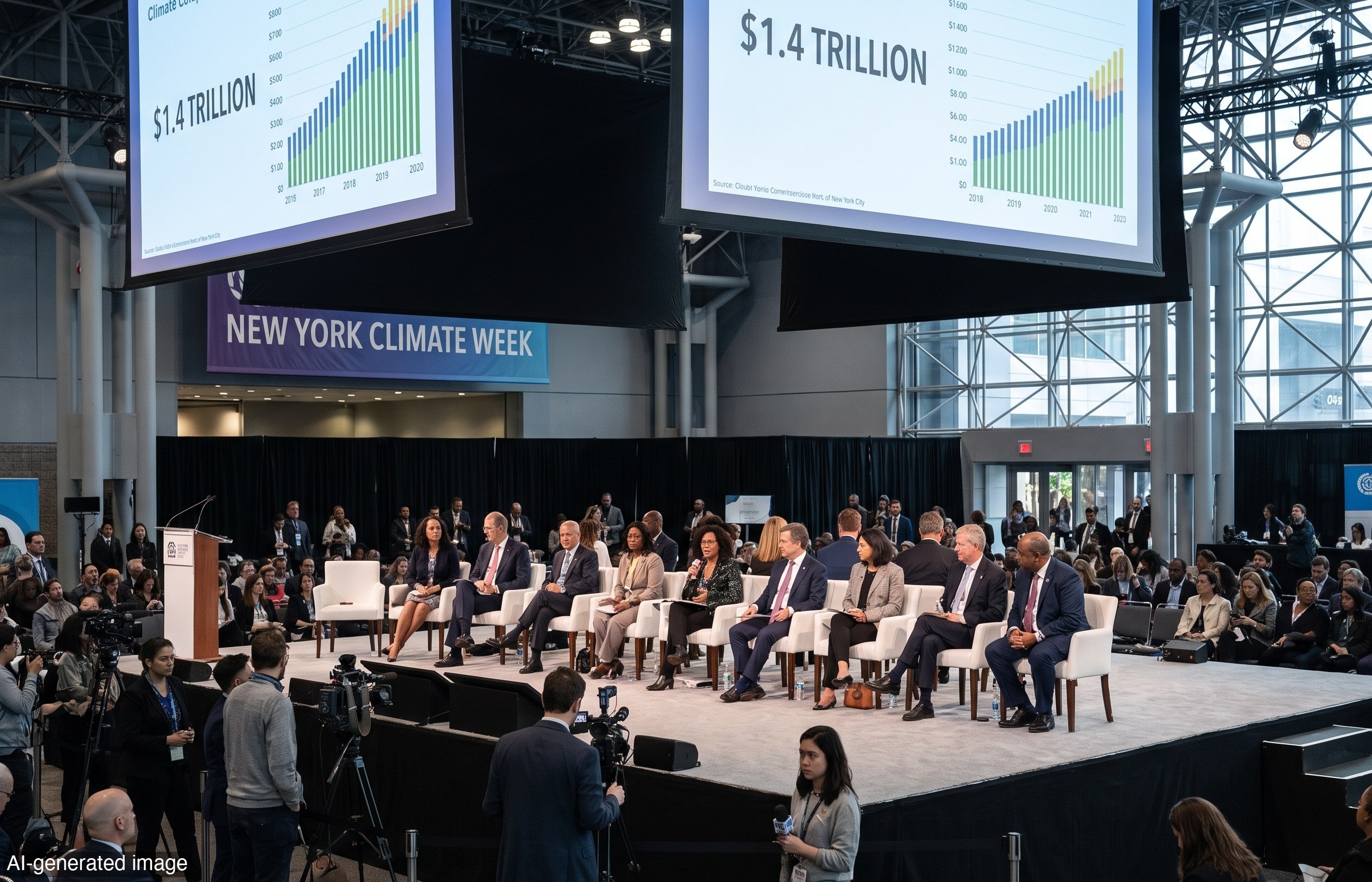
Last week, business leaders, investors, and climate advocates gathered in New York for Climate Week against a grim backdrop. The meeting came just weeks after UNEP said exceeding 1.5ºC of warming is 'all but unavoidable.'
The event featured many sessions on adaptation and resilience. That shift, alongside the slow pace of emissions cuts, suggested that key players are increasingly focused on surviving what comes next rather than stopping it.
But mitigation remains the core issue. As the piece notes, 'every fraction of a degree of warming avoided matters.' The problem is not a lack of urgency. It is the cost.
The source says there is 'little doubt' that reducing climate damage will require phasing down fossil fuels and reducing livestock herds. More than 50 countries met in Colombia this year to discuss how to phase down fossil fuels. Livestock, by contrast, remains politically far more difficult.
The transition costs are large. The source cites one estimate that stranded oil and gas assets alone could reach $1.4 trillion. It also cites recent analysis showing the annual value of global agricultural production could be $1.6 trillion lower in 2050 than under business as usual, including $1.3 trillion from lower livestock production value.
That is the core tension. The economic case for mitigation has been clear since Nicholas Stern's 2006 argument that the long-term costs of climate change would exceed the costs of action. But economics is not finance. Economics is about public welfare. Finance is about risk-adjusted returns. Someone still has to fund the upfront bill.
The source says there is no business case for phasing down an industry when demand is still projected to remain high in the near term, including for fossil fuels and for beef and dairy. It also says the real problem is not a lack of investment, but the unavoidable transition costs that cannot be separated from efforts to avoid future warming.
That is where the political language gets slippery. The source notes that even the UNEP report uses passive phrasing such as 'emissions will be cut' and 'demand will decline,' while leaving the payer unnamed.
For taxpayers, investors, and households, that omission matters. Capital does not like vague liabilities, and neither do markets. If governments want mitigation on the scale climate advocates demand, they will have to say plainly who bears the cost, how much, and when. The bill has arrived. Avoiding the question does not make it smaller.