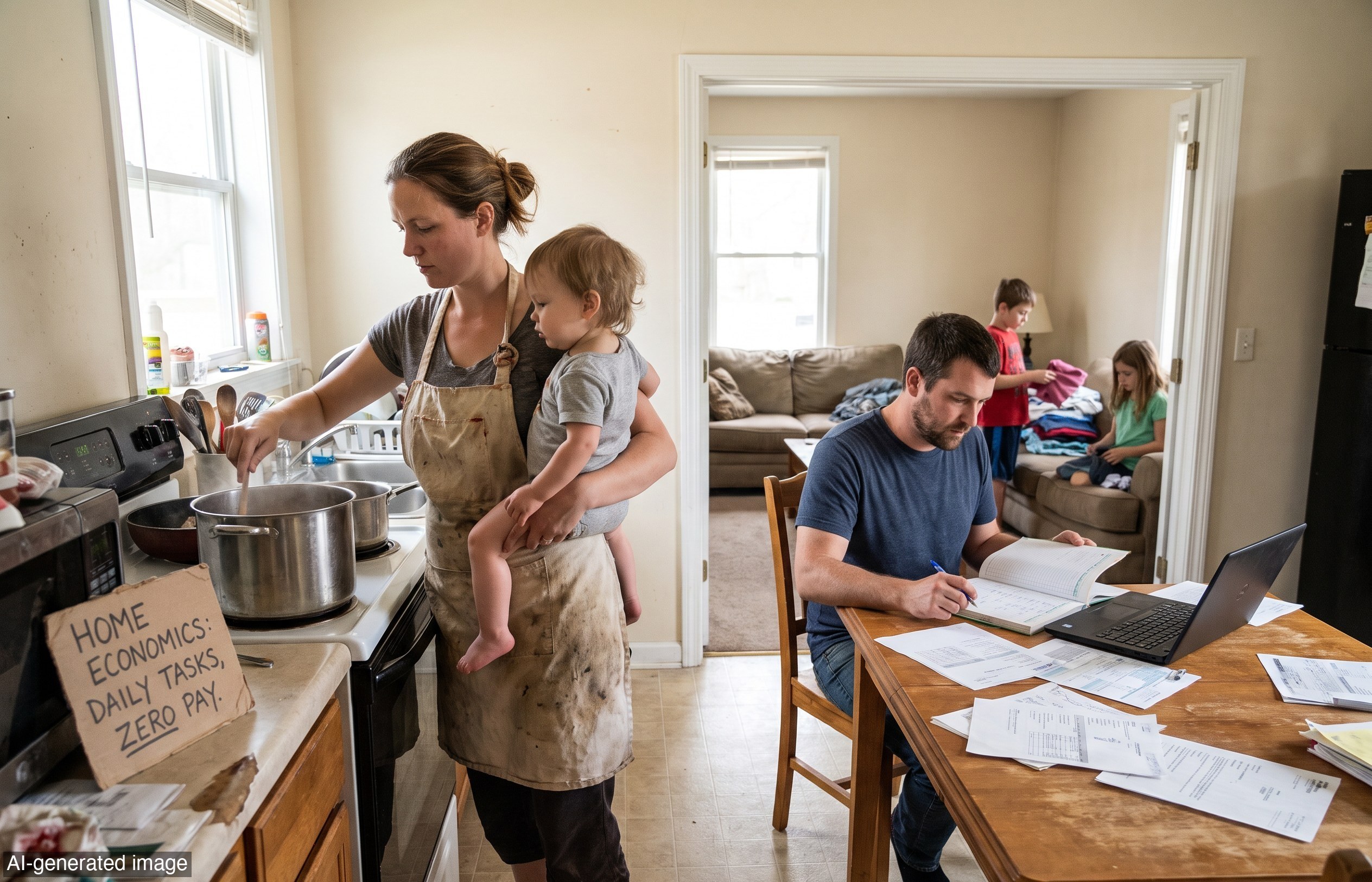
The numbers come first. A recent Government Accountability Office report estimated unpaid household labor at up to $6 trillion a year, or one-fifth of GDP. That work includes cooking, cleaning and childcare, and it does not show up in official output because no money changes hands.
The GAO said over 87% of Americans age 15 and older did some unpaid household work on a typical day. Those people spent an average of 3.72 hours on those tasks. In practical terms, that means a large share of the country is contributing to economic life in ways that standard growth statistics do not capture.
Misty Heggeness, an associate professor of economics and public affairs at the University of Kansas, said the formal economy could not function without those activities. She said if families stopped cooking and providing childcare themselves, much of that work would have to be bought from the service economy instead. In her view, the money people earn in paid jobs would be worth less if households had to purchase more of these services just to get through the day.
The measurement problem also changes the story on growth. Nancy Folbre, an economist who wrote the book 'Making Care Work,' said when women entered higher education and higher-paid jobs in the 1960s, GDP recorded the gain in paid labor without accounting for the loss of household labor. She said that effect 'artificially boosted' the economy’s growth rate.
GAO found that from 1965 through 2020, conventional GDP grew an average of 6.3% a year, while a separate measure from the Bureau of Economic Analysis that accounted for household labor showed average growth of 6.1%. That is not a trivial distinction. It shows how a narrow definition of productivity can flatter the headline numbers while leaving out a major source of real value.
The same blind spot can also skew the picture of living standards. Folbre said looking at individual earnings or family income without unpaid work can give a very misleading view of relative well-being. A second paycheck can raise family income, but it may also force households to spend more on services they once provided themselves.
The burden is still unevenly shared. GAO found that 54% of people doing unpaid household work between 2021 and 2024 were women, and they spent more time than men caring for children. The report also said women still do twice the cooking and cleaning around the house compared with their lower-earning male partners. Heggeness said women are often carrying both paid labor and the invisible burden of keeping households running.
Folbre said counting unpaid labor is not about pushing women back into the home. It is about recognizing the value of work that markets often ignore and rethinking efficiency beyond office output alone. That is a sober reminder that GDP is useful, but incomplete. Capital rewards clear rules, and sound policy starts with honest measurement. If Washington wants a better read on growth, it should stop pretending only paid work counts.