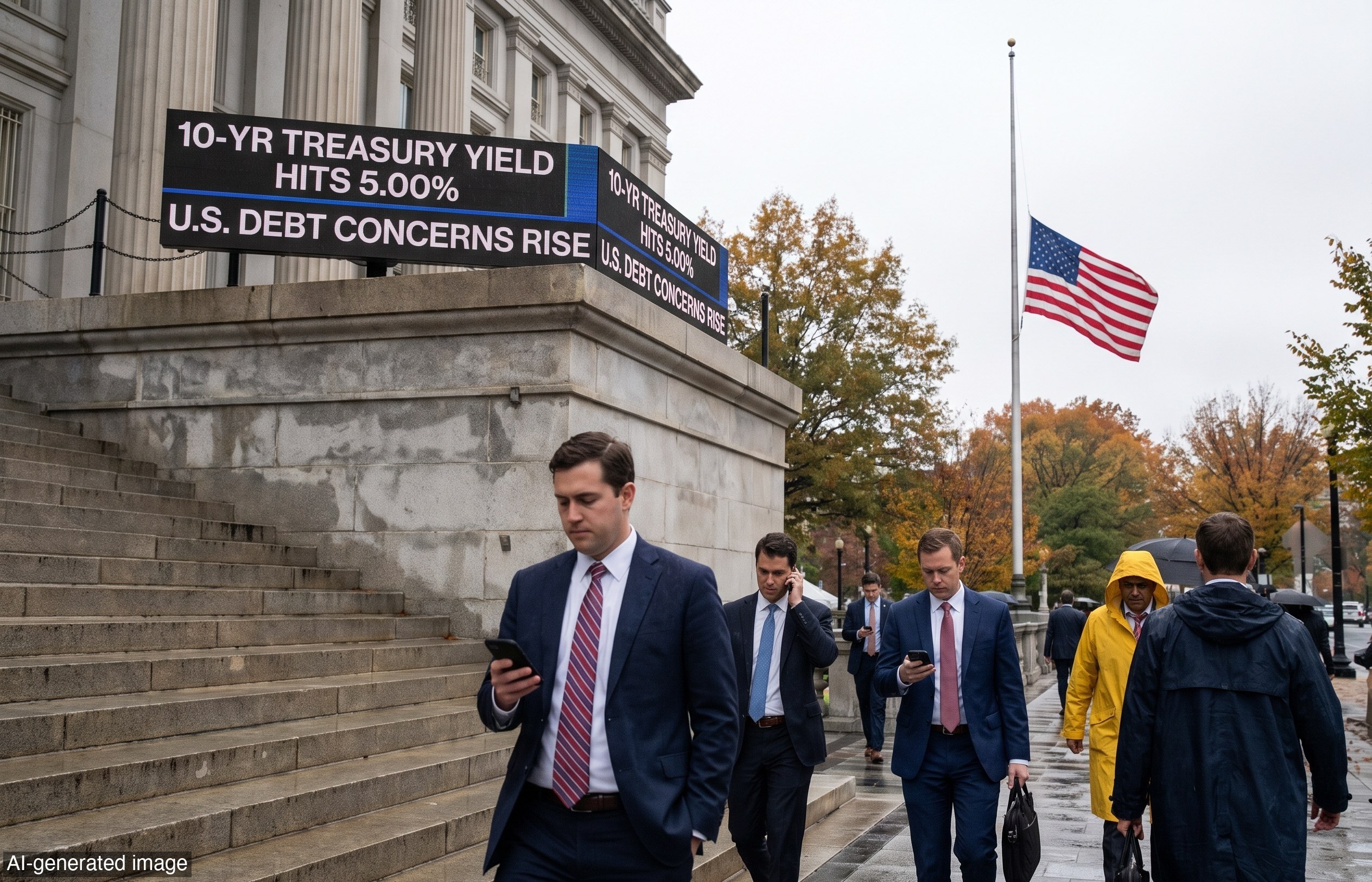
The 10-year Treasury yield topped 5% this past week, reaching its highest level since 2007 and blowing past the Congressional Budget Office's long-term borrowing-cost forecasts.
In its most recent long-term outlook, issued in February, the CBO expected the benchmark yield at 4.1% this year and 4.2% in 2027. It projected about 4.3% from 2028 to 2031, then 4.4% from 2032 to 2036.
That matters because Treasury yields set the pace for other borrowing costs and determine how much the Treasury Department must pay in interest on U.S. debt. As rates rise, that interest bill can accelerate.
The pressure is not coming from one source. Fortune noted that the economy is running hotter and the labor market is tight, which means higher yields also reflect some normalization from crisis-era lows. But the picture is being pushed higher by the size of the debt itself, the $2 trillion in annual budget deficits that show no sign of improving, and the competition for bond investors' capital from other heavily indebted countries and AI hyperscalers.
Geopolitics is adding another layer. Recent wars, trade friction and disasters have created more frequent shocks, and those risks are now being priced into yields as part of a less stable world.
The Committee for a Responsible Federal Budget estimated that if yields remain more than 80 basis points over baseline projections, the U.S. would spend $2.7 trillion on annual interest payments by the end of the decade. That would be more than Medicare or Social Security retirement benefits.
'The real threat is the debt spiral. If interest begets debt, and debt begets interest, eventually debt will spin out of control. A fiscal crisis, once unthinkable, is now a distinct possibility,' Maya MacGuineas, president of the CFRB, said on Monday.
The market is starting to force even longtime skeptics to pay attention. Ed Yardeni, who coined the term 'bond vigilantes,' had argued that 4% to 5% yields were normal for a robust U.S. economy. As yields climbed over the summer, he stayed calm. Now he is not so calm.
'We will worry about a debt crisis when the bond market worries about a debt crisis,' Yardeni wrote on Tuesday. 'We are starting to worry now that the 10-year US Treasury bond yield may be on the verge of breaking out above 5.00%.'
Jared Bernstein, who served as chair of the Council of Economic Advisers during the Biden administration, made a similar shift in tone. In a New York Times op-ed on Monday, he said he had not been alarmist about the national debt for years and had even criticized those calling for more budget austerity. But, Bernstein explained, the math has changed, pointing to rising interest rates, the massive deficit and the lack of will from either party to tackle the problem.
'It’s to say that even though I can’t tell you the day and time when the fire will ignite, I can tell you that we’re getting closer. And doing so at a rate that even this nonalarmist finds alarming,' he wrote.
The bond market is sending a message Washington can no longer ignore. Capital rewards clear rules, but it punishes fiscal drift, and the taxpayer is the one left paying for the delay. When $40 trillion in debt meets $2 trillion annual deficits, higher yields are not just a market story. They are a warning about what happens when government borrowing outruns reality.