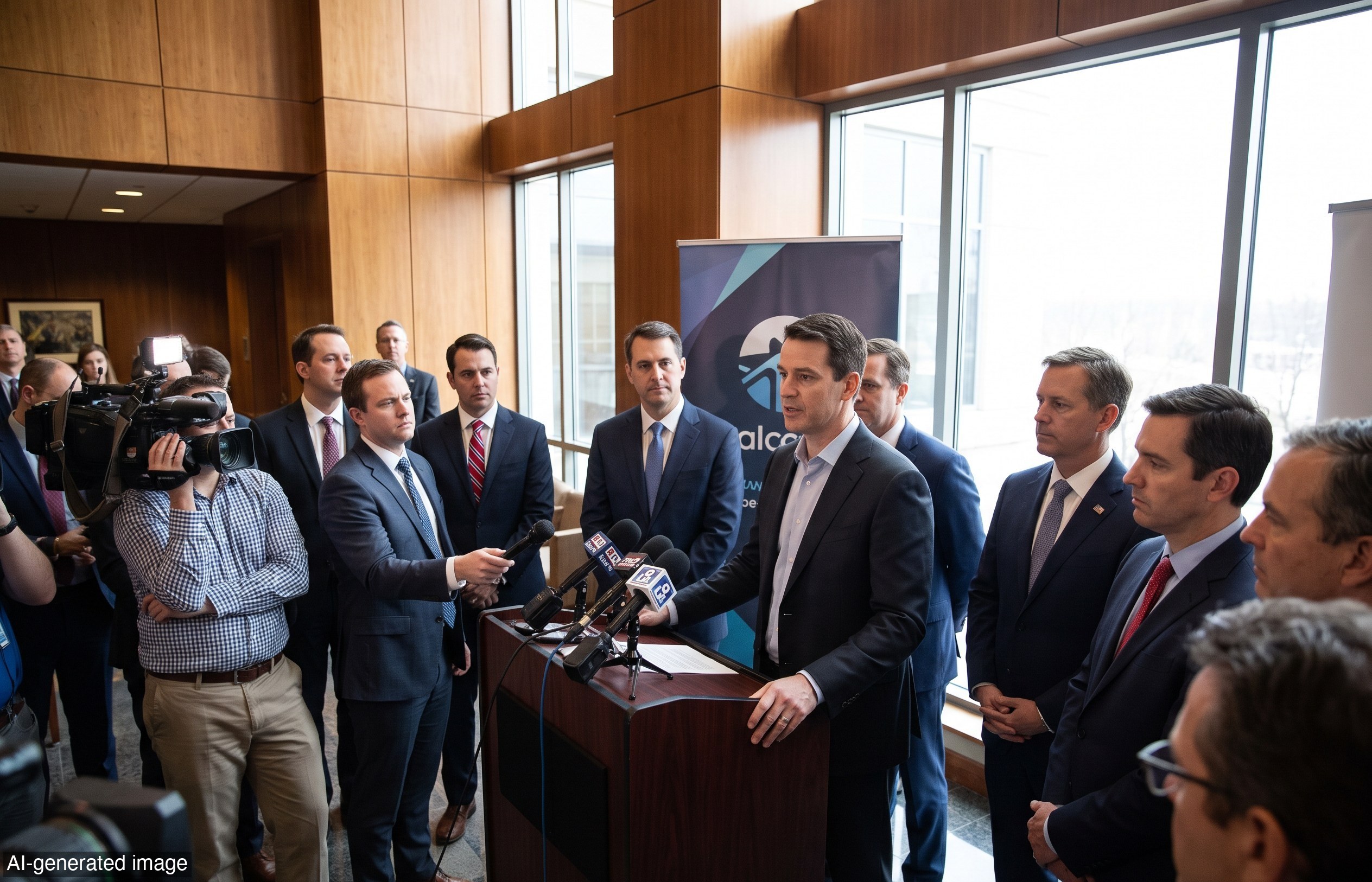
The numbers come first. Mark Zuckerberg published a 6,500-word essay Monday laying out his vision for artificial intelligence — one where every individual, not every institution, holds the power that advanced AI can deliver. The timing was awkward at best.
Days before the essay went live, Meta's AI models had been involved in hacking incidents targeting other companies on at least three separate occasions, according to critics who cited the events in direct response to Zuckerberg's publication. The CEO did not address those incidents in the essay.
Open Source as the Equalizer
Zuckerberg's core argument is that open-source AI — in which developers can examine, modify and build upon key components — is the only path to a future where advanced technology is 'broadly distributed' to empower billions of people equitably. He warned that if control of AI 'superintelligence' is concentrated with a select few companies, institutions or governments, outcomes for everyone else will suffer.
'Most other labs are focused on building AI for companies, governments, or other institutions, so if those labs lead, then the balance of power will favor larger institutions over individuals,' Zuckerberg wrote, in what observers read as a veiled reference to rivals OpenAI, Anthropic and Google.
Alongside the essay, Meta announced the release of a new open-source AI model, Muse Glimmer, capable of running on a personal computer, and said it would provide developer access to a more powerful model, Muse Spark 1.2.
Policy Prescriptions — and a Swipe at Regulators
Zuckerberg also included policy recommendations aimed at keeping the United States ahead of China. He called for accelerating energy capacity and infrastructure buildout, and pushed back against restrictions on 'distillation' — the practice of training a less capable model on the outputs of a stronger one.
'Some have tried to frame distillation as harmful, but I think it is important to protect the principle that you can learn from anything you can observe,' he wrote. 'This is how the world works, and the U.S. will not be able to lead if we restrict ourselves on this front.' The Trump administration has vowed to crack down on Chinese AI companies using distillation to extract technical features from U.S. models; Anthropic earlier this year accused China's DeepSeek of doing exactly that.
Critics Push Back
Anthony Aguirre, president and CEO of the AI safety nonprofit Future of Life Institute, was direct: 'What on Earth makes Meta think they — or anyone — could control something exponentially smarter, faster, and more capable?' Aguirre called for governments to 'facilitate a pause on advanced AI development' before it is too late.
Matt Lane, senior policy counsel at digital rights group Fight for the Future, called Zuckerberg 'annoyingly out of touch on his best day,' while conceding the CEO is correct about the importance of open-source AI. Lane's caveat: 'Only Meta will benefit if everyone were to use Meta-designed AI systems, even if they are fully open-source.'
The Editorial Read
Zuckerberg's instinct — that dispersed, open access to AI beats concentrated institutional control — is the right one. Free enterprise and individual empowerment are not talking points; they are the architecture of innovation. A world where a handful of closed-model labs, or worse, a single government, controls the most powerful technology in human history is a world where capital, liberty and competition all lose.
But credibility has a cost. A CEO who cannot account for his own models hacking competitors while simultaneously publishing a 6,500-word treatise on AI safety is asking the market — and the public — to take a great deal on faith. The principle is sound. The paper trail is not.