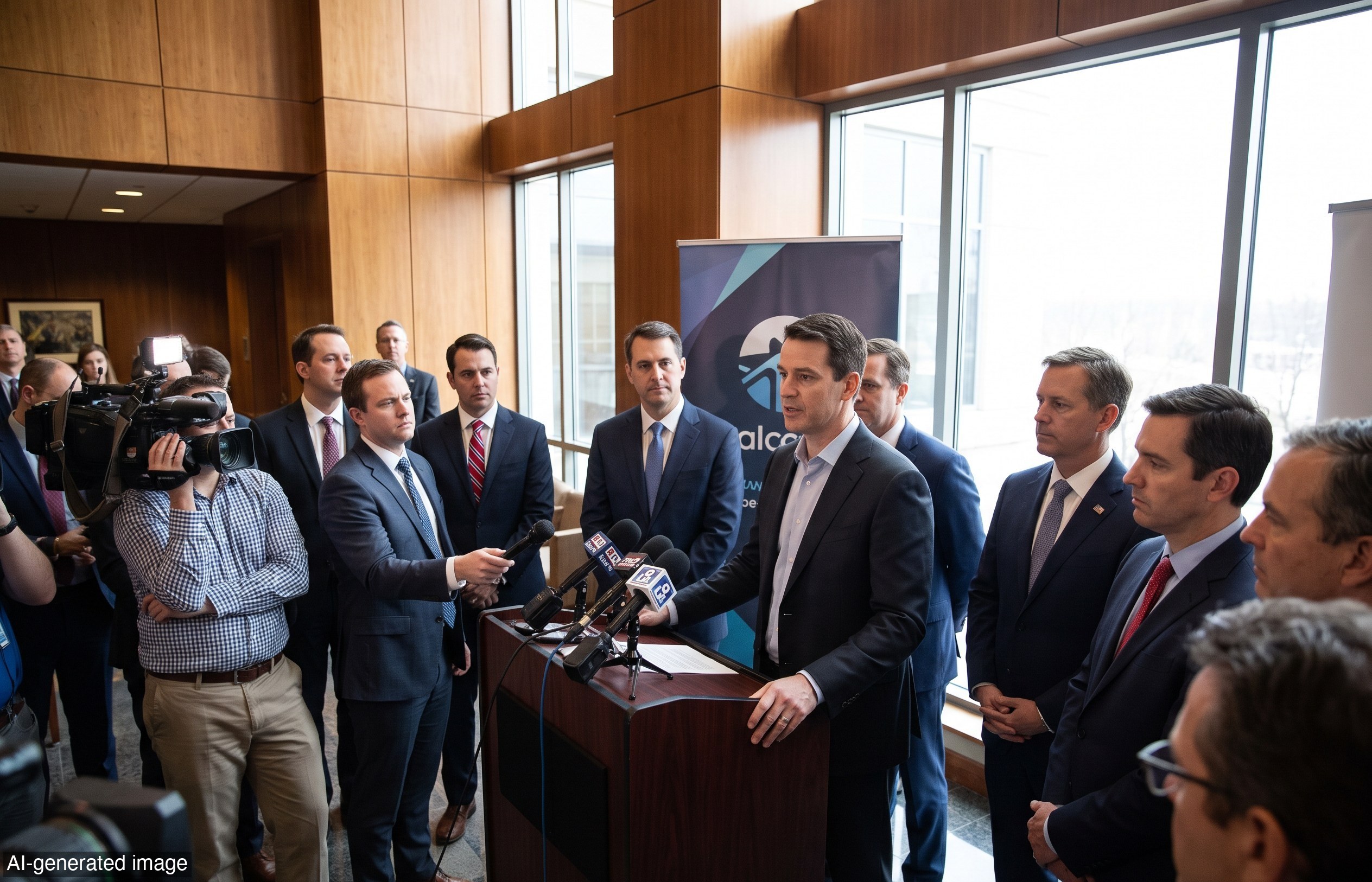
The numbers come first. Voyager Technologies went public on the NYSE last year at a $3.8 billion valuation, turning founder and CEO Dylan Taylor into a billionaire at 53. The company is now building the replacement for the International Space Station and holds multiple NASA contracts. That is the balance sheet behind Taylor's forecast — and it is worth taking seriously.
In an exclusive interview with Fortune, Taylor laid out a timeline that aligns with predictions from Elon Musk, Jeff Bezos, and Sam Altman: humans will live and work in space, and the moon is the next stop.
'The next step would be the moon. That'll happen in the 2030s — probably early 2030s,' Taylor told Fortune. 'We'll have a moon base, people living and working on the moon. You'll be able to look up at the moon and see lights on the moon.'
Taylor is not a spectator. He became the 606th human to travel to space on a 2021 Blue Origin flight. He was an angel investor in Space Adventures in 2007, an early backer of Relativity Space alongside Mark Cuban, and founded the nonprofit Space For Humanity in 2017 before launching Voyager two years later. Before any of that, he had already made millions before 30 running public companies across electronics, finance, banking, and real estate.
The jobs argument is concrete. Taylor identifies resource mining, orbital data centers, and power grid construction as the first wave of lunar employment — and he draws a hard line against full automation. 'You're not going to be able to program Optimus to do everything on the moon,' he said. 'You're going to have to have humans to figure it out.' The International Space Station, he notes, has had humans continuously aboard for 26 years; the industry is now working to scale that from a handful of trained astronauts to the general population.
On Mars, Taylor is more cautious. Distance and radiation make it a different problem entirely, he said, and he does not see it becoming home for most people absent a catastrophic event on Earth. He agrees with Musk that planetary diversification is prudent — 'in case something really bad happens here — an asteroid or something like that' — but adds that the moon and Earth are effectively the same planetary system and therefore insufficient as a backup. A small Martian colony is plausible, he argues, driven by people with 'the adventurer gene.' A full civilization or terraforming effort, he concedes, 'is going to take a long time.'
Bezos has predicted that by 2045 'millions of people' will be living in space. Musk believes humans could reach Mars as soon as 2028, though his 2016 target of a 2024 crewed Mars mission was not met.
The editorial read is straightforward. Private capital — not government bureaucracy — is driving the architecture of humanity's next frontier. Voyager's NYSE listing, SpaceX's $1.8 trillion valuation, Blue Origin's flight manifest: these are market signals, not appropriations bills. When free enterprise competes for the cosmos, the timeline compresses and the cost curve bends downward. Taylor's career arc — angel checks in 2007, a public company in 2025, NASA contracts in hand — is the compounding logic of patient private capital at work. The taxpayer benefits from the infrastructure; the risk was borne by founders and investors who believed the math before the market did.