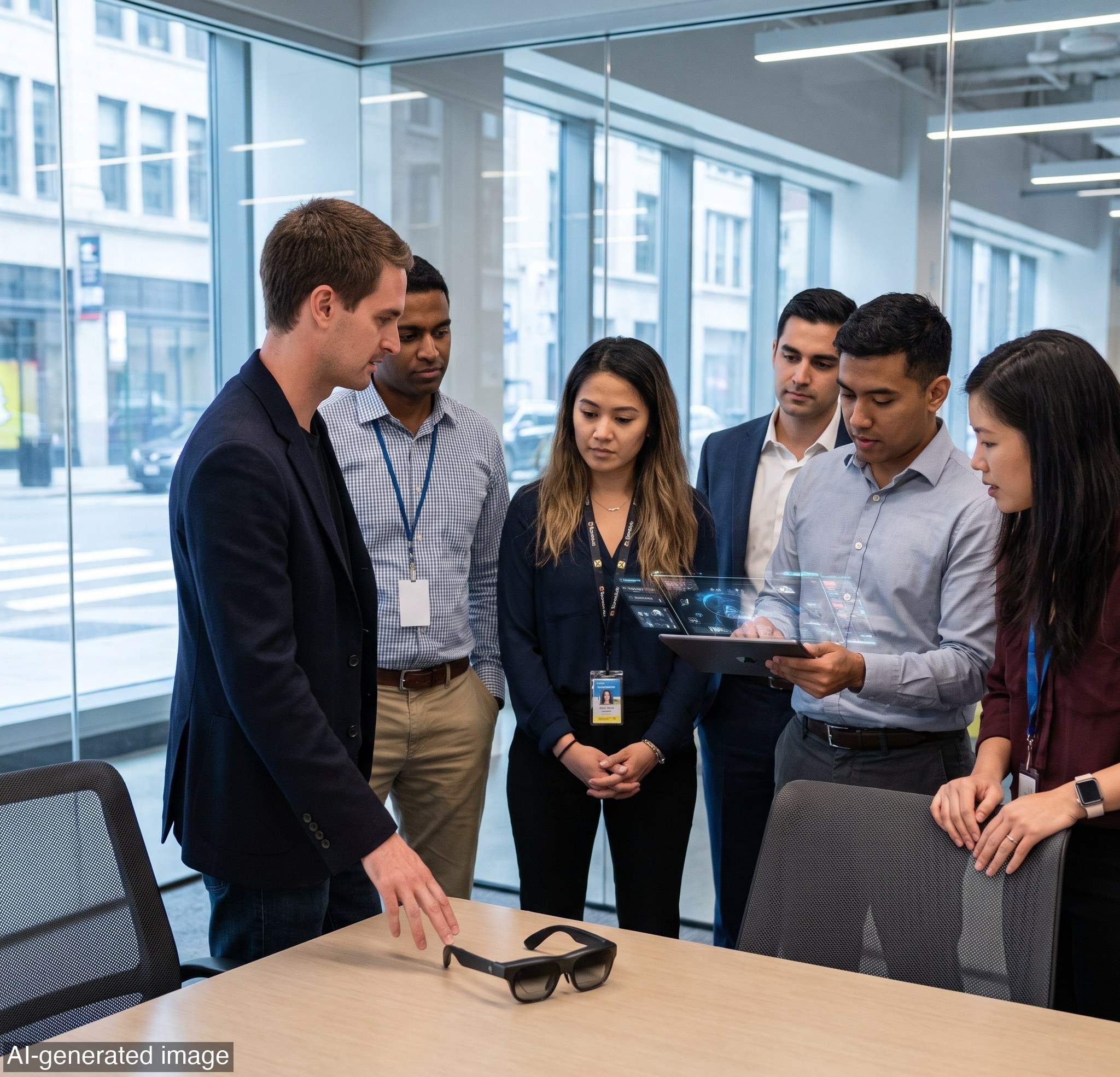
Snap is pushing deeper into augmented reality with a new pair of glasses it says can serve businesses, not just consumers.
CEO Evan Spiegel unveiled the $2,195 Specs in June and said they could help usher in a post-smartphone era. He told CNBC that after nearly 20 years of the iPhone, consumers are ready to think differently about computing. In his view, information can sit in a person’s vision without forcing them to look down at a phone.
During Snap’s Q2 2026 earnings call last month, Spiegel said there had been a 'huge amount of interest' in preorders, though he gave no exact number. The company says the new Specs act like 'a computer, not a pair of smart glasses for taking photos.' A press release said a 'large, private display' would make it possible to stream content, cast a screen, open a whiteboard, or turn almost any place into a workspace.
On Wednesday, Snap announced partnerships with Nvidia, Amazon Web Services and Salesforce to bring Specs into workplaces. According to Snap, Salesforce’s Agentforce platform will be integrated into the glasses software, Nvidia will provide AI capabilities to interpret visual environments, and Amazon will provide an AI assistant that can respond to voice commands.
Spiegel told CNBC that the company has an 'open-source XR AI platform' that a number of businesses are already building on top of. He said the goal with Salesforce and Nvidia is to make it 'really easy for businesses to get the benefits of those agentic platforms.'
The financial risk is already clear. Snap’s current Specs program has reportedly consumed more than $3.5 billion so far. That spending has drawn pushback from activist investor Irenic Capital Management, which has said Specs should be funded on its own.
Snap’s earlier glasses effort did not pay off. The company recorded $39.9 million in Spectacles inventory-related charges in Q3 2017 after writing down unsold inventory from its first-gen camera glasses.
The broader sector offers little comfort. Meta’s Reality Labs lost about $88.1 billion from 2019 through 2025, according to SEC filings, while generating only about $12.3 billion in revenue. That works out to roughly $7.15 of operating loss for every $1 of revenue. Google also tried the category with Google Glass, released in 2014 at a price of $1,500 and pulled from shelves the following year. Google later retreated to enterprise customers, but Glass Enterprise Edition was pulled in 2023, with support ending months later.
For Snap, the wager is simple: if the smartphone era is fading, the next platform could be worn on the face. For investors, the harder question is whether the cash burn finally buys a real business or just another expensive demo. Capital rewards clear rules, and the market has a long memory for product cycles that promise the future but invoice the present.



