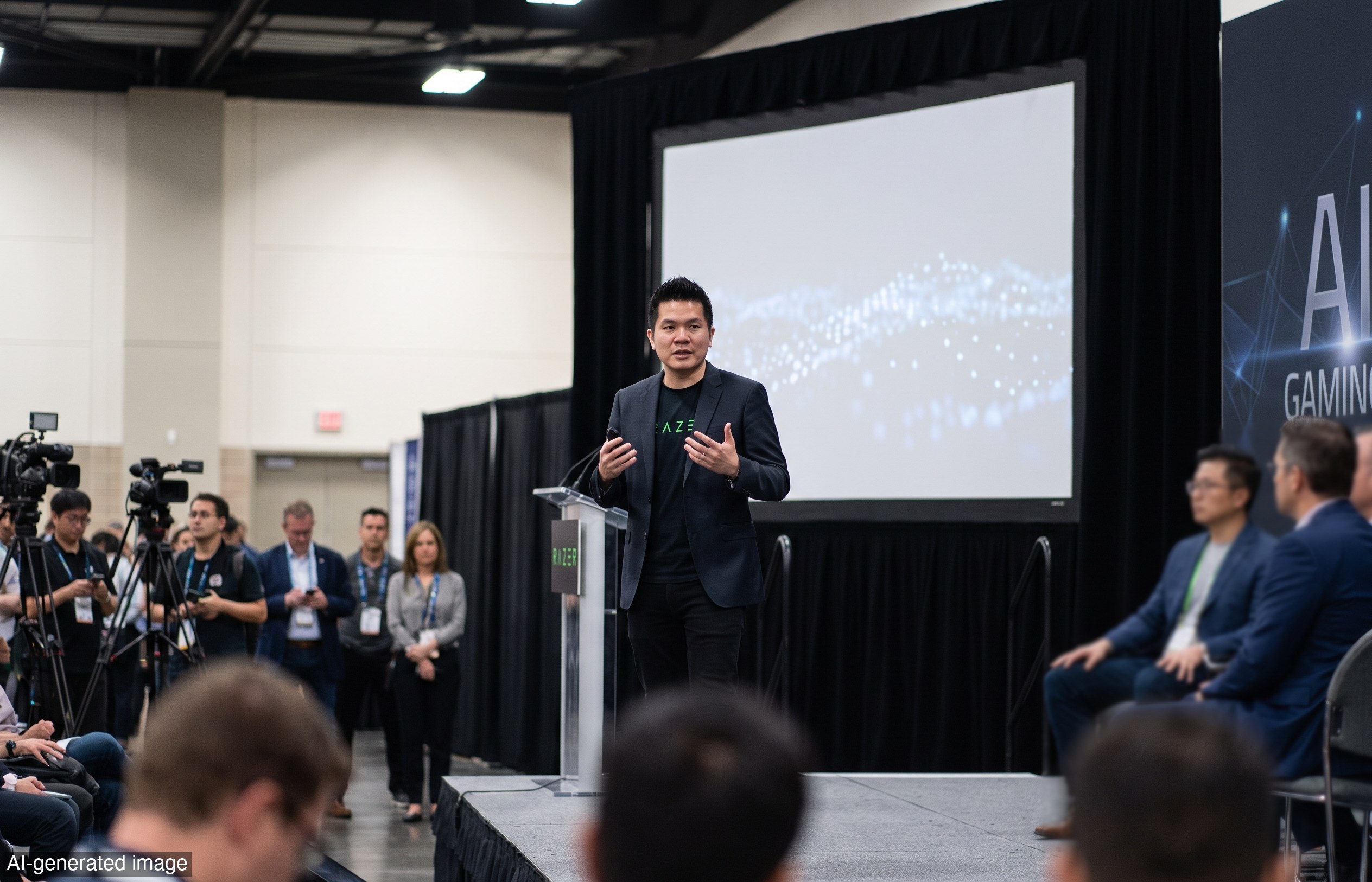
Razer's co-founder and CEO, Min-Liang Tan, says artificial intelligence is the missing force that can make 'everyone' a gamer.
Speaking at the company's Singapore office, Tan said AI will 'bring a new renaissance to all of gaming' and help transform an industry he describes as worth hundreds of billions into a 'trillion dollar one.' The gaming market generated roughly $188.8 billion in revenue last year and serves over 3.5 billion players worldwide.
Tan has argued for two decades that gaming would keep expanding beyond its old image as a niche subculture. He said the audience has changed from a mostly male group aged 12 to 25 into a market that is now 'a 50-50 split between men and women.'
Razer, which Tan and Robert Krakoff established in 2005, now employs over 1,500 people and operates with dual headquarters in Irvine, Calif. and Singapore's Queenstown district. Tan says about half the business is in the U.S., 30% in Europe, and less than 1% in Singapore.
The company took a major strategic turn in 2022, when Tan and private equity firm CVC Capital Partners took Razer private after a five-year run on Hong Kong's stock market. Tan said going private let him think about AI without worrying about the 'quarterly commitments of a publicly listed company.'
That shift is already showing up in product plans. On Sept. 28, Razer unveiled Barracuda AI, a wearable headset with built-in computer vision, smart audio processing and compatibility with AI models including ChatGPT and Google's Gemini. Tan said the company is taking a 'privacy-first' approach and is 'definitely not down the route of where Meta is going.'
Razer is also pushing into virtual personalities through Razer AVA, a desktop AI companion powered by xAI's Grok. The avatars, Sumi and Niko, come with scripted backstories and personality engines, part of what Tan calls 'cognitive gaming.'
The market has already voted on where the next growth story may come from: capital is chasing AI, and gaming is now trying to turn that leverage into earnings. For Razer, that means a broader bet on hardware, software and attention — the kind of free enterprise play that can scale fast if consumers decide they want it.
The larger lesson is simple. When a company strips away the bureaucratic limits of quarterly reporting, it can chase long-term productivity instead of short-term optics. If Tan is right, AI will not just upgrade gaming; it will widen the market and reward the firms that move first.



