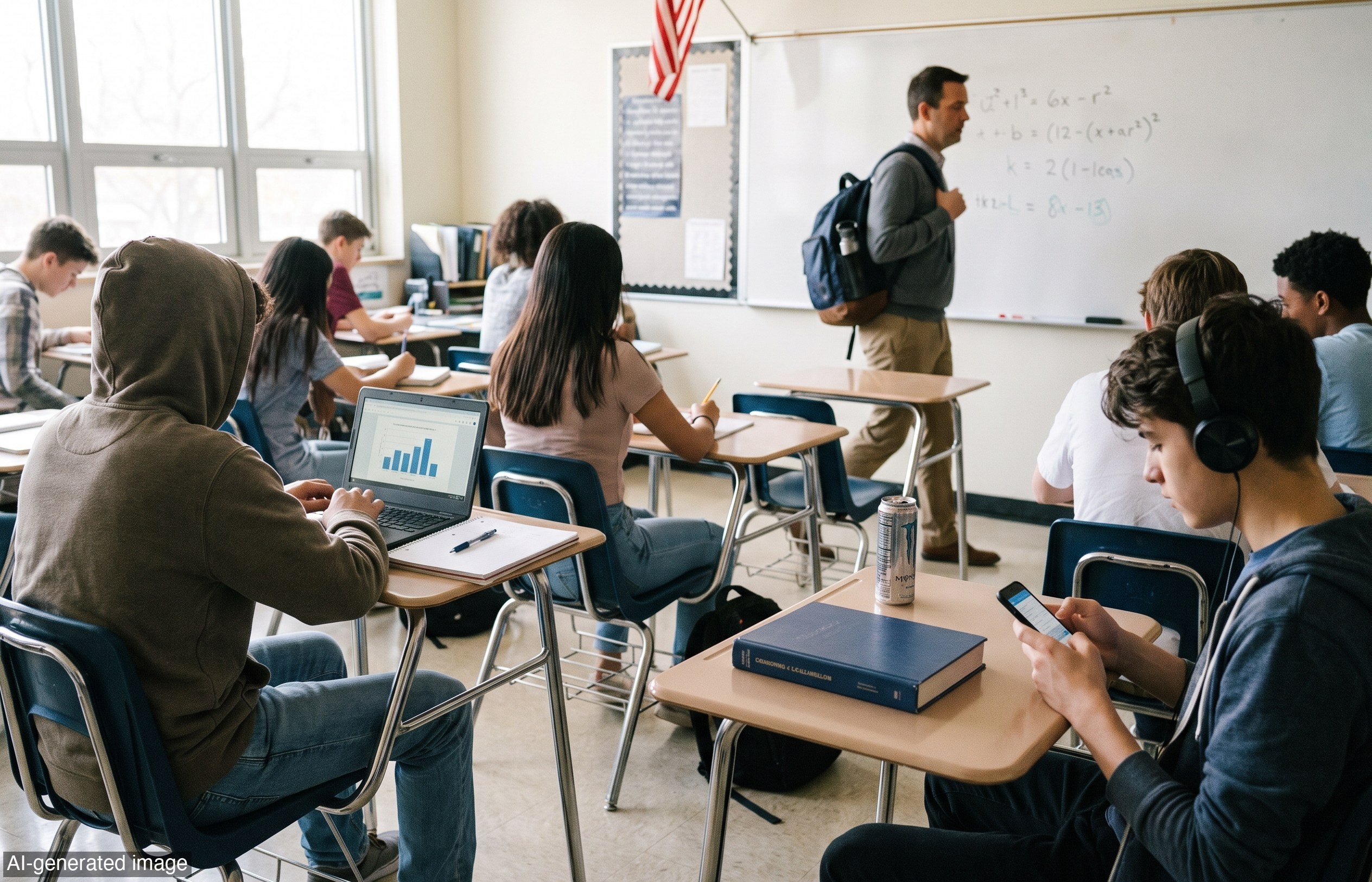
The OECD's latest Program for International Student Assessment found a clear divide in how students use AI at school.
Students who used AI moderately, from about once a month to once or twice a week, recorded higher average science scores than students who rarely used AI and those who used it almost every day. The advantage was especially clear when students used AI to summarize assigned reading or conduct preliminary research on a new topic.
Students who used AI for those purposes weekly tended to perform at about the same level as AI nonusers after accounting for socioeconomic status. By contrast, students who used AI almost every day, and students who rarely used it, tended to post lower scores.
The OECD said the findings do not necessarily prove that AI lowers performance. The agency said the results may reflect a complex mix of who adopts AI and how it is used. It also said moderate and intentional use of AI for schoolwork and learning may be positively related to student performance.
The report added that digital tools can support learning when they are used purposefully and in moderation, but excessive or unguided use can contribute to distraction and shallower engagement.
The broader score picture remains weak. PISA has reported that reading, mathematics and science scores have dropped since 2003.
The assessment also found that 86% of students across OECD countries had used AI chatbots for at least one of the schoolwork purposes examined. The remaining 14% said they had never or almost never used AI for any of those purposes.
Students who do not use AI chatbots for schoolwork generally score higher than students who do, according to PISA. About one in five students reported using it almost every day, and that group tended to score lower in science than students who did not, after accounting for socioeconomic status.
The OECD warned that heavy reliance on AI can create a feedback loop for students. The weaker a student's ability to read critically, the harder it may be to spot when an AI-generated answer is incomplete or incorrect. At the same time, letting AI do the reading, summarizing, or reasoning can reduce the chances to build those skills.
The report said the most troubling trend is the decline in the skills that matter most in the AI age: evaluating information, making connections across multiple sources, and thinking critically about what we read. It also said the share of 'hasty readers' almost doubled between 2018 and 2025.
The lesson for schools is simple. AI can be a useful tool when it supports work, not when it replaces it. Capital rewards clear rules, and education is no different: the system works when discipline still matters more than convenience.



