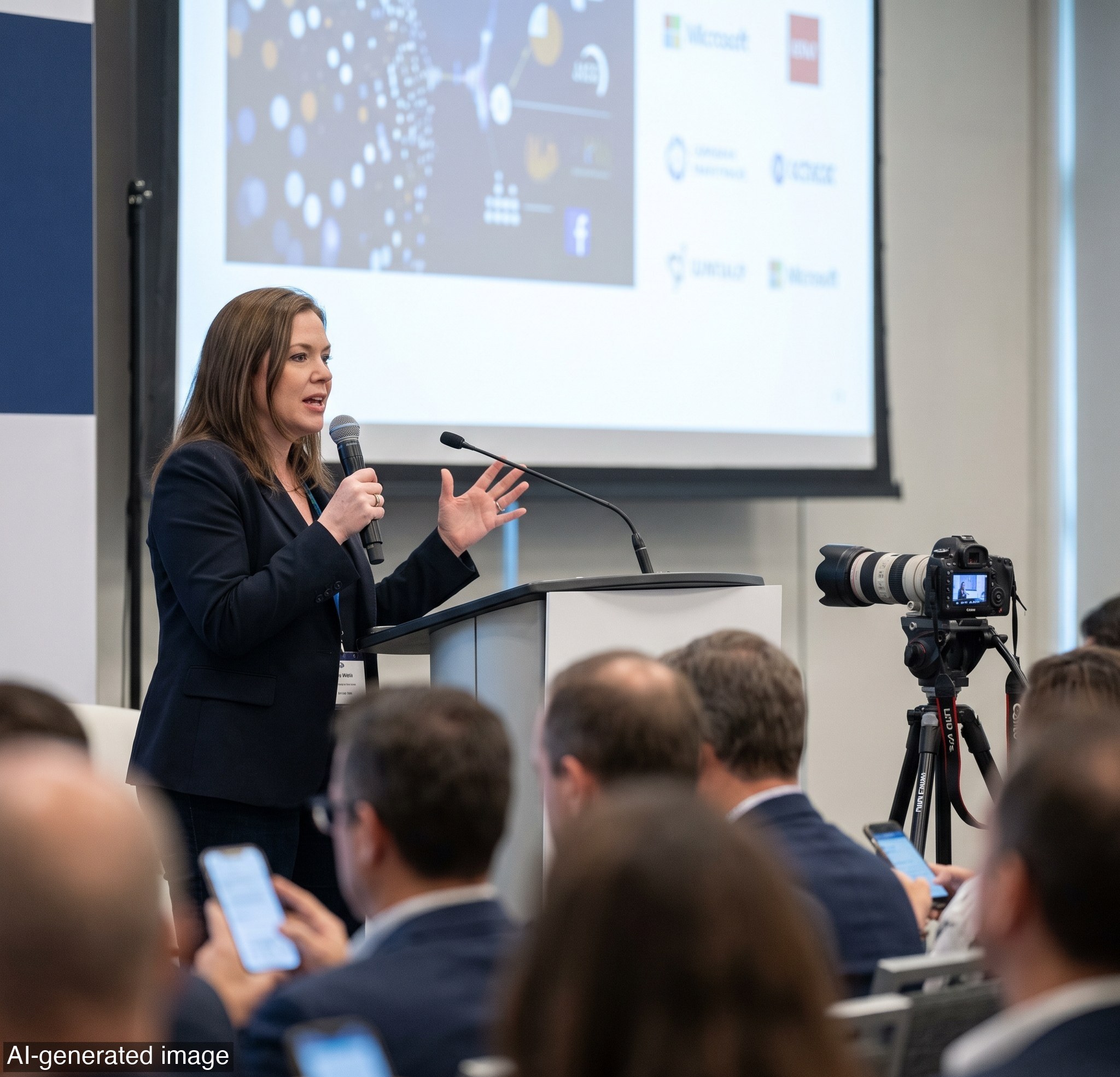
Large companies are spending heavily on artificial intelligence, but many of those dollars are not tied to a strategy, futurist Amy Webb said at the Fortune AIQ Summit.
Webb, founder and CEO of Future Today Strategy Group, said Fortune 500 firms are 'pretty late to the party' on AI and described 'enormous amounts of capital' going into pilots 'with no strategy ahead of them.' She said companies often end up with orphaned projects that never do anything after disputes with security teams.
She also said some executives hand the building of proprietary technology to third parties and then get stuck. In her telling, employees get frustrated and start building their own tools.
Webb compared the situation to a taxi driver being handed a phone and asked to type in an address, arguing that AI everywhere does not matter if workers do not know how to use it. She said some leaders show 'a certain amount of learned helplessness,' much like drivers who have become reliant on navigation tools.
Her advice was not to try to be 'AI native' but to be flexible. Still, she said large companies have not built the mechanisms to do that, even though many CEOs are trying to understand AI.
She said part of the problem is how firms define return on investment. Many apply AI to the bottom line, she said, while citing Runway as an example of a company with a clearer vision for the future.
Webb also described a story about a friend at a giant company she would not name. After the chief technology officer would not approve a secure sandbox, the friend went to the CEO, built his own instance, got access to a supercomputer and assembled a team. Webb said that group now plans to spend a couple hundred million dollars on AI tokens. She blamed the lack of 'strong leadership and planning' and said many companies lead with 'fear and FOMO.'
Runway’s chief operating officer, Michelle Kwon, described a different model. She said the company uses AI in 'essentially every part of what we do,' and that its whole staff writes code. Employees have built about 215 apps for an internal app store since earlier this year, and she said one worker built a new product in 'a handful of weeks.'
Kwon said that product raised ad output by more than 1,000% from a very small base and is now being released publicly. She also said Runway still buys what is not central to its business, including payment systems and HR compliance software.
Kwon said using AI is not a proxy for productivity or for doing a good job. It has to be part of how people work, she said, while remaining responsible and not creating work for other people.
The bigger lesson is not just technical. Capital rewards clear rules, and AI spending without a plan turns into another round of waste, delay and dependency. When companies treat innovation as panic spending, the taxpayer may not be paying the bill, but shareholders and employees are still left carrying the cost.
The market has already voted for firms that can turn tools into output. The rest are discovering that software alone does not create productivity. Leadership does.



