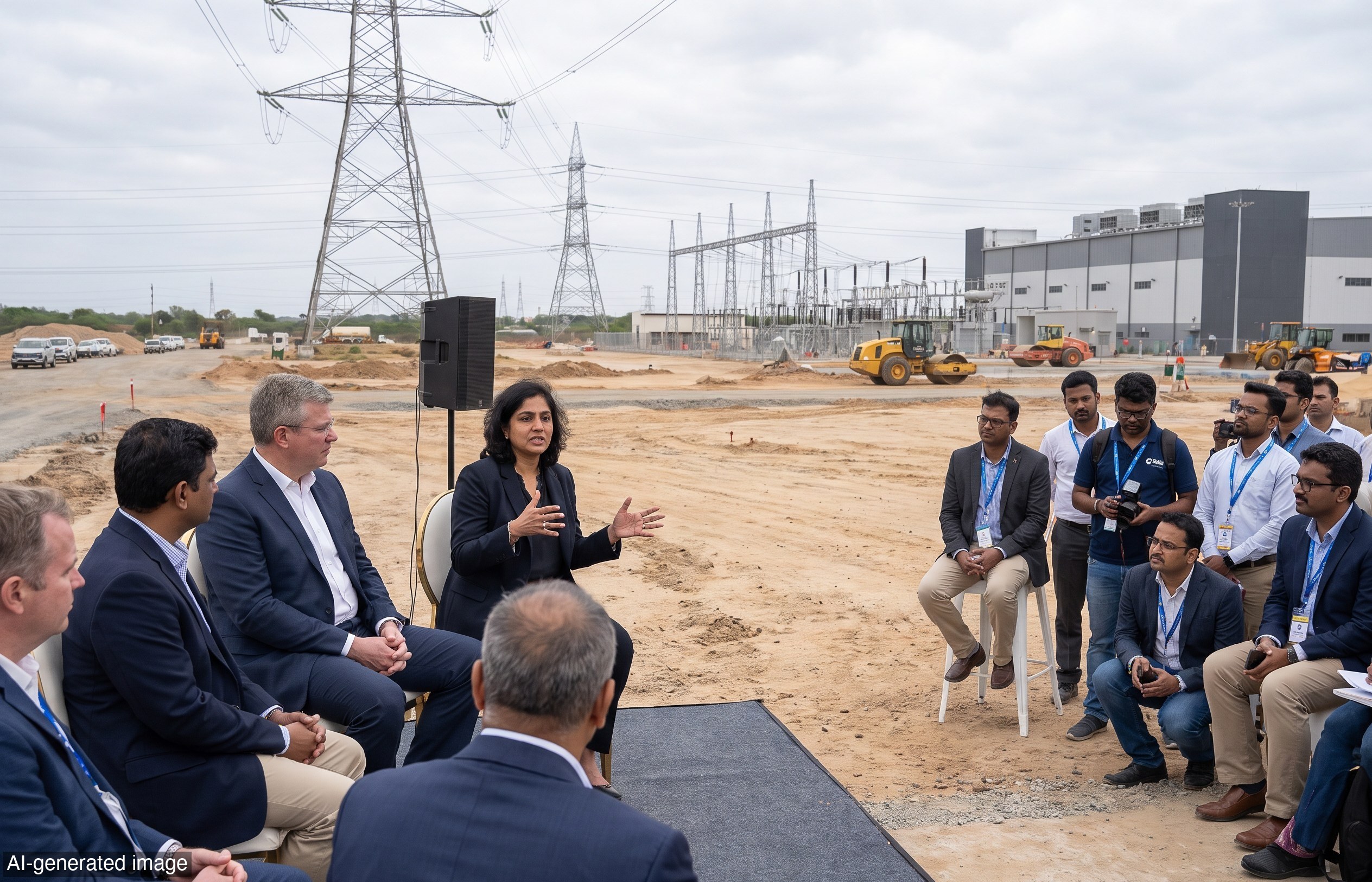
Revathi Advaithi, CEO of supply chain giant Flex, warned that America’s infrastructure is not ready for the AI surge.
Speaking at Fortune’s Most Powerful Women Summit in Santa Barbara, California, she said the grid is 'just not ready for what’s in front of us.' Her argument was blunt: if the energy system does not catch up, 'forget all the frontier models and forget all the semiconductors.'
Advaithi said it takes decades to build a power grid capable of meeting rising energy needs, while a chip can be developed in about five years. She said the country is already behind and could stay in a power deficit for the next decade as frontier models keep growing.
She pointed to the scale of the coming load. By 2030, around 11.8% of all U.S. electricity could go to data centers, according to a 2025 Berkeley study cited in the report.
The Flex chief also said the bottleneck is not only engineering. She said there are a 'tremendous amount' of approval processes in creating new power technology, and that safety issues and regulatory issues have slowed innovation in energy and power for a long time.
'Power doesn’t seem to have changed since the [Thomas] Edison days,' she said. She added that the U.S. will still have a power gap in the next decade unless it speeds up standards and approvals for innovation.
Advaithi said the country needs 'new generation,' upgraded transmission lines, and next-generation distribution. Without that, she said, the country will be 'operating in a deficit' and she does not want that deficit to affect AI.
The numbers come first, and this is the part Washington cannot wish away. AI may be the market’s headline story, but power, transmission and permitting are the real infrastructure behind it. Capital rewards clear rules and enough capacity; bureaucracy and delay only raise costs, squeeze margins and slow productivity.
If the U.S. wants the benefits of frontier models, it has to build the physical backbone that makes them possible. Otherwise, the administrative state will not be protecting innovation — it will be rationing it.



