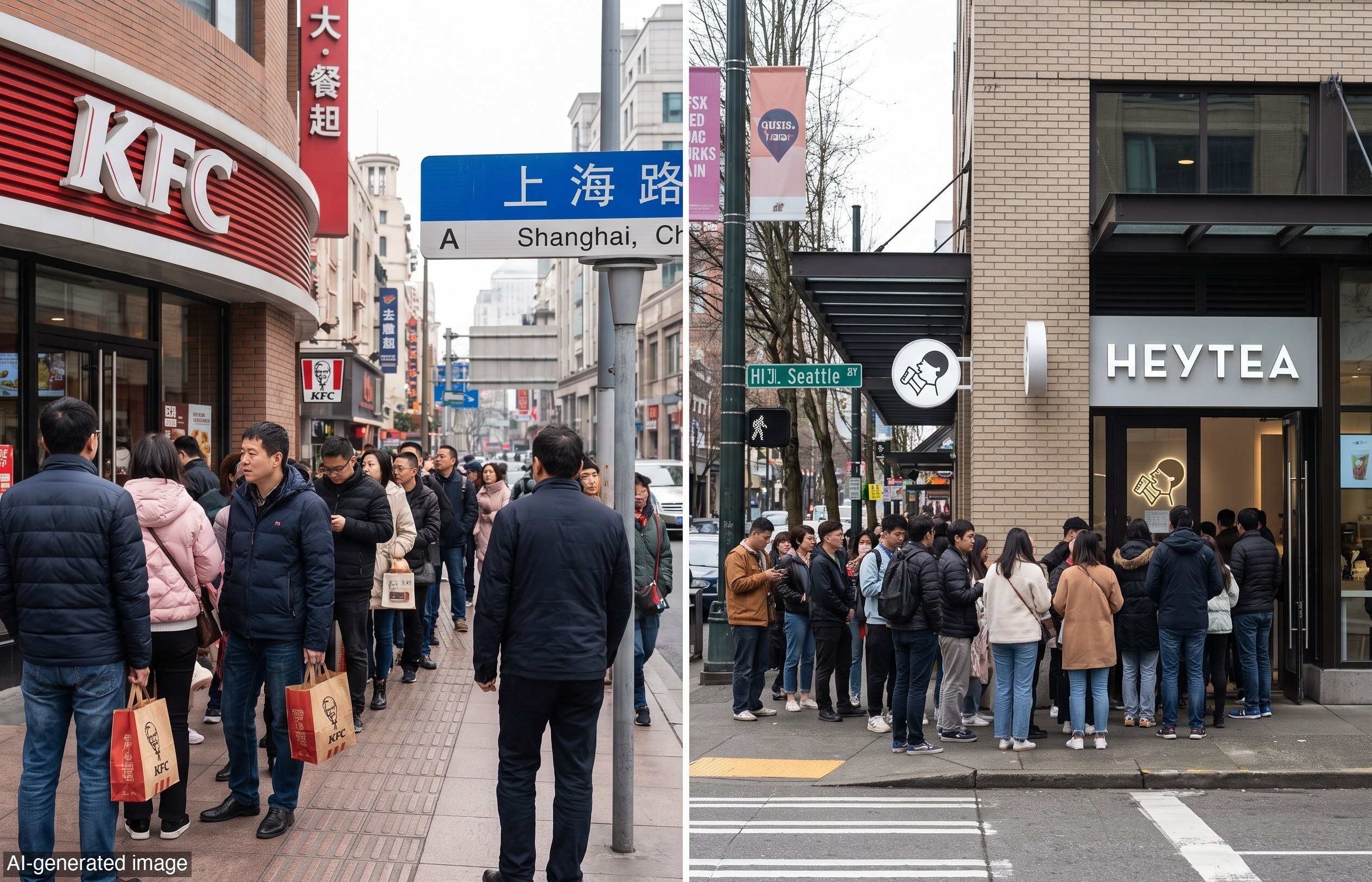
China and the United States remain divided on tariffs, technology and Taiwan. But fast food has become a commercial channel that keeps moving anyway.
American restaurant and beverage chains are expanding rapidly in China, where companies see a customer pool that is roughly four times the size of the U.S. population. Chinese chains, facing a languishing home economy and cutthroat competition, are taking their chances in the U.S. market. The result is a two-way flow of brands that turns fries, fried chicken and bubble tea into a form of gastrodiplomacy.
Yaling Jiang, founder of ApertureChina, called it a business- and consumer-led version of gastrodiplomacy. In China, recent American arrivals such as Popeyes and Five Guys are seen as a guilty pleasure, she said, while Americans' more international palates have opened space for Chinese brands to act as unofficial ambassadors.
The market has already voted with its feet. Last month, Chinese customers lined up in the rain for the opening of the first Church's Texas Chicken in Shanghai. Church's plans at least 600 more locations across China. Wendy's says it anticipates opening 1,000 restaurants there over the next decade.
Established U.S. names are also pushing deeper into the Chinese market. McDonald's plans 1,000 new Chinese restaurants this year and 10,000 total by 2028. Burger King, which arrived in China in 2005, expects to triple its store count to 4,000 by 2035. Shaun Rein, founder and managing director of the Shanghai-based China Market Research Group, said Chinese consumers still 'go crazy for American brands' despite political tensions.
KFC became the first major American fast-food chain to enter mainland China when it opened a Beijing restaurant in 1987. McDonald's and Pizza Hut arrived in 1990. KFC is now China’s largest market by far, with about 13,000 restaurants there, compared with around 3,750 in the U.S.
The competitive picture is not easy for foreign operators. Most American chains now rely on Chinese partners to find locations and share financial risk. Earlier this year, a Chinese investment firm acquired a 60% stake in Starbucks' China operation after several years of falling store traffic.
The adaptation cuts both ways. KFC in China serves french fries and Original Recipe chicken alongside egg tarts and congee, a savory rice porridge. As Sory Park of Daxue Consulting put it, companies have to operate like a Chinese company while delivering American menus that incorporate Chinese values, eating habits and tastes.
Mixue shows how far the flow has gone in the other direction. The Chinese chain, which has more than 53,000 locations, opened its first three U.S. stores in December. New York customers waited in the cold to sample soft-serve ice cream, fruit teas and milk tea with toppings like coconut jelly and taro balls in Herald Square. Mixue has announced at least two dozen more planned locations across four states, and at least nine other mainland Chinese chains have made similar moves.
The White House has not revealed the menu for the state dinner that Trump is hosting for Xi Jinping on Thursday. That kind of symbolism matters, but the real story is more basic: consumers are still rewarding brands that deliver value, familiarity and a product they want.
For investors, that is the part worth watching. Where governments trade threats, restaurants trade margins. Capital rewards clear rules, and even in a period of political tension, free enterprise keeps finding a way through.



