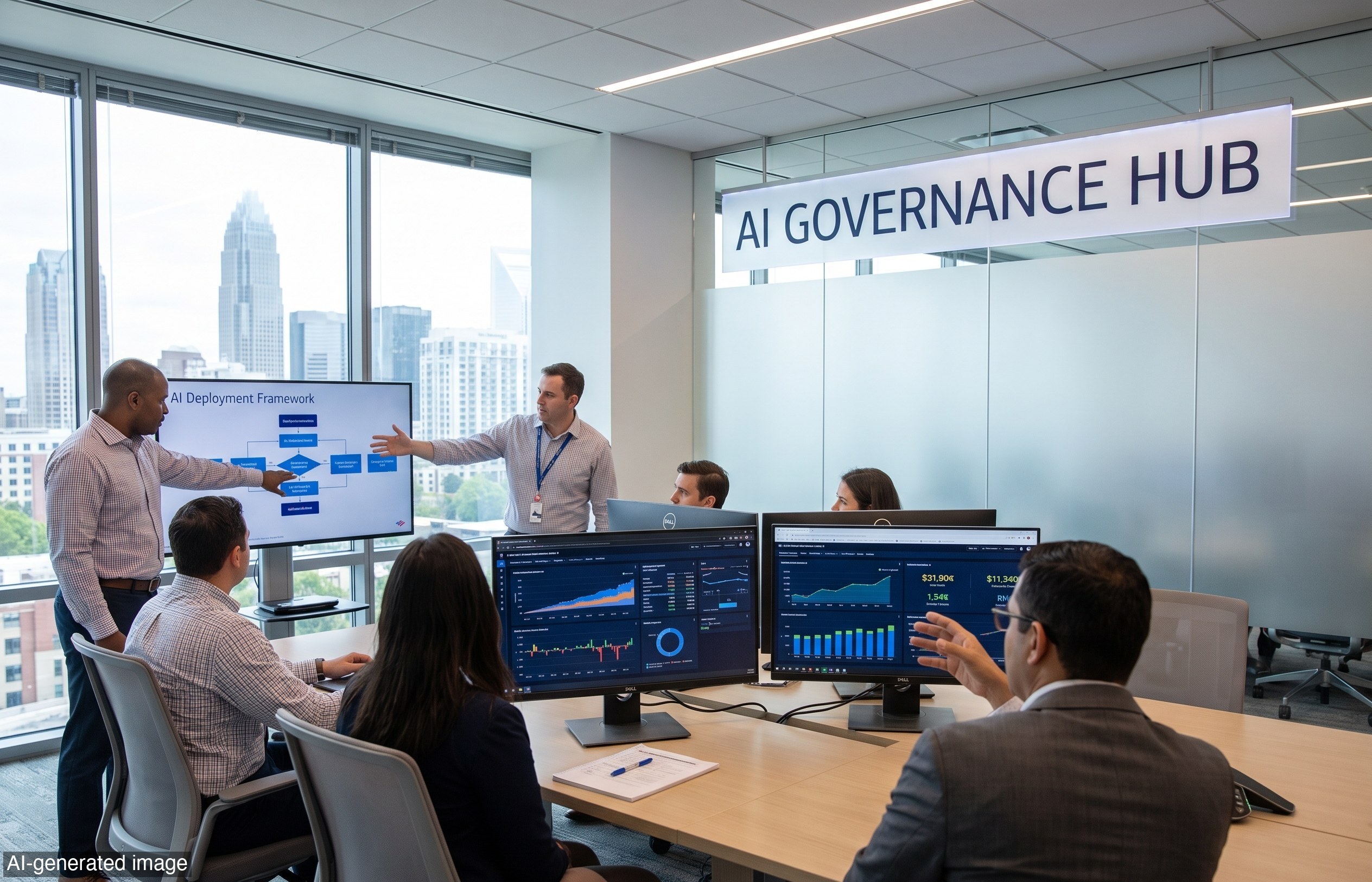
Bank of America says it is finding real money in artificial intelligence, but only by resisting the urge to chase every new model.
At Fortune’s AIQ Summit in New York, Hari Gopalkrishnan, the bank’s chief technology and information officer, said one of the biggest mistakes is to 'rush to AI as a solution' when deterministic models can do the job. He said the bank begins with what clients need and a 'process inventory' of the steps behind their requests.
That approach often leads Bank of America to avoid AI altogether. Gopalkrishnan said the bank chooses other tools 'plenty of times,' including a mobile app or a real-time decision rule. Every AI project also goes through a review of 16 'pillars' of risk, including privacy, bias, workforce impact and intellectual property.
The bank is not treating AI as a side project. Gopalkrishnan said Bank of America has used AI for more than a decade, starting with fraud models. Its Erica virtual assistant has handled 3.6 billion transactions, and he said the bank would need 11,000 more people to answer the calls without it. A March bank press release put Erica’s client interactions at more than 3.2 billion.
The spending is large. CEO Brian Moynihan said in September that about 140 AI uses cost $400 million and generate $800 million in benefit, and that the AI expense budget will double next year.
Gopalkrishnan said the bank is model-agnostic and routes tasks carefully. An orchestration layer called Orchestra sends simple classification work to approved open-weight models running on the bank’s own GPUs, while harder reasoning goes to proprietary models. He said this helps control token costs. In wealth management, he said advisors can now prepare for client meetings in 'seconds and minutes' instead of days and weeks.
S&P Global is taking a similar approach. Sally Moore, the company’s chief client officer and co-head of Kensho Data & Platforms, said the 160-year-old company is 'repositioning itself — aggressively and carefully.' She said much of its financial data feeds regulated workflows, where accuracy, citations and traceability to the source matter.
Moore said 'data is the currency within AI.' S&P bought the AI company Kensho in 2018, and she said that bet has 'given us an advantage.' On July 6, S&P split Market Intelligence into two units, and CEO Martina Cheung said the changes should support revenue growth and better margins.
Moore said S&P serves 60,000 clients at different stages of AI adoption. It works with frontier AI labs, puts its data into large language models and productivity tools, and now builds its own agents. She gave one example in which S&P helped a tier-one bank with 8,000 bankers bring a platform to production 'six times quicker,' while accuracy rose from about 60% to 98%.
The market has already voted on the larger lesson: AI can save labor, speed up production and improve margins, but only when companies keep humans in the loop and treat control as a feature, not an afterthought. For regulated industries, that is not caution for its own sake. It is how capital avoids expensive mistakes and turns software into productivity.



