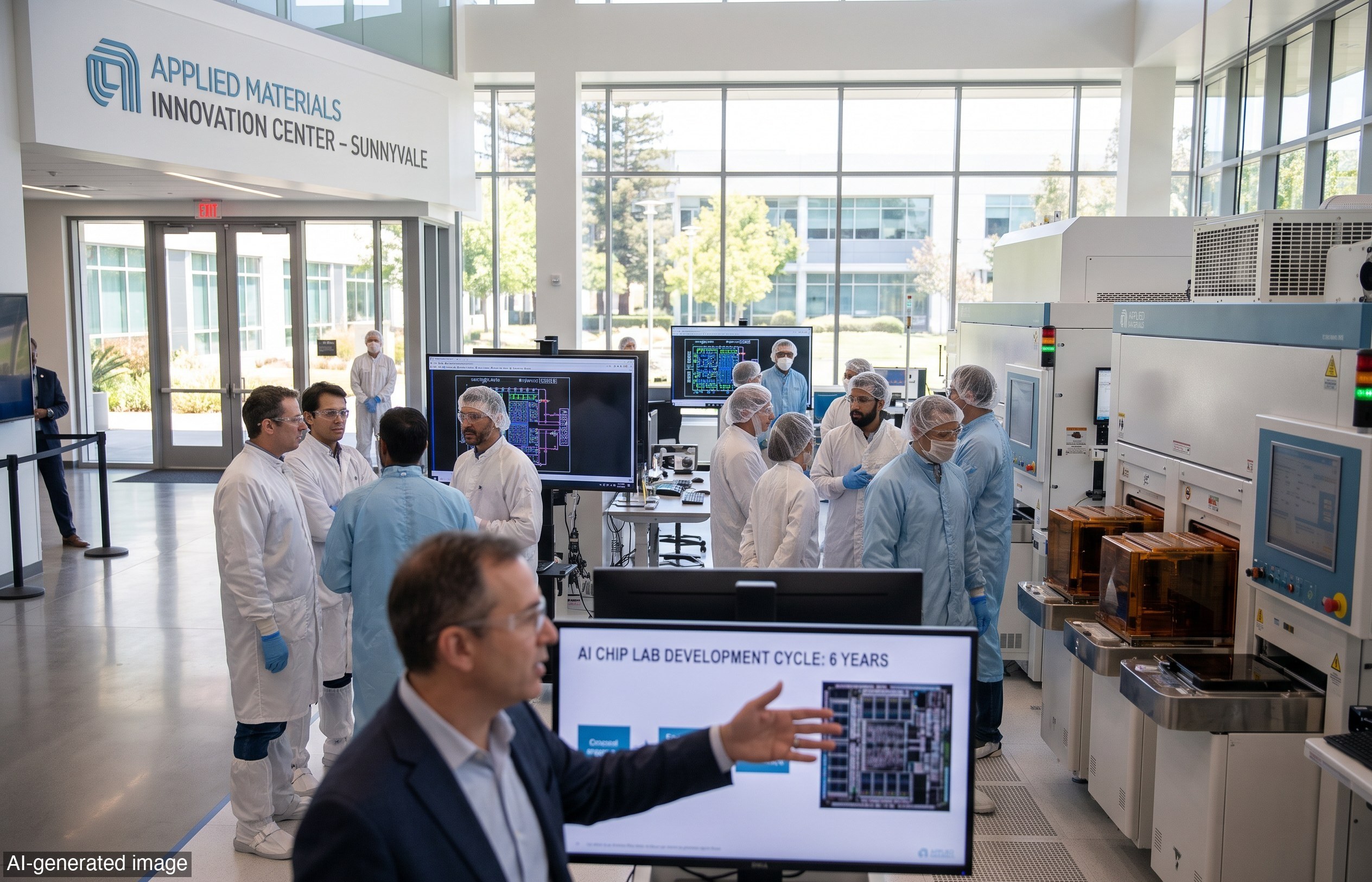
Applied Materials unveiled its new EPIC semiconductor research and development facility on Monday at its Sunnyvale, Calif. campus, a two-year construction project just down the road from the company’s headquarters. The 600,000-square-foot building is part of a $5 billion effort and was described by the company as the largest-ever U.S. investment in advanced semiconductor equipment R&D.
The facility was built with some of the biggest names in the chip industry, including Intel, TSMC, Micron, SK Hynix and Samsung. Applied Materials said each partner will have teams of researchers on-site, working alongside Applied Materials engineers and getting early access to the company’s newest equipment to develop advances in microprocessors and memory chips.
Gary Dickerson, Applied Materials’ CEO, said co-locating innovators and giving them earlier access to the technologies that enable new AI architectures is 'a complete game changer.' The company said the collaboration at EPIC will speed up the time it takes to develop each new generation of chip architectures, cutting the typical 'concept to commercialization' timeframe from 10 to 12 years to as little as six years.
The EPIC center is for research only, not commercial chip production. That means it is not, by itself, a factory bringing manufacturing back to the U.S. Even so, Applied Materials said the project is aimed at keeping Silicon Valley and the company at the forefront of cutting-edge chip technologies, which it called a critical weapon in the race to develop more powerful AI models.
The stakes are sharpened by the pressure coming from China. On Monday, CXMT, a memory maker in China, announced a breakthrough in memory chip density. The company said the breakthrough could allow CXMT to produce more power-efficient memory chips, and the news sent shares of Samsung and SK Hynix down roughly 7% and 10% respectively in South Korea, according to Bloomberg.
The U.S. government has barred sales of advanced GPU chips and advanced chipmaking equipment to China, aiming to deprive the country of the computing power needed to create AI models that could outperform those made by U.S. companies like OpenAI, Anthropic and Google. Dickerson repeatedly invoked 'winning the AI race' at Monday’s event, though he would not comment specifically on his views about U.S. regulations on sales to China.
Applied Materials has been one of the biggest beneficiaries of the AI boom and the resulting shortage of memory chips. Its shares are up more than 110% over the past 12 months, and in August the company reported $9.12 billion in quarterly revenue, up 25% year-over-year.
The market has already voted. A company that puts capital into faster development, earlier technical insight and tighter collaboration is trying to buy time in an industry where time is money. For investors, the signal is straightforward: productivity wins, and bureaucratic delay loses. The taxpayer should notice the larger lesson too. When private enterprise builds the tools of the next cycle, Washington does not have to pretend it invented progress.



