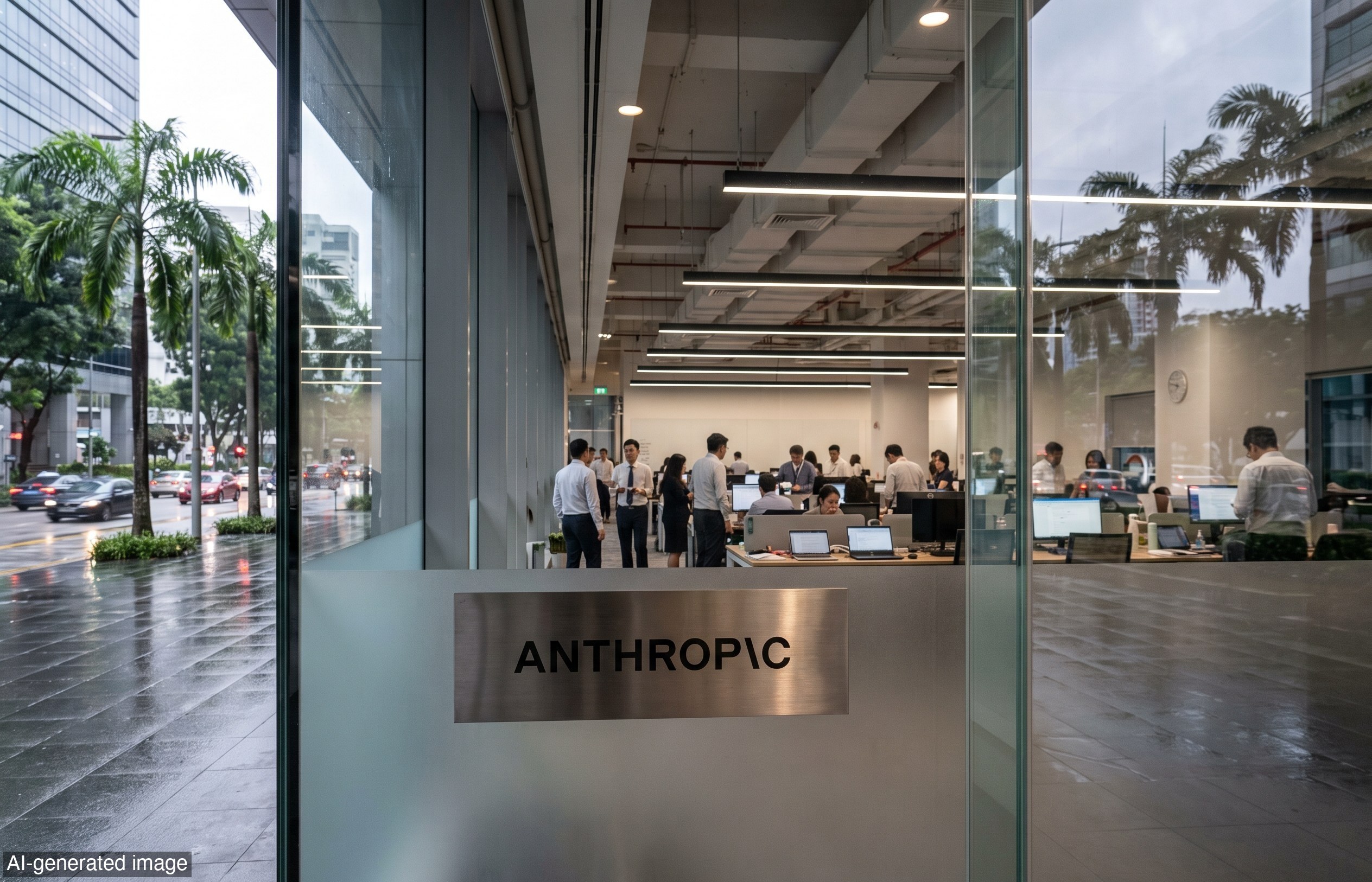
Anthropic said it will open its Singapore office in October, marking its first location in Southeast Asia and its fifth in Asia-Pacific.
The company’s international managing director, Chris Ciauri, said in a Sept. 16 press release that opening in Singapore was 'a natural next step' as the company grows across Asia-Pacific, citing 'Claude usage per capita' that is among the highest in the world.
According to Anthropic data, Singapore ranked second out of 121 countries in Claude usage, behind Australia.
Anthropic said the regional expansion will be led by Dale Finlay, who joined after six months as OpenAI’s regional go-to-market head. Finlay said in Anthropic’s press release that 'ambition isn’t the blocker to AI adoption—trust is.'
The move puts Anthropic in direct competition with OpenAI, which opened its Asia headquarters in Singapore in late 2024. The Business Times reported last month that OpenAI was planning to lease 100,000 square feet of new office space in Singapore. OpenAI also hired Sandhya Devanathan, Meta’s head for South Asia, as its new ASEAN and Australia head.
Singapore has long functioned as a 'port of entry' to Southeast Asia because of its stable political environment and business-friendly policies, and AI firms have followed that lead. Companies including Cognition and Sierra have picked Singapore as their ASEAN or Asia headquarters.
The city-state also wants to become an 'AI nation' and has committed over $1 billion Singapore dollars, or over $770 million, to strengthen public AI capabilities.
Plaud, a San Francisco-headquartered maker of AI-powered note-takers, also opened its regional headquarters in Singapore on Sept. 16. The office will serve as Plaud’s 'base of operations' across twelve Asia-Pacific markets, including India, Malaysia, New Zealand, Australia, South Korea, Thailand and Vietnam.
Nathan Xu, Plaud’s CEO and co-founder, said at the office launch event that the company began in Singapore with 'a very modest idea' to start a data engineering team. 'In about nine months, we grew the team from 10 people to about 100,' Xu said. Plaud also said it would invest $20 million Singapore dollars, or $15.7 million, to accelerate engineering and product development in the country.
Asia remains one of the hardest places in the world to build AI that understands context and intent because people switch between languages, dialects and contexts, Xu said in a Sept. 16 press release. 'If we can make AI feel natural here, we can make it feel natural anywhere in the world,' he said.
The numbers come first: Singapore’s stability, policy climate and regional reach are drawing AI capital, while the firms themselves are chasing talent, trust and market share. For investors and operators, that is the point. Capital rewards clear rules, and the market has already voted for the places that make it easiest to build, hire and expand.



