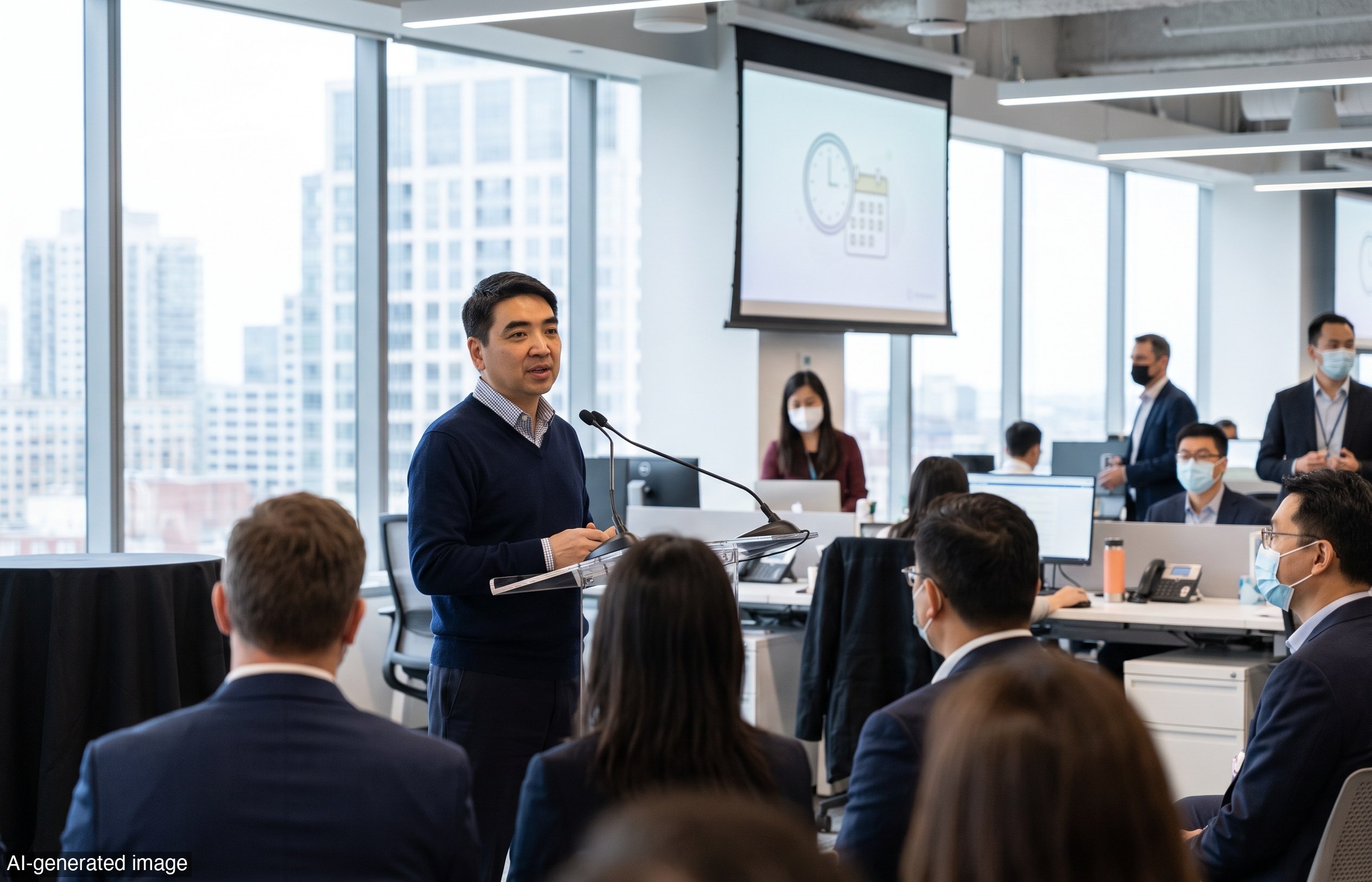
Zoom CEO Eric Yuan says artificial intelligence could soon make a three-day or four-day workweek possible. In a 2025 interview with The New York Times, Yuan said, 'I feel like if AI can make all of our lives better, why do we need to work for five days a week?'
'Every company will support three days, four days a week,' Yuan said. 'I think this ultimately frees up everyone’s time.'
The idea is not isolated. Microsoft cofounder Bill Gates has said AI could remove the need for humans for 'most things' in the next 10 years. Nvidia CEO Jensen Huang said the AI revolution is only beginning and that wider adoption could 'probably' bring a four-day workweek, though he also said workers may be 'busier in the future than now.' JPMorgan Chase CEO Jamie Dimon has predicted people may 'probably' be working '3 and a half days a week.'
Yuan also acknowledged that the shift would not be painless. 'Whenever there’s a technology paradigm shift, some job opportunities are gone, but it will create some new opportunities,' he said. 'For some jobs, like entry-level engineers, we can use A.I. to write code. However, you still need to manage that code. You also create a lot of digital agents, and you need someone to manage those agents.'
The article points to a U.S. experiment by Exos, a performance coaching company, which tested a one-day-shorter schedule. The company said employee burnout was cut in half and productivity rose by 24%.
That is the promise and the warning wrapped into the same forecast. AI may deliver real gains in productivity, but the transition will also reshape labor markets and push some workers out of roles that machines can now handle faster and cheaper. For business leaders, the upside is obvious: less wasted time, lower friction and more output per worker.
For everyone else, the question is whether the gains will show up as more freedom, more leverage and better margins for companies — or as fewer jobs for people who built their careers around the five-day week. Capital rewards clear rules, but technological change rarely waits for comfort.
The market has already voted: companies are racing to automate. What remains to be seen is whether workers will share in the productivity gains, or simply absorb the disruption while management keeps the upside.



