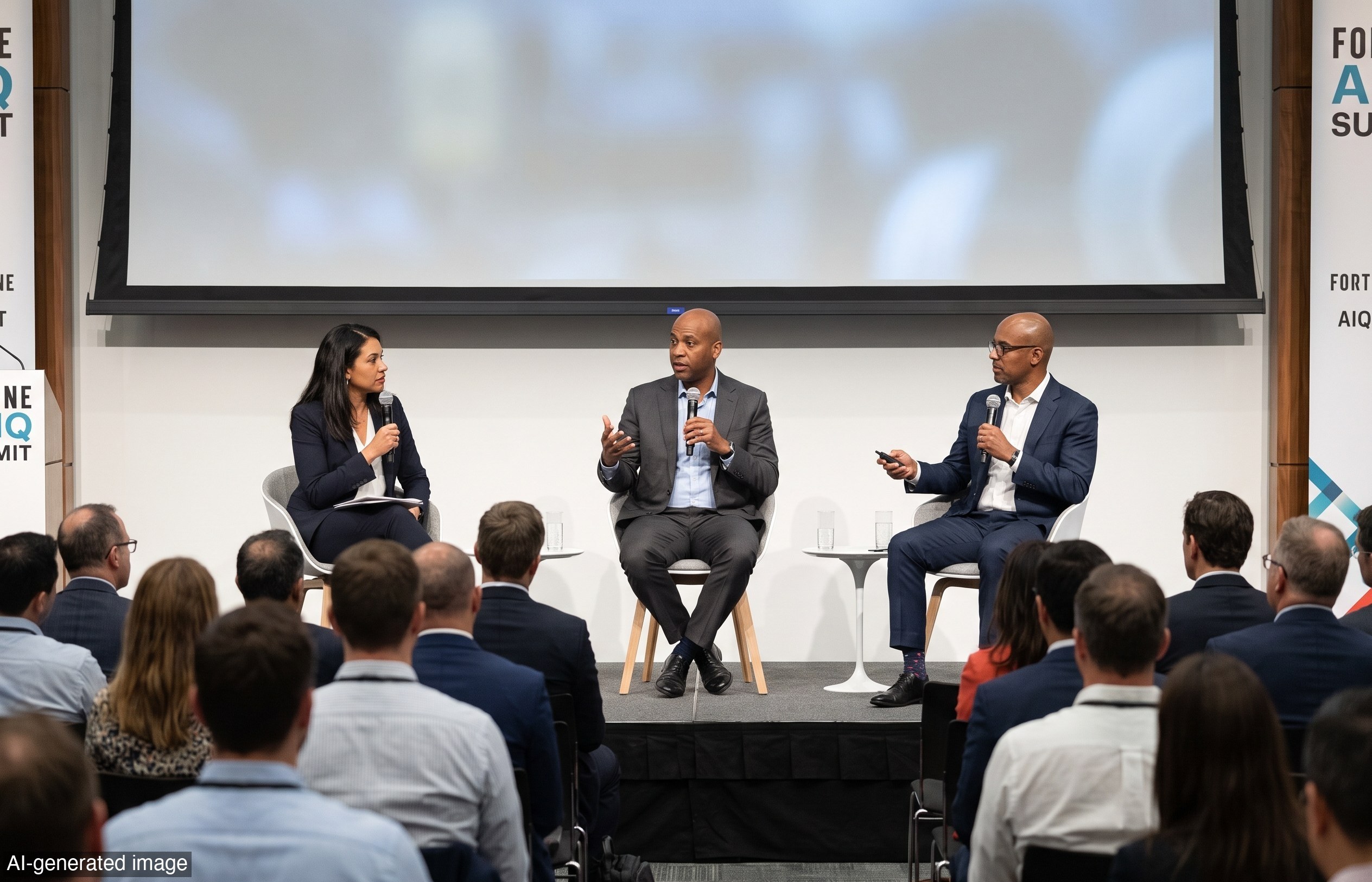
The conversation around artificial intelligence has shifted from experimentation to execution, according to executives at Fortune's AIQ Summit at the New York Stock Exchange.
Speakers from technology, finance, industrial operations, travel, and human resources said the key question is no longer whether a company has adopted AI tools. It is whether those tools have changed how work gets done without adding new costs, risks, or organizational confusion.
Diana David, director of futures at ServiceNow, said the strongest companies are investing in people and process. In ServiceNow's Enterprise AI Maturity Index, 57% of 'pacesetters' invest in ongoing AI upskilling, compared with 4% of other organizations. On attracting, hiring, and retaining AI talent, 68% of pacesetters do so, compared with 10% of other companies.
David said broad access to AI does not automatically translate into productivity. '95% of everybody has X, Y, Z,' she said. 'But it is not translating into productivity, and it's often not with training, and that doesn't equal maturity.'
Paul Fipps, president of Global Customer Operations at ServiceNow, said the biggest gains will come not from automating old processes faster, but from redesigning them around new capabilities. He said companies should deploy AI across employee-facing functions such as HR, legal, and technology, instead of leaving it isolated in one department.
Fipps pointed to Standard Chartered, where AI has helped deflect 77% of employee requests. He said 25% to 30% deflection in those use cases is 'game-changing,' and 75% to 80% is 'life-changing.'
Amy Webb, founder and CEO of Future Today Strategy Group, said Fortune 500 companies are 'pretty late to the party' and warned that many are pouring significant capital into pilots without enough strategy, leadership, or planning. That, she said, leaves firms with isolated projects that fail to produce durable value.
Stacy Dillow, executive vice president and chief people officer at HPE, said companies must avoid simply inserting AI into existing systems. 'We've got to force ourselves to think differently,' she said, adding that senior executives now carry central responsibility for AI adoption and transformation.
Danielle Gonzalez, chief people officer at Palo Alto Networks, said a custom AI agent has reduced IT tickets by 83% and now supports workflows across HR, finance, and legal. She said companies should hire and develop people who can adapt quickly, learn new skills, and question assumptions that no longer hold.
The numbers come first. The market has already voted for firms that can turn AI into productivity, margins, and better operations, not just splashy pilots. Capital rewards clear rules, disciplined management, and a workforce that can adapt fast enough to keep up.
For executives, the message is blunt: free enterprise does not pay for technology on faith. It pays for results. Companies that redesign work around AI may unlock real leverage; those that stop at software will likely burn capital and call it innovation.



