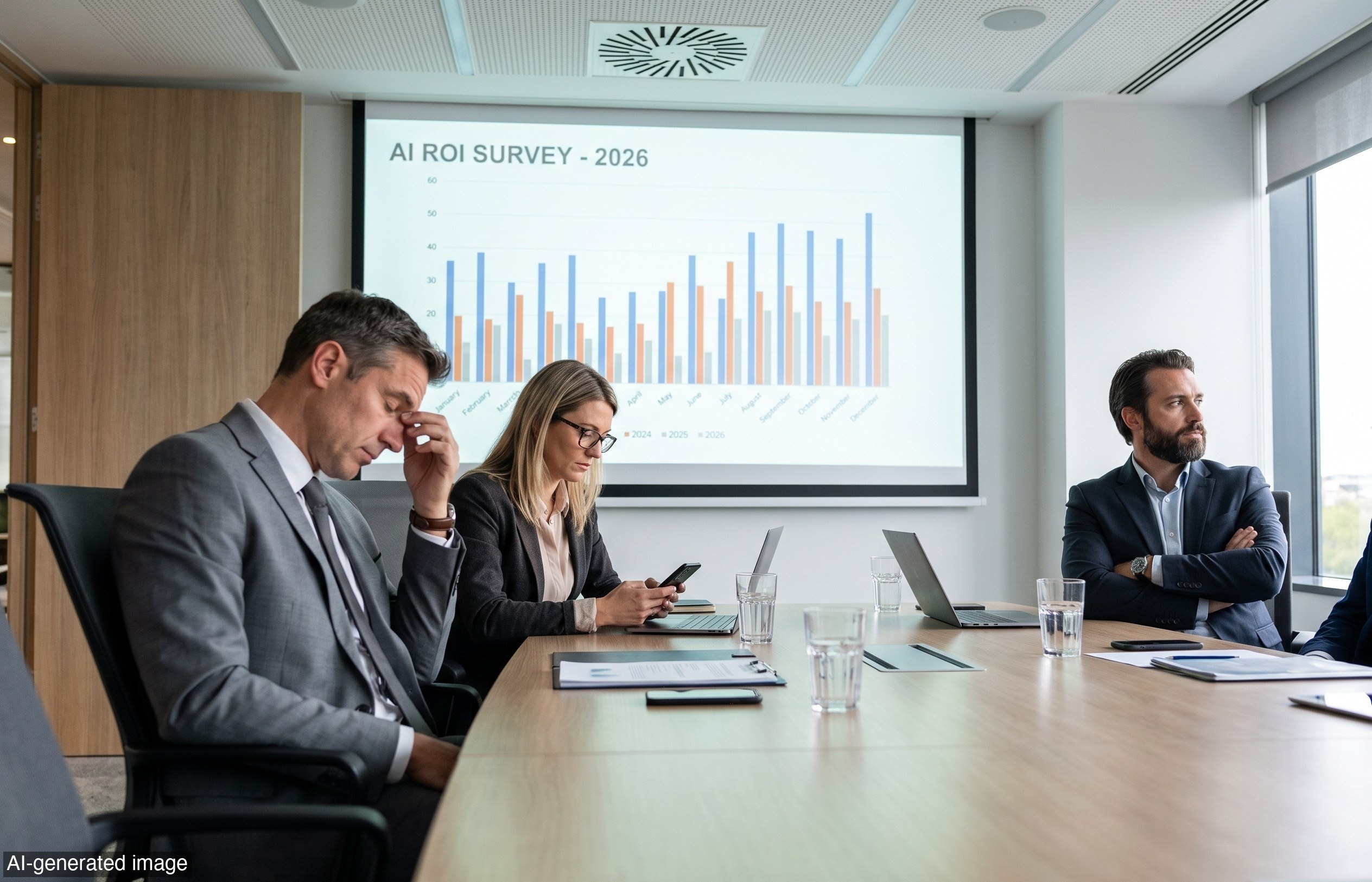
The numbers come first. A Fortune commentary says the AI revolution is moving faster than the economy can absorb it, even as consumer adoption surges.
Ming Lu argues that the world is seeing an 'Innovation Paradox': faster innovation and slower growth. He cites McKinsey's 2026 State of AI survey, which found that when chief financial officers of the world's largest companies are asked how AI is transforming the bottom line, 88% of them answer 'Not so much.'
The gap between hype and execution is stark inside companies. The commentary says consumer AI usage has surged to 53% of U.S. adults barely three years after ChatGPT's launch, while enterprise AI in productive deployment stands at just 10%. It also says 88% of organizations use AI in at least one function, but only 6% qualify as 'high performers' achieving more than 5% EBIT impact.
That 6% is not just using tools; Lu says those firms are three times more likely to have redesigned workflows end-to-end. Only 21% of all adopters have done that. He adds that 36 S&P 500 AI companies now represent 45% of the index's market capitalization, and that over three years the headline S&P 500 returned 76%, versus 32% if AI stocks are stripped out.
His broader claim is that the drag comes from structure, not technology. Lu says services now dominate GDP, and that sectors such as healthcare, education, public administration and construction account for roughly 50% of advanced-economy GDP while remaining resistant to productivity gains.
He also points to what he calls a Combined Overhead Ratio, including government spending, corporate SG&A and regulatory compliance costs. In the U.S., he says, that ratio crossed 47% of GDP around 2000. Above that threshold, he says GDP growth has not sustainably exceeded 2.5%. He says government spending has risen to 36% of GDP, corporate SG&A has doubled since the 1980s, and the Competitive Enterprise Institute estimates U.S. firms spend more than $2 trillion annually on compliance.
Lu's warning is simple: if companies keep layering AI onto bloated systems, they may get a faster engine in a horse-drawn carriage. The market has already voted for the winners, but capital still rewards clear rules, leaner overhead and real operating change.
For business leaders, the message is uncomfortable but familiar. Technology alone does not create productivity. Free enterprise still depends on institutions that let innovation turn into output, not just headlines.



