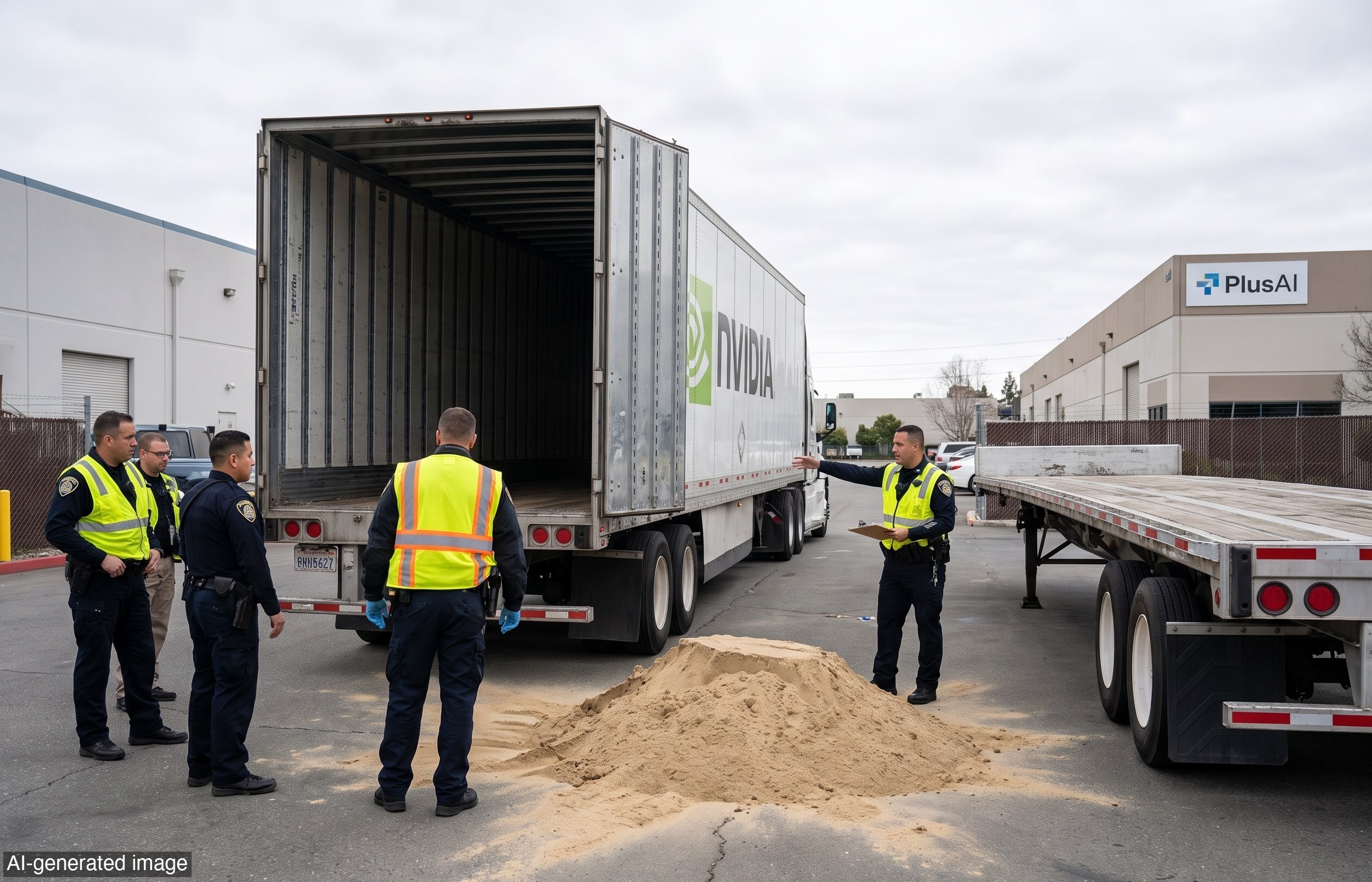
Thieves stole two trailers from PlusAI’s Fremont, California, warehouse last week, including one with Nvidia branding, and found 40,000 pounds of sand instead of chips.
PlusAI said the trailers were recovered later that day after a friend of its vice president of legal spotted them outside a Newark office and sent a photo. Authorities told the company the thieves broke open the back of the vehicles, found nothing of value, and left them.
The company said the trailers were not carrying Nvidia chips. PlusAI uses sand to simulate the loads its trailers must carry for research and development testing. Each truck held about 20,000 pounds of sand. Lauren Kwan, vice president of marketing at PlusAI, said the company has never had a tractor or trailer stolen since its founding in 2016: 'This was a first.' Nvidia declined to comment.
The theft lands inside a broader surge in AI-related cargo crime. In June, investigators with the Cook County Sheriff’s Office in Illinois recovered two trailers outside Chicago, including one with $300,000 worth of copper wire stolen from Alabama and $1 million in data center equipment reported stolen in Florida. In December 2024, thieves took more than $7 million worth of Nvidia computer chips from a California warehouse, one day before delivery to a Supermicro facility in San Jose.
Supply-chain risk management firm Overhaul said it has already tracked more than $150 million in AI equipment cargo losses since it began tracking the data. Overhaul also said AI-related theft, including data center equipment and chips, has increased 34% since 2024, while the total value of goods stolen has increased by more than 110% in the same period.
David Warrick, executive vice president at Overhaul, said thieves have found a new target in AI spending, which some estimates project will reach $2.7 trillion this year. He said the surge in spending has created a black-market opportunity for memory chips and infrastructure. 'The economics have become just crazy from the criminal opportunistic perspective,' Warrick told Fortune earlier this year.
Warrick also said the scale of the heists points to organized criminals, not petty theft. He said these groups operate like big corporations and have penetrated supply chains at multiple levels, including drivers and warehouse operators. He added that they look for weak points in the supply chain to exploit.
Freight companies are trying to respond. Kwan said cargo theft has been a persistent problem for the trucking industry, but there is 'no standard industrywide solution just yet.' Overhaul said it is using AI to certify driver’s licenses and track cargo through billions of data points.
The market has already voted on the real cost of the AI boom: more capital, more equipment, and more exposure. When supply chains get stretched by fast-moving technology races, criminals do not need to beat innovation. They only need to find the weak link.
For free enterprise, the lesson is blunt. Big bets on AI create real productivity gains, but they also create targets. The companies building the future now have to defend the physical chain behind it, because every stolen trailer is a reminder that innovation still depends on order, security, and clear rules.



