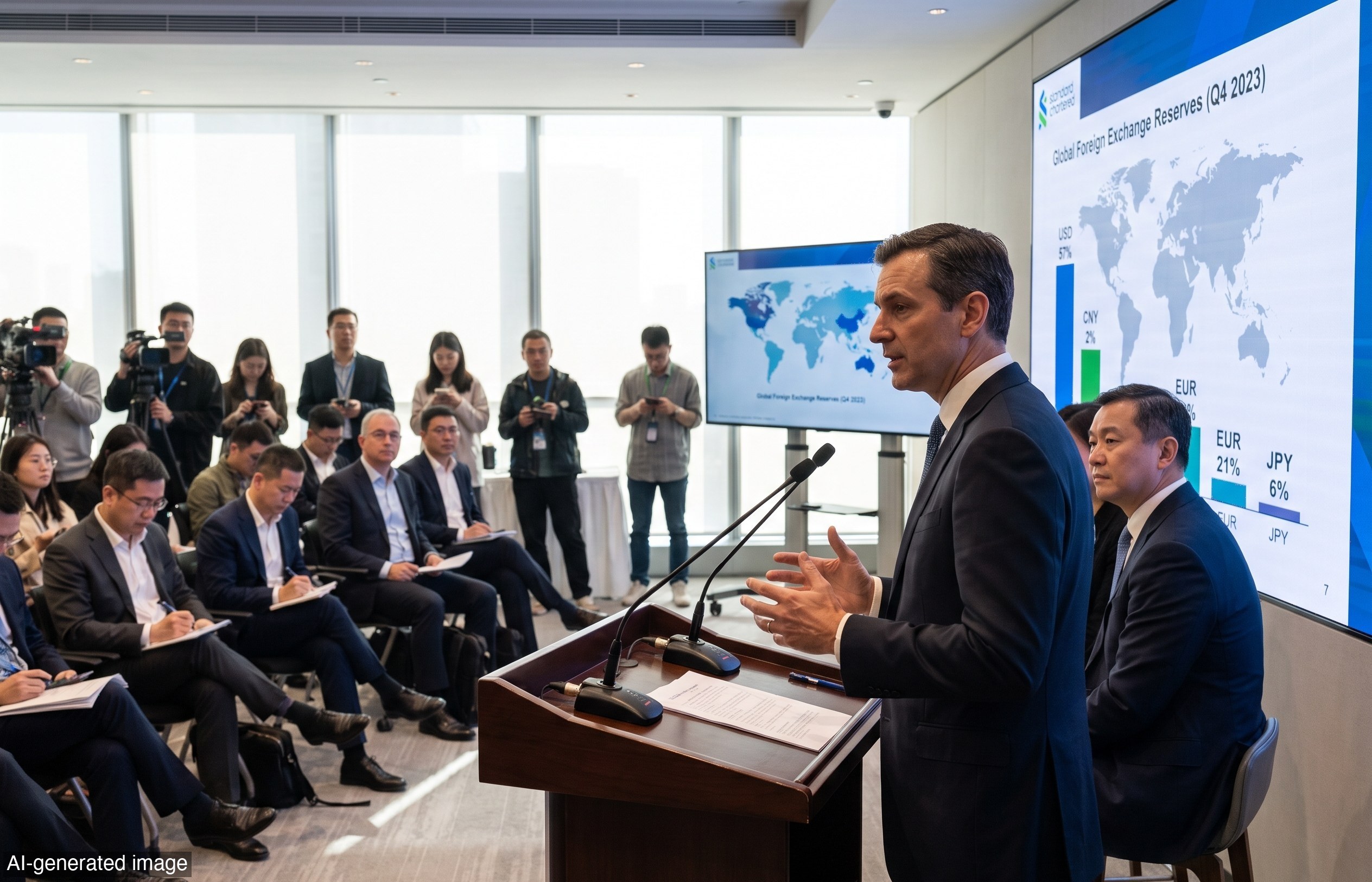
The yuan is gaining ground in trade, but not in the one arena that matters most for global monetary power. Standard Chartered China CEO Jean Lu said there is 'no way' the RMB will challenge the USD in her career, even as Beijing pushes to expand the currency’s role abroad.
Lu told a media roundtable in Singapore that the yuan may have a chance against the yen or pound, but not against the dollar. That view is backed by the reserve data: the U.S. dollar made up 57% of global foreign exchange reserves in the first quarter of 2026, according to the International Monetary Fund, while the yuan accounted for just 2%.
Beijing is still working to build international use of the currency. China’s most recent five-year plan, released in March, calls for expanding the yuan’s role through tools such as panda and dim sum bonds, and the People’s Bank of China has tapped Deutsche Bank as an offshore clearing bank to streamline European access to RMB liquidity. It also launched new repo facilities to help foreign central banks secure yuan liquidity.
The market has already voted on the scale of that challenge. Lu cited 'limited liquidity in offshore markets' and said there is 'less than 2 trillion yuan,' with almost half of it in Hong Kong. Chinese capital controls also remain a brake on the currency’s global reach.
Even so, the yuan is expanding in parts of Asia where trade ties with China are deepening. In 2025, settlement volumes between China and Southeast Asia surged to 8.9 trillion yuan, or $1.3 trillion, a 50.7% increase, according to a March Standard Chartered report. Singapore Airlines also issued a 1.5 billion yuan dim sum bond in June, a sign that RMB capital markets are being used for hedging and fundraising.
Geopolitics is also helping drive the shift. U.S. sanctions on Russia pushed China and India to adopt the yuan as an alternate trading currency, and after U.S. strikes on Iran earlier this year, Tehran asked shippers crossing the Strait of Hormuz to pay tolls in yuan. Those moves show how sanctions and conflict can redirect trade flows, even if they do not erase dollar dominance.
Trade between Southeast Asia and China is also hitting historic highs, helped by infrastructure such as the Pinglu Canal, which connects southwestern China to the Beibu Gulf and cuts logistics costs by as much as 30%. Patrick Lee, Standard Chartered’s ASEAN and Singapore CEO, said Chinese companies see ASEAN as an attractive place to invest and build supply-chain ecosystems.
But there is a harder edge to China’s expansion. Southeast Asian manufacturers are struggling with Chinese overcapacity. Thailand saw more than 2,000 factory closures in 2024 because of cheap Chinese steel and other goods, while Indonesian textile makers also struggled to compete, according to Shay Wester of the Asia Society Policy Institute.
Capital rewards clear rules, convertible money, and deep markets. On those tests, the dollar still dominates. Beijing may win more business for the yuan at the margins, but reserve-currency leadership remains a long way off.