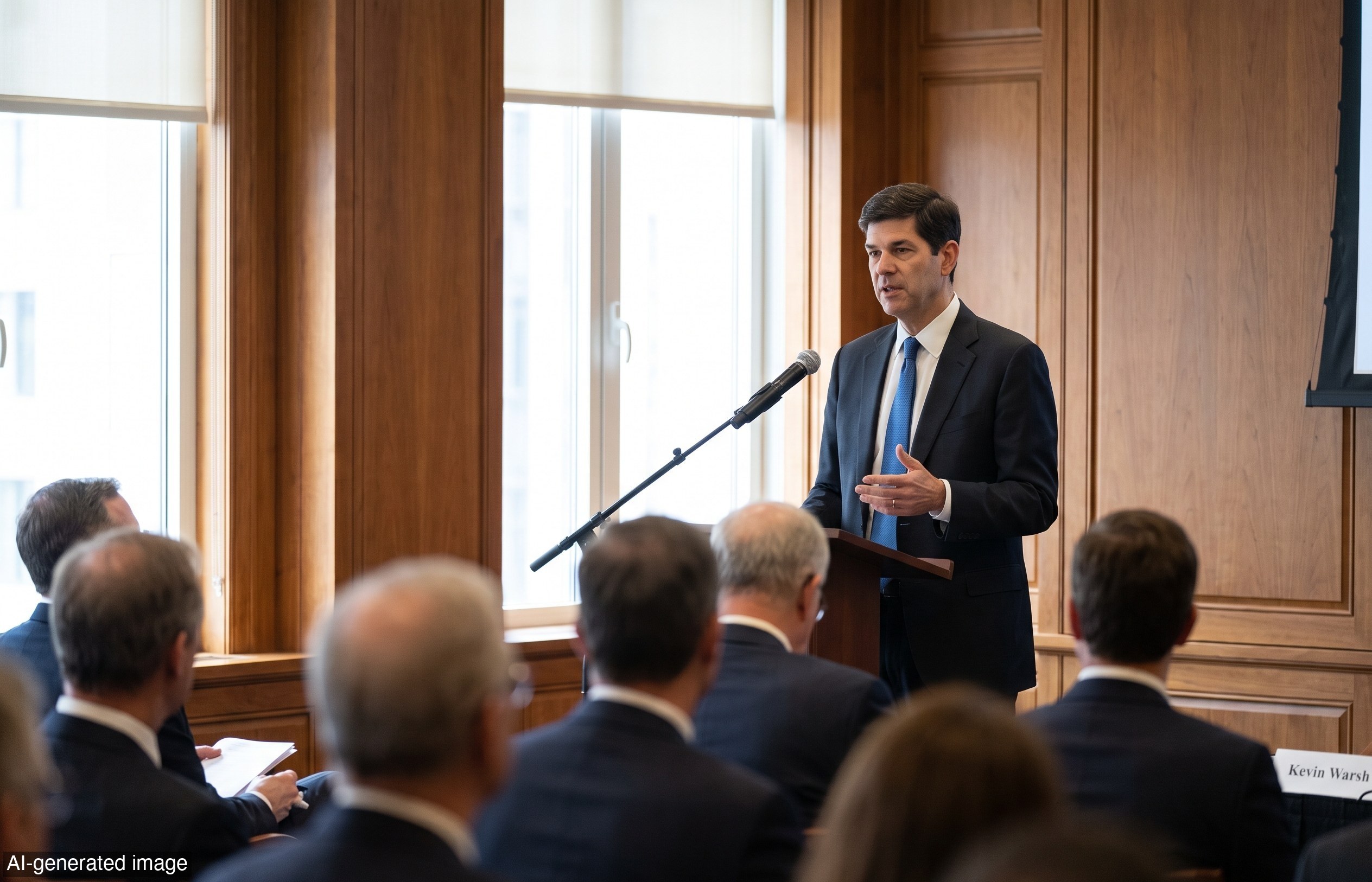
Federal Reserve Chair Kevin Warsh has revealed himself, at least in the eyes of two Fortune commentators who say he is 'a camp follower' of monetarism. They call it a dramatic change at the Fed, where 'the past Chairman Jerome Powell' repeatedly rejected the basic tenets of monetarism.
The numbers come first. Monetarism holds that money has a major influence on asset prices, economic activity, and the price level. It also says monetary policy works best when the growth rate of the money supply is the target. In the piece, that doctrine is presented as the opposite of the Keynesian-leaning models that, the commentators say, dominate academia and much of the Fed's internal culture.
Warsh's remarks at Jackson Hole and in his September 16 post-Federal Open Market Committee press conference are the basis for that conclusion. At Jackson Hole, he outlined principles that included the idea that changes in the money supply have something to do with economic activity and inflation. Then, in the press conference, he said the Fed cannot address individual prices like food and energy, but can make sure those relative price changes do not have 'second and third order effects.'
He also said the Fed does not deal in questions of distribution. According to the piece, Warsh said the Fed looks at aggregates like the labor market, GDP, total spending, and overall inflation. He added that the lowest income classes, including those without financial assets and those living from paycheck to paycheck, would benefit most from stable prices.
On the latest CPI reading, Warsh said it was not the deciding factor in the rate-hike decision. 'Datapoints are noisy,' he argued, and what mattered was the trend. The trend of inflation, he said, was still too high.
That is the central political economy point hiding inside the monetary jargon. If the Fed returns to money supply, aggregates, and stable prices, it is moving away from a model that treats central banking as a kind of discretionary social management. Capital rewards clear rules, not bureaucratic improvisation. Markets price certainty faster than speeches.
For taxpayers and savers, the distinction matters. Stable prices protect paycheck-to-paycheck households more directly than fine-tuned narratives about distribution. If Warsh is действительно signaling a monetarist turn, the real test will be whether the Fed stops chasing every noisy datapoint and starts respecting the link between money, inflation, and economic discipline.