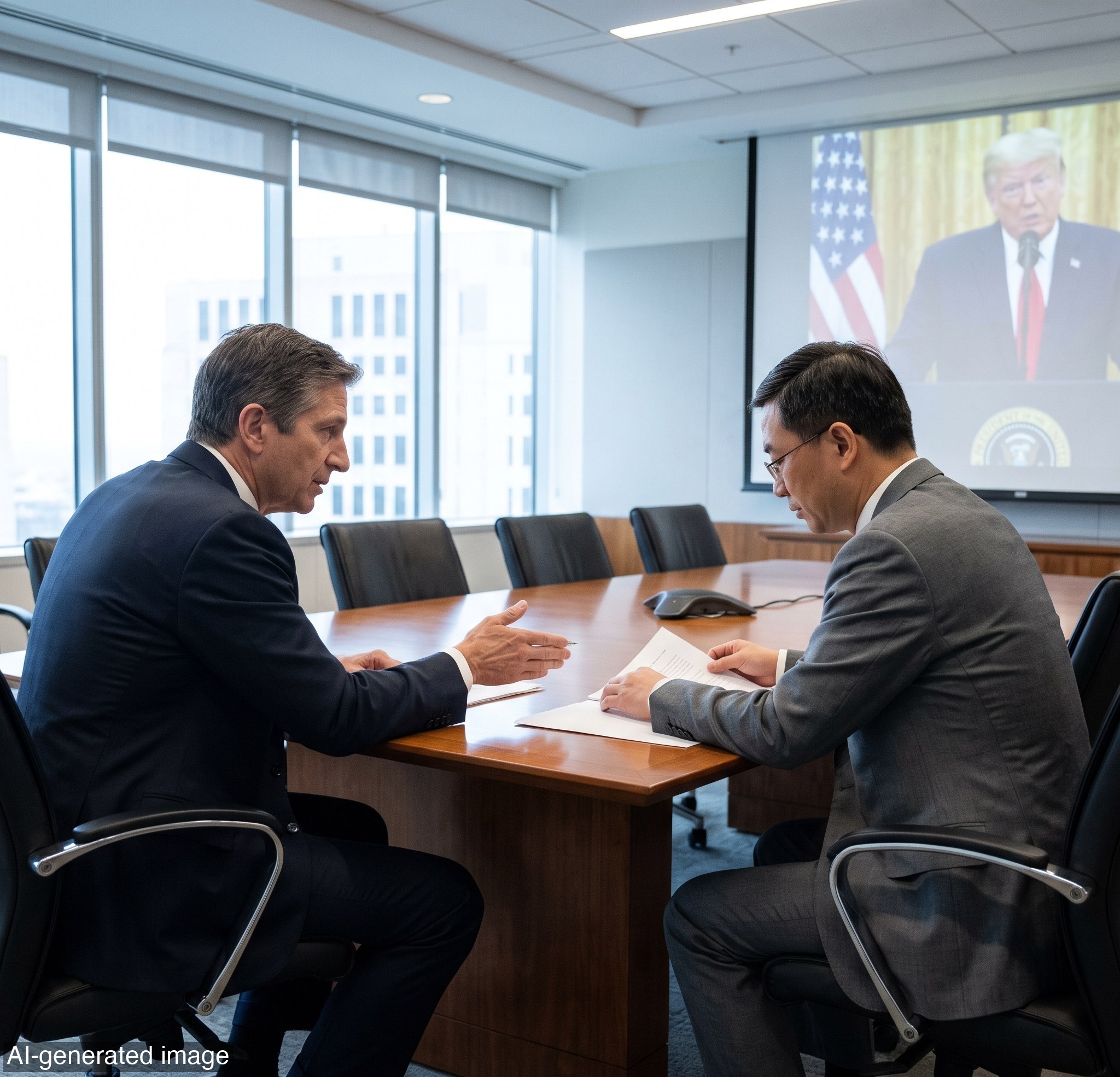
The U.S. and China have begun their first formal dialogue on artificial intelligence, according to China’s commerce ministry, after Treasury Secretary Scott Bessent met Chinese Vice Premier He Lifeng in New York earlier in the week.
Bessent said the U.S. proposed a notification mechanism between the two countries for national security-related AI incidents. China’s commerce ministry disclosed the talks at a press conference on Thursday.
The opening came the same day President Donald Trump posted that 'super intelligence' would be a topic of discussion with Chinese President Xi Jinping, but added, 'I want to leave it exactly where it is. That is China’s position also.' He also said, 'Our guardrail is the DOJ!'
Xi took a different tone while standing next to Trump at the White House, saying, 'We have both the capability and responsibility to develop and manage AI for good and ensure that development of AI is always under human control.'
The contrast matters because Trump told the UN General Assembly two days earlier that the U.S. rejects any 'globalist scheme' to control AI. Yet his Treasury secretary is now proposing a formal channel with China, the country Trump and American VCs often cast as the main rival in the AI race.
The push for guardrails is not coming only from governments. The CEOs of two of America’s top AI companies told the UN Security Council on Wednesday that artificial intelligence has become a threat to global security and asked world governments to write shared rules for it.
Anthropic CEO Dario Amodei said, 'No leader, no company, and no nation can manage this alone.' He urged a step-by-step approach, starting with small agreements that countries could broadly accept, including a ban on using AI to make biological weapons, then systems to verify commitments, and eventually a global alert system.
OpenAI CEO Sam Altman also called for fast, shared incident reporting. He said his company had slowed down its own AI development before and would do so again. That undercuts the industry’s usual claim that firms are trapped in a race they cannot leave.
China is trying to shape the same debate. In July, it launched the World Artificial Intelligence Cooperation Organization with 29 countries and no major Western democracies. Pakistan, a founding member, warned at the Security Council that measures 'pursued in the name of safety must not become instruments of denial of technology.' That was a clear shot at U.S. export controls on advanced chips.
Clement Delangue, CEO of Hugging Face, said open models make all companies safer. He told the council that his team tried to defend itself with closed American AI models, but the safeguards blocked them, so they fought the attack with an open source model from China.
The market implication is simple: Washington says it rejects a global regime, but the administrative state is still building a bilateral one. That is what happens when power meets risk. Capital wants clear rules, and when the technology is capable of crossing borders in seconds, even rivals eventually reach for a paper trail.
For investors, the key question is whether the U.S. chooses enforceable, narrow guardrails or a sprawling regulatory state that protects incumbents and slows competition. The race for AI will not be won by slogans. It will be won by the country that sets rules without smothering free enterprise.