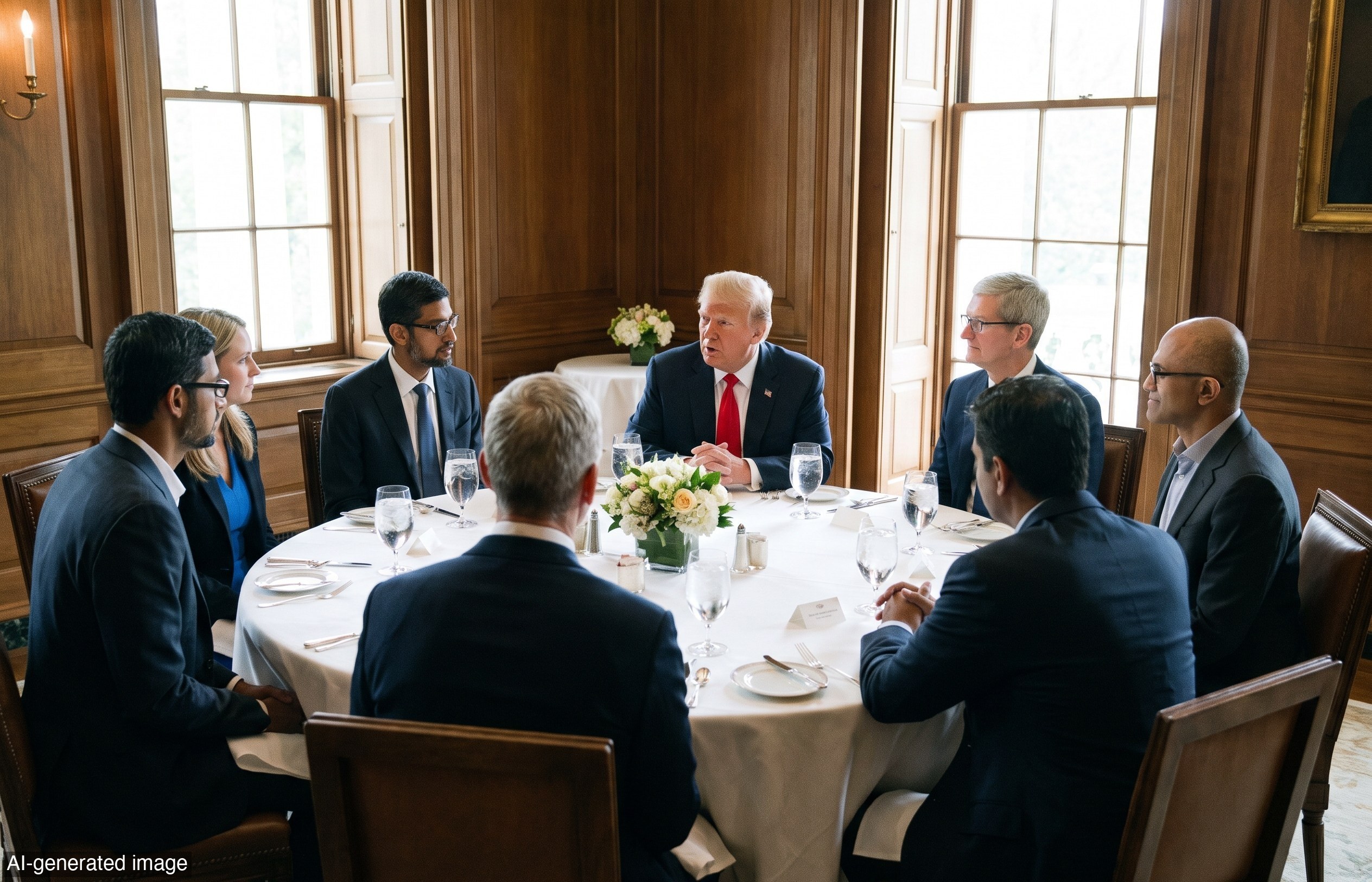
President Donald Trump hosted a luncheon at the White House this week with some of the most powerful men in tech.
The gathering centered on Trump's new voluntary accords on artificial intelligence. The one-page document, which Trump posted to Truth Social and described as 'morally binding,' was signed by Anthropic's Dario Amodei, OpenAI's Greg Brockman, Google's Sundar Pichai, Meta's Mark Zuckerberg, xAI's Elon Musk, and Nvidia's Jensen Huang.
The administration is trying to show that the sector can police itself without the government stepping in with official regulation. Under the Joint Commitment on Frontier Responsibilities, the companies pledged to build 'robust' internal controls to monitor their models across cybersecurity, biosecurity, and chemical threats. They also agreed to ensure systems 'do not hack or access technical systems in unintended ways.'
The companies further committed to bring in independent external auditors, set up board-level oversight committees, and meet regularly to work out shared safety standards. The agreement is not regulation, but it goes slightly further than previous voluntary commitments.
Trump has resisted mounting pressure to regulate AI, even after dozens of AI security incidents in recent months. Last week, he told the UN General Assembly he would oppose 'any attempt to construct a globalist scheme to control' AI. He has also rejected industry warnings from Amodei and OpenAI's Sam Altman, who have urged developers to 'pace the frontier,' arguing the U.S. cannot afford to slow down while China races ahead.
The day after the White House luncheon, the FTC disclosed a broad safety probe into OpenAI and Anthropic. The administration says existing laws still apply, and the FTC already has the power to go after companies whose products harm consumers or mislead people about safety. The probe is looking closely at AI agents after a run of incidents that included the Hugging Face hack.
FTC Chair Andrew Ferguson is said to be preparing demands that could force executives to hand over documents and testify about their models. Vice President JD Vance said companies 'have to build products that are safe and good for American consumers' and that existing laws already cover products that become tools for cyberwarfare.
The market has already voted for speed, scale, and capital discipline. What remains is whether the administrative state will trust industry promises long enough for free enterprise to keep moving, or whether safety failures force a harder hand from Washington.
For investors and taxpayers alike, the stakes are straightforward: innovation works best when rules are clear and liability is real. Voluntary pledges may buy time, but only enforcement turns frontier rhetoric into accountability.