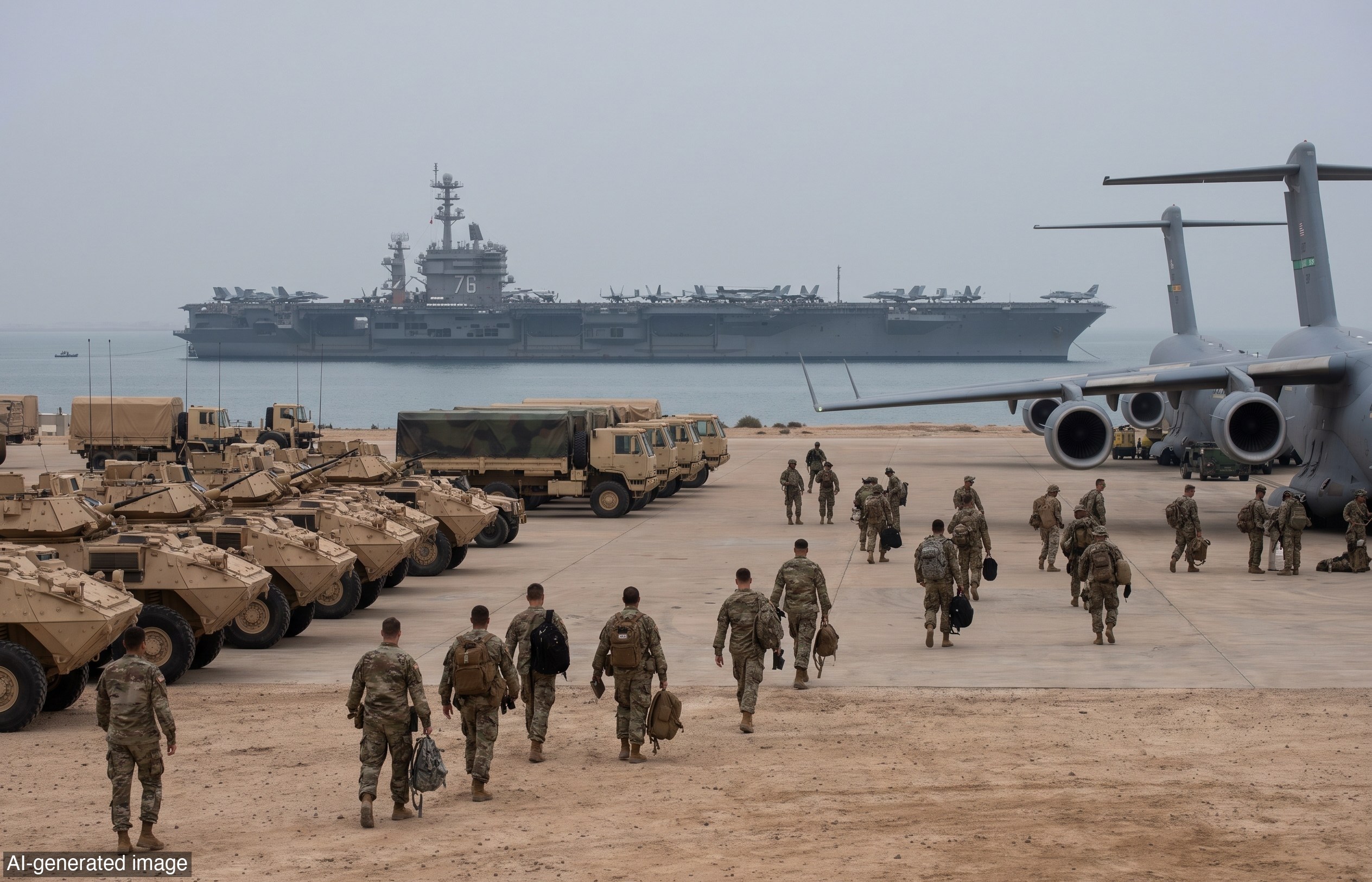
The U.S. military is dispatching roughly 9,000 troops to the Middle East aboard a group of ships, a U.S. official said Thursday. The movement includes a third aircraft carrier and comes as President Donald Trump warned that new strikes against Iran could be on the horizon.
The ships now en route carry more than 7,000 sailors and 2,000 Marines. They include the USS Theodore Roosevelt carrier strike group, the cruiser USS Chosin, and the USS Makin Island amphibious readiness group, which includes the USS John P. Murtha and USS Anchorage amphibious landing ships.
A U.S. official said it could mean three carriers are in the region as early as the end of October. If that happens, the U.S. naval presence would rise to more than 20,000 sailors and Marines, along with hundreds of aircraft. The Navy previously had three carrier strike groups in the Middle East in April for the first time since 2003.
Trump said Thursday that if a link to Iran is established in the FlyDubai incident, the United States would retaliate. Asked about the issue at the White House, he said: 'I would say the answer, based on what I’m hearing, is 'yes,' but we’re working on it right now.' He added: 'Oh, they’ll be hit very hard, don’t worry.'
In a Time magazine interview published Thursday, Trump also said it was 'possible' that he will ramp up bombing in Iran after the Nov. 3 elections in the United States. He said he rejected the latest ceasefire proposal from Iran because 'things that I wouldn’t have approved a year ago I wouldn’t have today.' He also said the proposal was 'not good enough.'
Trump said the war could help Republicans politically if Iran does not get a nuclear weapon. 'It should help, because Iran will not have a nuclear weapon,' he said.
The numbers come first. This is not a small deployment, and it is not a cheap one. More ships, more sailors, more Marines, more aircraft, and more days at sea all mean more strain on the defense budget and more exposure for American forces.
Power leaves a paper trail, and this one is long. The market will watch for whether this buildup stays limited or turns into a broader campaign with lasting costs. When Washington moves this much force at once, the question is no longer only strategy. It is who pays, how long, and how far the mission expands.