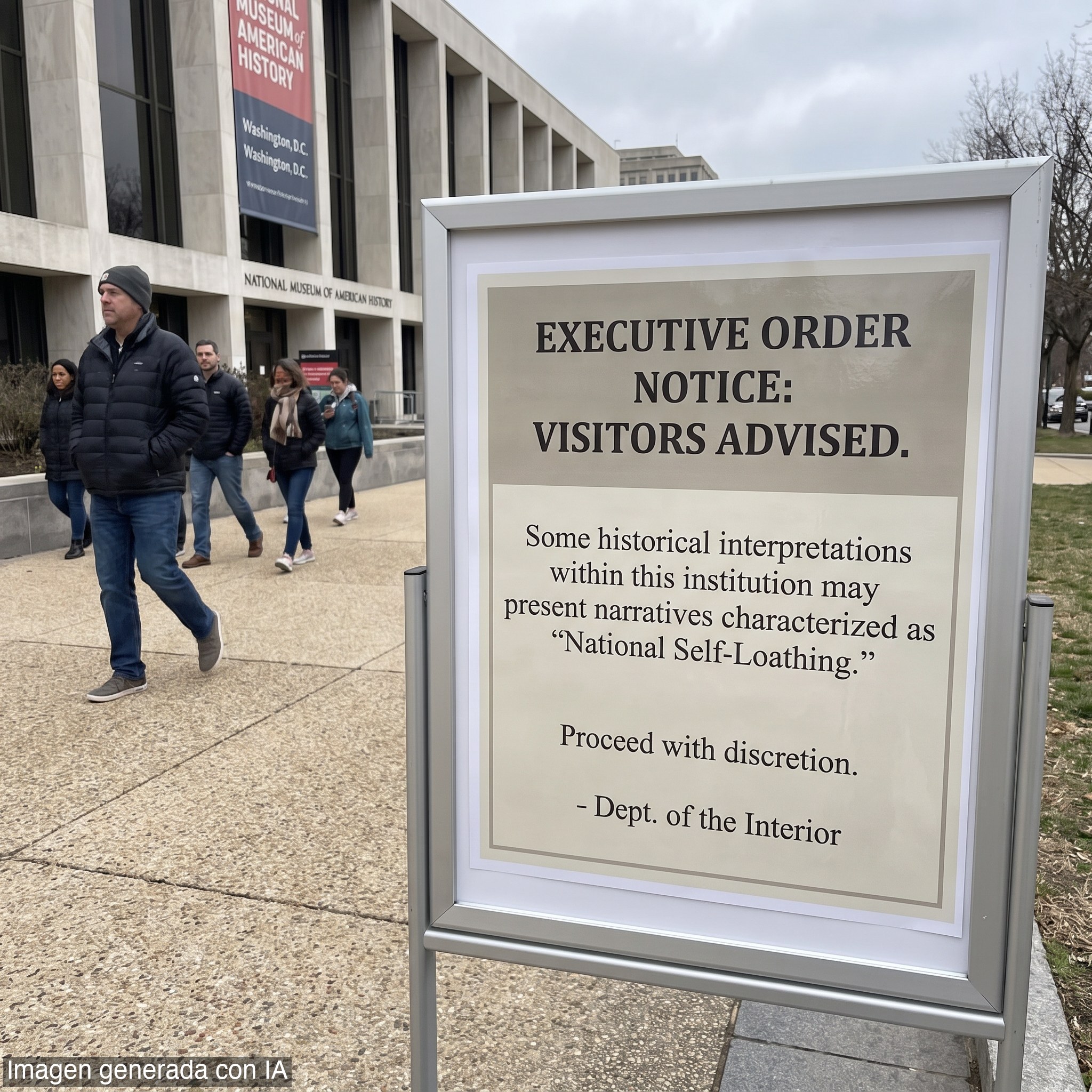
Washington, D.C. — President Donald Trump signed an executive order Friday directing Interior Secretary Doug Burgum to erect warning signs on National Park Service-controlled sidewalks and walkways leading to the Smithsonian's National Museum of American History.
The signs, whose exact wording has not yet been released, are intended to alert visitors to White House objections about the museum's historical framing and to direct them, in the order's language, 'to locations and resources for accurate information regarding America's history.' No timetable for installation has been announced.
A dispute over framing
The executive order followed congressional hearings this week in which museum director Anthea M. Hartig was questioned by Republican legislators. Right-wing professor Matthew Spalding characterized the Smithsonian's approach as 'national self-loathing.' Hartig pushed back directly during the hearings: 'When historians talk about reframing a traditional narrative, we don't mean erasing it. We mean adding the evidence, the voices, the objects that earlier tellings left out so that more Americans can see themselves reflected in the national story.'
Earlier this month, Trump's Domestic Policy Council released a report accusing the Smithsonian and its National Museum of American History of presenting history that is not 'inspiring, unifying, and worthy of our great republic.'
The limits of executive reach
Because Trump lacks the authority to order direct changes to the Smithsonian's exhibits — the institution operates under a congressional charter with significant independence — the White House targeted the outdoor walkways maintained by the National Park Service, which falls within executive-branch jurisdiction. The move echoes Trump's earlier effort to rename and install new signage at the Kennedy Center.
The tactic is legally narrow but symbolically pointed: the administration cannot rewrite the museum's placards from the Oval Office, so it is planting its own placards at the door.
CEO Times take
The numbers here are not financial — they are civic. A federally chartered institution that receives taxpayer support carries an obligation to present history that is honest, complete, and yes, worthy of the republic that funds it. If the Smithsonian's curators have allowed ideological fashions to crowd out the kind of patriotic narrative that unifies rather than divides, the public has a right to know. Warning signs are a blunt instrument, but the underlying principle — that government-funded institutions are accountable to the citizens who pay for them — is sound.
At the same time, the executive order's reach is deliberately constrained by constitutional reality. The administration is working at the edges of its authority, a reminder that durable cultural change in public institutions requires Congress, not just executive orders. The market for American identity is contested, and the White House has placed its bid. Whether voters and legislators back it up is the next move.