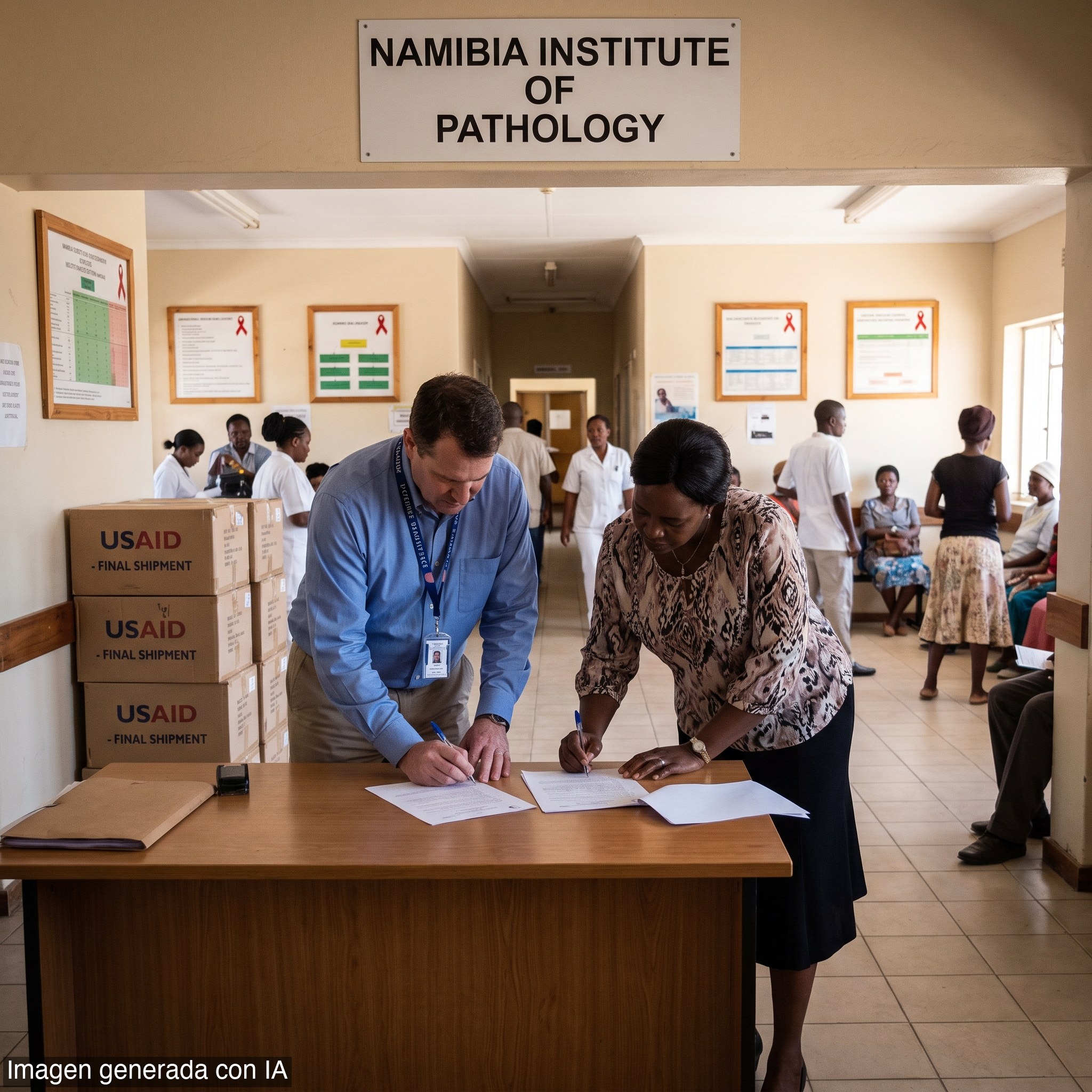
The United States will phase out its direct financial support for Namibia's HIV response, according to a joint statement from both governments. Washington will provide $45 million for fiscal year 2027, after which Namibia will fund its own HIV programs, with the U.S. limiting its role to 'technical cooperation.'
Namibia has received roughly $45 million a year in recent years through the President's Emergency Plan for AIDS Relief (PEPFAR). The U.S. says it has contributed more than $1.1 billion to the country's HIV response since 2003.
The move follows Namibia's rejection of proposed provisions requiring it to share health data and biological specimens with the United States. Namibian officials said the terms, in their original form, were 'not in compliance with Namibia's national laws' and infringed on constitutional privacy protections and national sovereignty over biological resources. The two governments are reportedly negotiating a new bilateral health agreement.
The Trump administration's 'America First' approach to foreign aid has produced country-by-country agreements with roughly 30 nations, most in Africa, that the White House says will cut donor dependency, boost domestic financing and protect American interests. The record has been mixed: Ghana rejected a similar proposal over sensitive health-data access, Zimbabwe withdrew from a $367 million package over the same concerns, Zambia has objected to data-sharing demands, and a court challenge has frozen Kenya's $2.5 billion agreement.
The joint statement noted Namibia has already surpassed UNAIDS targets, with 96% of people living with HIV aware of their status, 98% of those diagnosed on treatment, and 98% of those treated achieving viral suppression. Officials said the HIV response will be 'fully integrated into Namibia's sustainable national health system, in line with Namibia's national laws.'
The Namibia decision follows a similar move on South Africa, where the U.S. is phasing out more than $400 million a year in HIV support under a broader PEPFAR drawdown. PEPFAR is widely credited with saving more than 20 million lives over its 20-year history.
For two decades, American taxpayers underwrote foreign health ministries with few strings attached and even fewer exit ramps. That model is now being retired. Namibia's own numbers — 96% diagnosed, 98% treated, 98% suppressed — make the case that a program built to reach self-sufficiency has done exactly that, and a permanent subsidy was never the point.
Windhoek's refusal to hand over biological specimens and health data as a condition of aid is also a sovereignty story, not just a budget one. A government that will not trade its citizens' genetic material for a check is asserting the same principle Washington claims for itself: foreign money should not come with a demand for control. The Trump administration's insistence on country-by-country deals, however uneven the results in Ghana, Zimbabwe or Kenya, at least forces that trade-off into the open instead of burying it in perpetual appropriations.