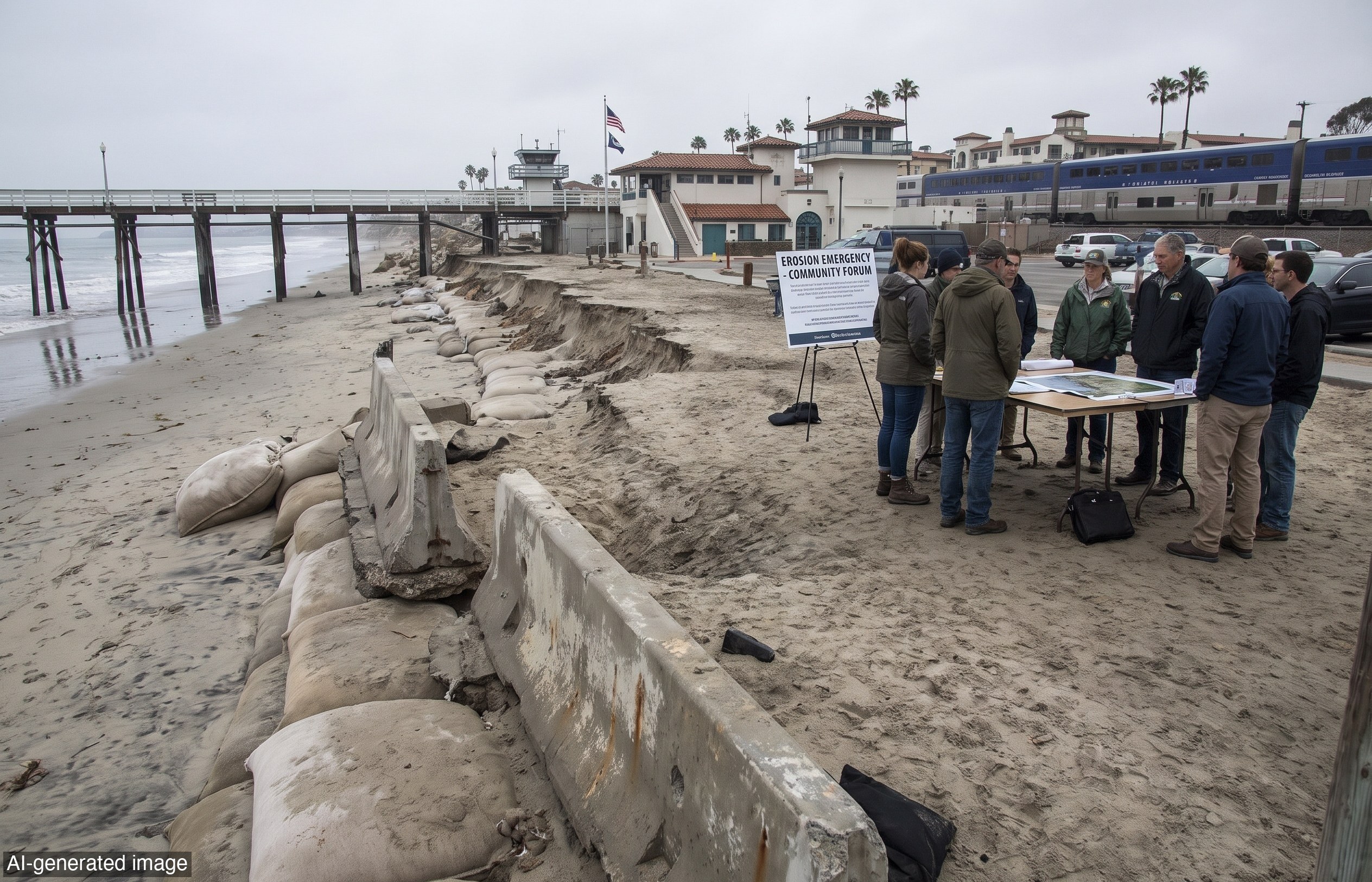
San Clemente is running out of beach and running into a bill.
Coastal erosion has pushed the shoreline landward in the Southern California city, splitting North Beach, damaging oceanfront homes and forcing repeated closures of a passenger rail line that runs along the coast. The city, which has 62,000 people, is now considering a 1% sales tax on the November ballot to fund wildfire protection and sand replenishment.
City Manager Andy Hall said San Clemente faces a sand deficit of about 3 million cubic yards. He added that trucking that much sand would require 300,000 trips. Darrell Johnson, chief executive of the Orange County Transportation Authority, said officials still face permit hurdles for moving more sand and that they may eventually study relocating the trains inland, an idea previously deemed too costly.
The erosion has altered daily life for residents. Cameron Cosgrove, who wrote the tax measure, said the city has 'lost our walkable beach.' He said people used to walk from North Beach to the pier and down to the south end of town, but cannot do that anymore.
Transportation officials have tried to protect the rail line by laying down rock, but the effort has had side effects. As waves slam against the rocks, they sweep more sand offshore and speed up erosion that could threaten the line again. The 7-mile segment is part of a 351-mile passenger rail corridor linking San Diego with Los Angeles County’s port complex and San Luis Obispo, and it is also used by freight and the military.
Opponents of the measure want sand without the tax and argue that San Clemente should work with other communities on a regional approach. City Councilman Zhen Wu, who opposes the measure, said: 'Fighting Mother Nature is very expensive.'
The town’s beach problem is part of a wider California pattern. The story cites scientists who have warned for years that more than half of Southern California’s beaches could significantly erode by 2100. It also notes that California is bracing for flooding and landslides ahead of an expected super El Niño.
What San Clemente is facing is a familiar public-policy trap: a natural problem that becomes a taxpayer problem once government and local leaders decide to preserve the asset in place. Capital, property and infrastructure all sit on the same shoreline, and when the sand disappears, the bills do not.
The market has already voted against easy fixes. Moving sand at this scale takes permits, money and time; moving rail inland was already considered too costly; and doing nothing leaves homes, trains and local commerce exposed. If residents approve the tax, they will be choosing to finance a defensive line against erosion. If they reject it, the coastline will keep sending the invoice anyway.



