The numbers come first. Ride-hailing companies in emerging markets are facing a squeeze. In Southeast Asia, apps grew ridership mainly by selling cheaper rides, so trips grew faster than the money spent on them. In July, Indonesia's government capped the commission platforms can take on motorbike rides, leaving them with less of each fare. For investors and operators, that is a regulatory cut into margins, and it has made the question of where to grow more urgent.
According to analysts Anthony Fox and Marco Fengler of World Data Lab, the answer depends on addressable market size. Household surveys in India and Mexico show families moving from motorbike rides to car rides once their household spends about $1,200 a month, or $300 a person, at today's market prices. By 2036, some 850 million more people in emerging markets are projected to spend more than $300 a month, making them the likeliest new customers for car rides. About half will live in India and China, with Indonesia, Vietnam, the Philippines and Bangladesh adding another 125 million.
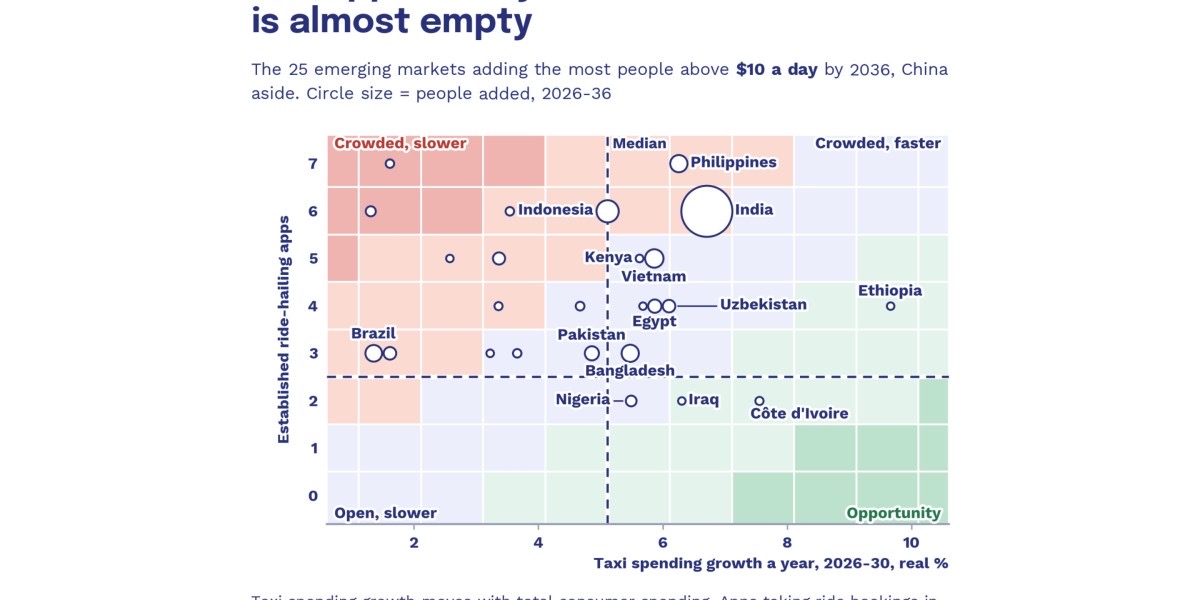
The catch is that nearly nine in ten of those future customers will live in markets where at least three established apps already compete. Of the 25 emerging markets adding the most new customers, only Iraq, Nigeria and Côte d'Ivoire have fewer than three established apps in their largest city. Kenya's taxi spending should still grow by almost 6% a year, yet five apps already take bookings in Nairobi, while Ethiopia, the fastest grower of the 25, already has four.
The open markets are too small to matter much. Namibia, Botswana and Mozambique will add about 2 million people spending more than $300 a month by 2036, compared with 35 million in Nigeria, Egypt, South Africa and Kenya combined. Entering uncontested markets buys a firm little addressable demand.
There is one sizable opportunity inside the crowded markets: growth beyond the capitals. Outside China, the biggest cities will add the most, about 118 million people by 2036, but smaller towns will grow fastest. Secondary cities such as Patna in India or Can Tho in Vietnam are expected to more than quadruple their customer numbers from a small base.
A crowded market is also worth more than its rides alone. Restaurant spending in emerging markets is projected to double to about $3 trillion a year by 2036. Gen Z already puts 6.1% of its budget into eating out and 3.3% into ride-hailing, against 5.5% and 2.6% for people aged 45 to 64. By 2036, nearly two in three Southeast Asians spending at least $300 a month are expected to buy goods online, up from about half, and many will order dinner through the same app they use to get home. The platform that owns the commute can capture the dinner order too.
The market has already voted on whether these economies are worth fighting for. Rising incomes are doing the rest. In India, the Philippines and Brazil, the share of households paying for a car ride rises from about 4% in the lower middle class to around 20% among the rich, so riders spend more as they get richer, not just because there are more of them.
This is where the free-enterprise reading matters. The cheap rides that look like a price war are, on this analysis, customer acquisition for a future premium product. Capital rewards clear rules and durable customer relationships, and the apps that keep budget riders loyal as their incomes cross the $300 threshold will be the ones that trade them up. The Indonesian commission cap shows how quickly policy can shift those economics, and investors should weigh that regulatory risk alongside the demographic tailwind.