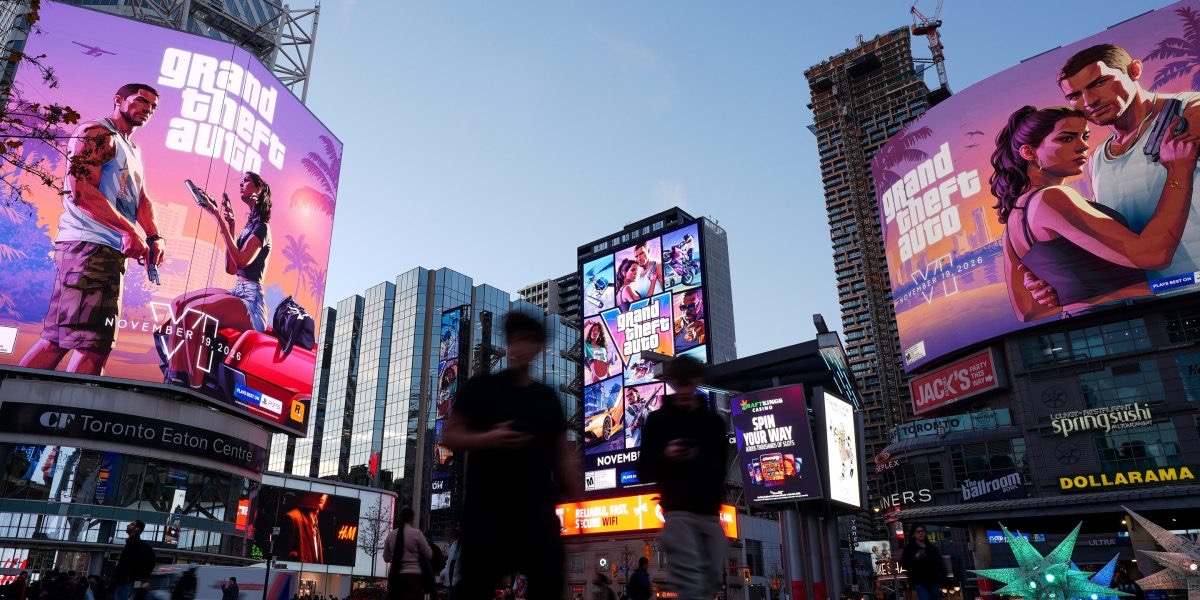
Grand Theft Auto VI, on track to be the biggest entertainment launch of any kind, was made the old-fashioned way. Take-Two Interactive CEO Strauss Zelnick said in February that generative AI has 'zero part' in what Rockstar Games is building. 'Their worlds are handcrafted,' Zelnick told GamesIndustry.biz. 'They're built from the ground up, building by building, street by street, neighborhood by neighborhood.'
That craftsmanship came at a steep price. Analysts estimate Take-Two spent more than a billion dollars on the game, which arrived more than 13 years after its predecessor. Zelnick never confirmed the figure but acknowledged the game was 'expensive.' Fortune reported that estimates put the development budget at $1 billion to $1.5 billion, and Brokerage Oppenheimer projected about $1.85 billion in gross revenue in the game's first three days, according to Reuters.
Ben Feder, who ran Take-Two Interactive when Grand Theft Auto IV came out in 2008, now sees a different path. 'Some great creative mind who would have otherwise gone to make a film will make a video game because it's as simple as point and click,' Feder said. He is now managing partner of Tirta Ventures, which invests in AI-native game projects. 'We put our money where our mouth is,' he said.
Feder's core argument is about cost. 'It's going to get harder to justify a $2 billion game in a world where the next best alternative is two orders of magnitude less,' he said. He acknowledged the counterpoint that GTA VI has already recouped its spending. 'What's the argument for not spending another $2 billion on the next one and making it back in a day?' he said. 'That's a valid argument.'
Feder expects AI to shrink the software side of the business as writing code grows cheaper. 'The argument would be that because AI is making software development commoditized, and software points to zero, it becomes much more about entertainment than it does about both entertainment and computer science,' he said.
He also expects a flood of new titles, with only a small share breaking through. 'I don't know how many billions of minutes of video have been on YouTube, but how many of them actually are good? How many of them actually get traction?' he said. 'But the ones that do get traction and are good reach billions of people, literally, and can create enormous outcomes, both creatively and commercially.'
Feder does not believe the flagship franchise is at risk. 'I don't think GTA is going anywhere. In fact, it probably goes from strength to strength,' he said. 'But that's not to say it's going to get created in the exact same way that it got created here.'
The market has already voted on the old model's scale. Capital rewards clear returns, and a game that repays its budget in a day is hard to argue with. Yet the same dynamic that lets a single hit dominate also concentrates risk. Feder himself noted that big publishers have long bet on fewer, bigger titles, a strategy he says Take-Two pioneered during GTA IV.
For the American consumer and the investor, the lesson is that lower barriers to entry can broaden competition, but they rarely produce a fairer distribution of rewards. Free enterprise works best when new entrants can reach customers without permission from incumbents. Whether AI tools deliver that, or simply let the largest platforms capture more of the value, is the question the next release cycle will answer.