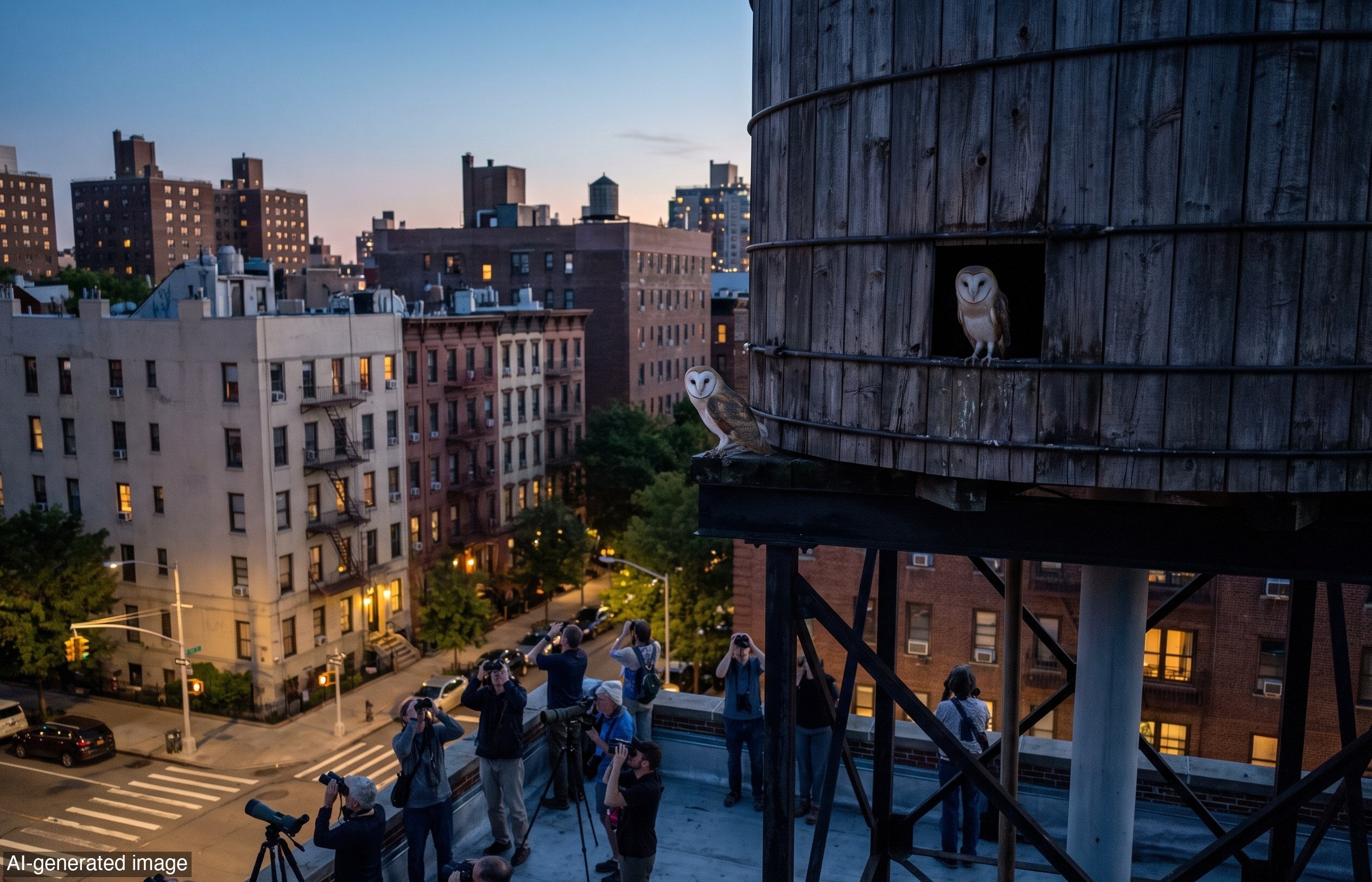
A rare family of barn owls has made its home in a water tower on Manhattan’s Upper West Side, drawing crowds of curious New Yorkers near Central Park.
The birds are nesting atop a building on West 75th Street, and one expert says this is the first documented instance of barn owls nesting in Manhattan in modern history. Andrew Farnsworth, a migration ecologist at the Cornell Lab of Ornithology, called the discovery 'totally shocking' and said that, to the best of the collective birding knowledge, there had not been a nest in Manhattan in recorded history.
Word spread after Elisabeth Williams, an Upper West Side resident, told a local news outlet on Oct. 6 that she and her husband had seen multiple owls at the water tower. She said the couple had first seen a single owl on an apartment windowsill days earlier.
'In a place like Manhattan, you normally really have to go out of your way to encounter nature,' Williams said. 'And here it was, just sort of right outside our window.'
The owls have since become a nightly attraction. Photographers and casual onlookers have gathered in the street to try to spot them, and David Barrett, a Manhattan-based birder who runs Manhattan Bird Alert, said he has observed at least one adult barn owl and five fledglings at the water tower. He also said he saw an adult owl carrying rodents back to the tower.
There are believed to be two adult owls, and some photographers have claimed to have seen six fledglings, Barrett added. He called the breeding pair 'special news' because, he said, it is the first time a family has bred in Manhattan in recorded history.
The attention reflects a broader pattern in the city. Residents have previously followed American woodcocks in Bryant Park, mourned Flaco the Eurasian eagle-owl after his death in 2024, and remembered Pale Male, the red-tailed hawk that nested above Fifth Avenue for three decades before dying in 2023.
Barn owl sightings in New York City parks are very rare, according to the New York City Department of Parks & Recreation. New York sits at the northern fringe of the barn owl’s range, and the state Department of Environmental Conservation says the population has declined 'at an alarming rate' over time.
Jessica Wilson, executive director of NYC Bird Alliance, said the owls have generated excitement among birders and non-birders alike because they are nocturnal, secretive, and not commonly seen on the Upper West Side. Val Coleman, a retired New York City resident, said she hoped the birds would hunt at dusk and avoid poisoned rats with rodenticide in them.
The market may have already voted for the birds, at least on the sidewalk. New Yorkers are showing up night after night for a sighting that required no subsidy, no planning hearing, and no public-relations campaign. Nature found a perch, and the city did what cities do best when something rare appears: it watched.
There is also a practical lesson here for any institution that still thinks every outcome can be managed from above. Power leaves a paper trail, but so does life. Sometimes the most memorable event in Manhattan is not a policy rollout or a regulator’s announcement, but a family of owls claiming a water tower and forcing the whole block to look up.