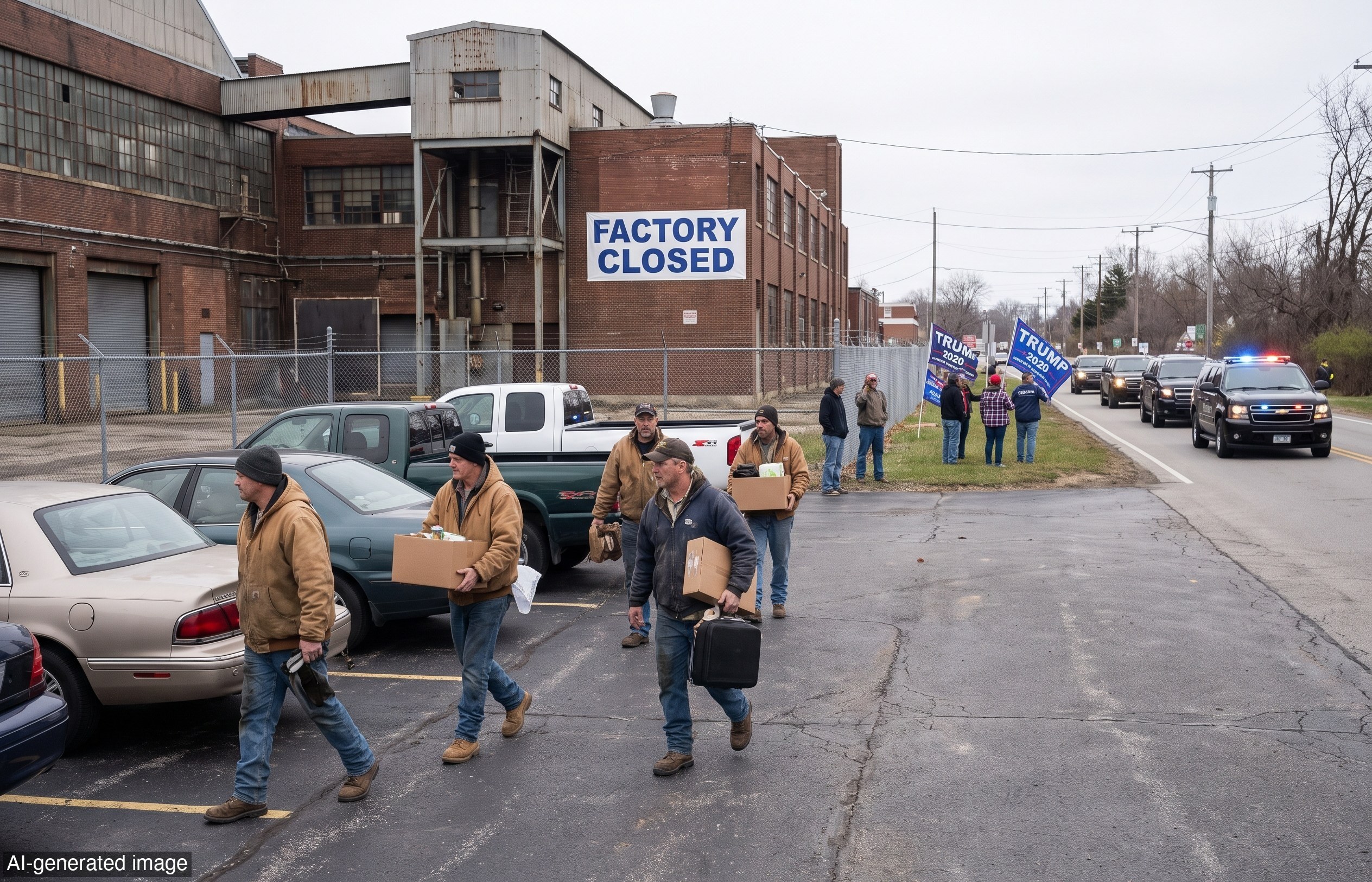
Nearly 1,400 workers were laid off Wednesday at the former Navistar truck factory in southwestern Ohio, just three days before President Donald Trump’s rally at a nearby high school.
The layoffs were large enough to basically erase an entire year of job growth in the greater Dayton area, according to the report. Kyle Bos, 30, who has two daughters and a third child due in January, said the loss hit as grocery prices keep rising and helped push him toward canvassing for Democrats in the final weeks before the November election.
Bos said he had voted for Trump three times, but no longer backs the president. 'Something has to change politically in this country,' he said. 'Seems like it just kept getting worse and worse and worse.'
Trump is making the Dayton area part of a 32-day rally marathon aimed at convincing voters the economy is better than they think. At a truck plant in Texas on Thursday, he said, 'All over the country, they’re building factories, plants — manufacturing’s coming back. The only thing we’re doing badly at is public relations.'
The political stakes are high in Ohio, where Republican Sen. Jon Husted is facing former Democratic Sen. Sherrod Brown. The race could help determine control of the Senate.
The Dayton area has lost about half of its 90,000 factory jobs since 1990, according to federal data, after the North American Free Trade Agreement shifted many jobs to Mexico. That trend accelerated after China joined the World Trade Organization. As steady paychecks disappeared, drug addiction and crime increased, and the area later drew new attention after the 2008 financial crisis.
The local economy has improved in recent years as Wright-Patterson Air Force Base expanded and now directly employs 38,000 people. The base has also attracted new aerospace companies, including Joby Aviation, Sierra Nevada Corporation and Electra. The White House pointed to Electra’s $850 million investment, along with announcements in Ohio from Honda, Stellantis and others, as evidence that Trump’s policies were creating jobs.
But the numbers come first, and in Dayton the numbers still tell a hard story: factory work has shrunk, wages have been squeezed, and political patience is thinning. When a worker who voted for Trump three times starts organizing for Democrats, it is a warning that economic frustration can outrun campaign rhetoric.
Capital rewards clear rules, steady investment and a labor market that can absorb shocks. Instead, workers in places like Dayton are left measuring promises against paychecks. If manufacturing is truly returning, voters will want more than slogans, and they will demand proof in earnings, margins and jobs.