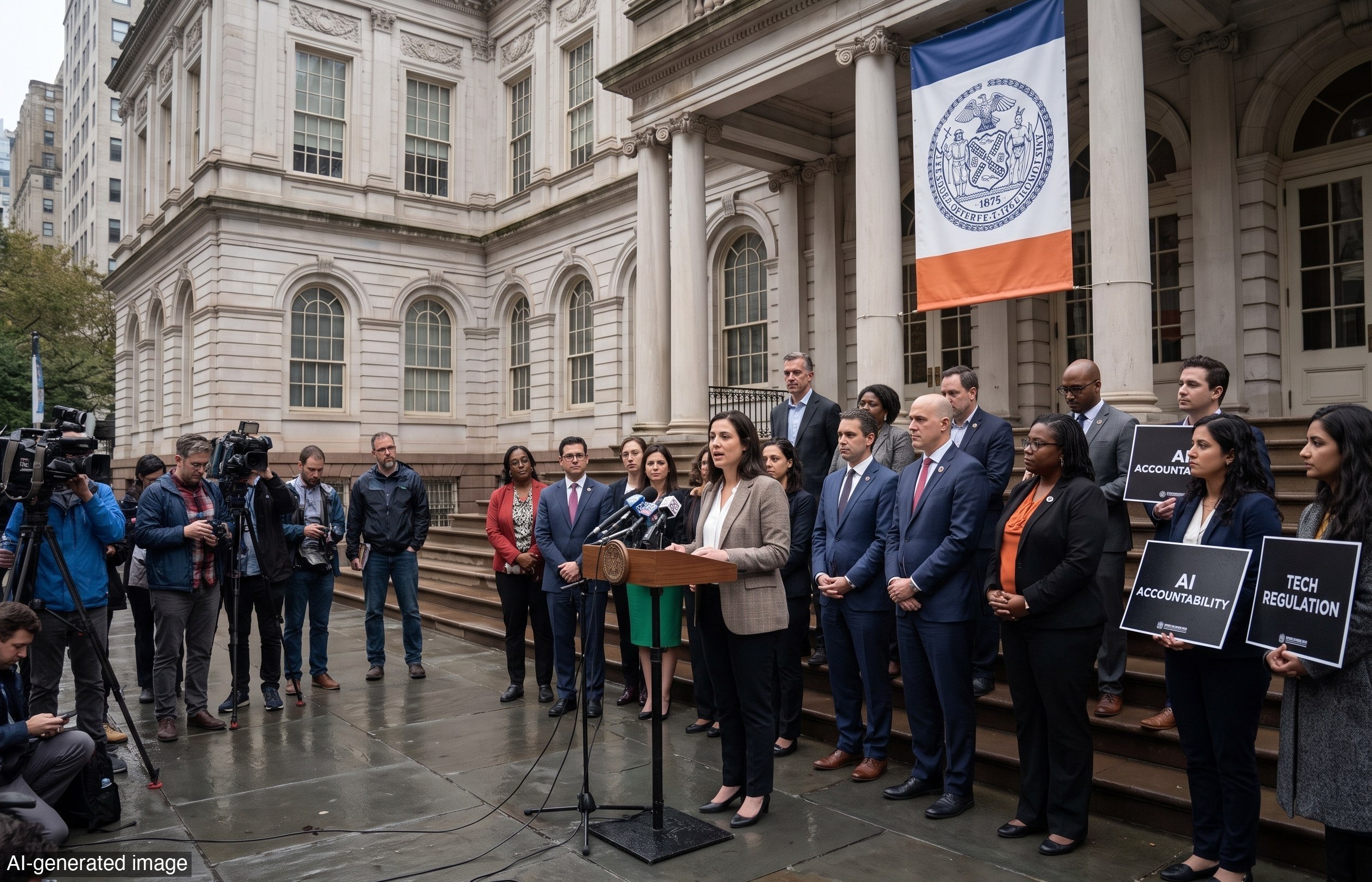
The New York City Council is introducing new AI legislation ahead of an October 5 hearing that could draw the industry’s biggest names into City Hall. The package, unveiled Friday by Council Speaker Julie Menin, would require AI systems sold in the city to pass outside validation and include a kill switch, pay whistleblowers who report violations, and let New Yorkers sue companies when jailbroken tools cause harm.
The hearing is set for the Committee of the Whole, bringing together all 51 council members. The council invited Dario Amodei, Sam Altman, Sundar Pichai, Elon Musk, and Mark Zuckerberg to testify, though sources with knowledge of the hearing told Fortune that none of the five requested CEOs are likely to appear. The council still reserves the right to subpoena them.
Menin framed the effort as a way to protect the public without shutting down business. ‘We obviously are not in any way looking to stifle innovation,’ she told Fortune. ‘We want to ensure that New York stays the AI capital of the world, but with that comes responsibility.’ She added that smart, sensible regulation and guardrails are needed so people can have faith in the product itself.
Menin, who described herself as a regulatory attorney-turned-politician, said the bill is meant to show what cities can do when Washington is slow or absent. She pointed to a Columbia University course she taught, ‘When Cities Take the Lead,’ which examined what happens ‘when the federal government is deregulating or failing to act.’ In her view, AI is a product with very little regulation, even as New York already regulates a wide range of services, ‘everything from barber shops to nail salons.’
The federal backdrop is part of the push. Congress has spent nearly a decade holding hearings on artificial intelligence while passing almost nothing to make it safer. The piece also notes that federal efforts have often been aimed at stopping states from acting, including a 99-1 Senate vote in July 2025 to strip a 10-year ban on state AI laws, and a subsequent Justice Department task force under President Trump that targeted state AI laws.
The companies in question already have major footprints in the city. Google has more than 14,000 employees in New York City, Meta leases 1.2 million square feet at 50 Hudson Yards, Anthropic leased an entire 16-story building at 330 Hudson Street this summer and expects more than 1,000 city employees by year-end, and OpenAI took 90,000 square feet at the Puck Building in 2024.
New York is trying to prove a larger point: that free enterprise and public trust do not have to be enemies. But every new layer of regulation carries a cost, and the market usually prices that cost faster than City Hall does. If the city makes compliance too heavy, the taxpayer and the consumer will feel it first, and capital will look for clearer rules elsewhere.
Still, Menin’s argument is straightforward: if the product is sold in New York, New York wants authority over it. Whether that becomes a model for the country or another cautionary tale will depend on whether the council can draw guardrails without building a wall around innovation.