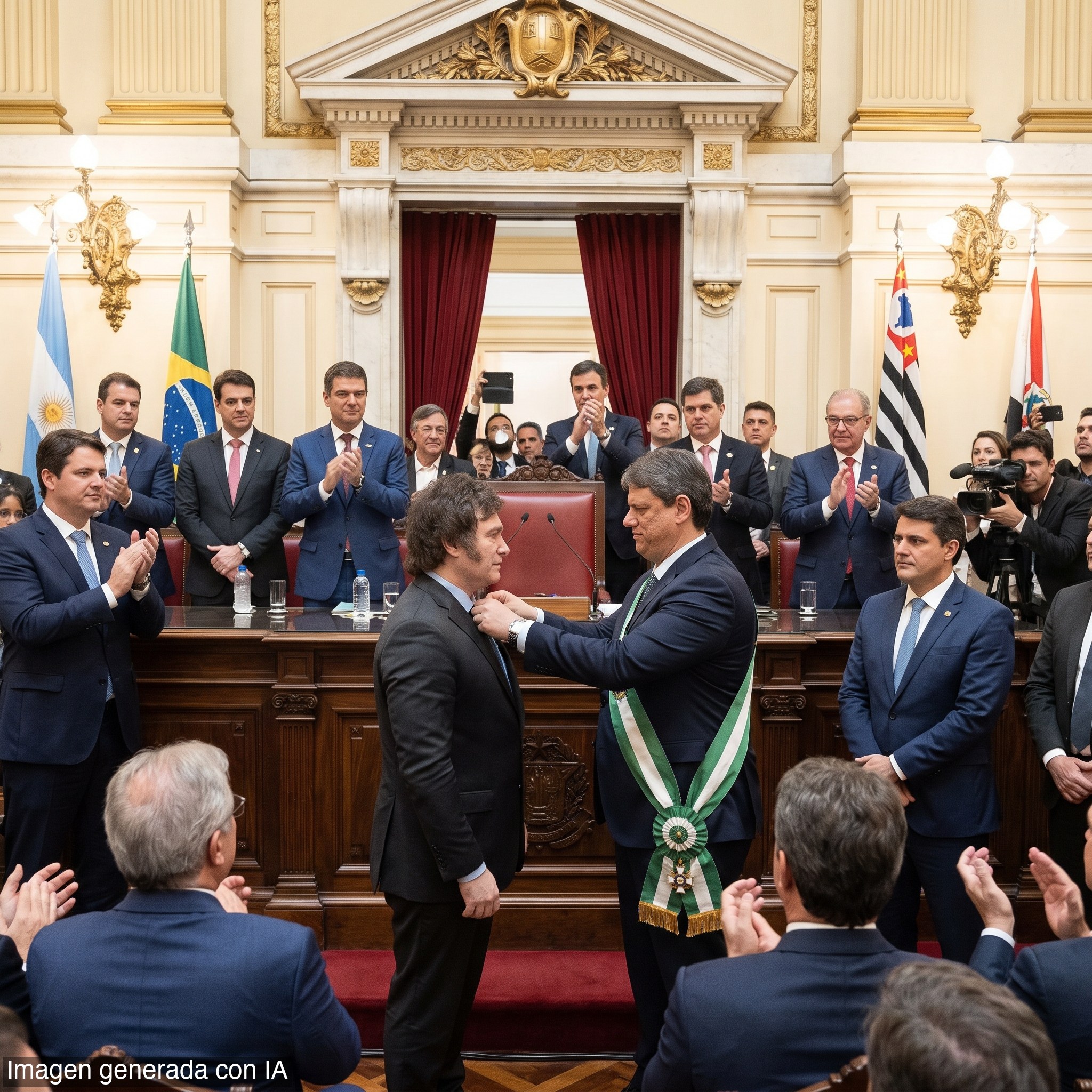
SÃO PAULO — Argentine President Javier Milei arrived at the Palácio dos Bandeirantes on Saturday to a blue carpet — not the traditional red — and left with the Ordem do Ipiranga in the grade of Gran Cruz, the highest distinction the State of São Paulo can confer.
The blue carpet was no accident. According to the host government, the color references what organizers described as the 'blue wave' of right-leaning administrations rising across Latin America, a deliberate inversion of the red carpet historically associated with the left.
Milei was accompanied by Karina Milei, Secretary General of the Presidency, and Foreign Minister Pablo Quirno. Military honors marked his arrival before the bilateral working session began at 9 a.m.
The Brazilian side of the table was notably broad. Governor Tarcísio Gomes de Freitas was joined by his wife Cristiane Freitas, Senator Flavio Bolsonaro of Rio de Janeiro, São Paulo Mayor Ricardo Nunes, and Samo Tosatti, head of the state's International Advisory Office. Argentina's delegation included Karina Milei, Quirno, and Consul General in São Paulo Luis María Kreckler.
The Ordem do Ipiranga — named for the river where Brazil declared independence in 1822 — is awarded by the São Paulo state government to figures deemed to have rendered exceptional service to the state or to Brazil-Argentina relations. Milei is the first Argentine head of state to receive it under the Freitas administration.
The meeting produced no joint communiqué released to reporters before press time, but the optics were deliberate and dense: a sitting governor who is widely considered a leading candidate for Brazil's 2026 presidential race hosting a head of state whose fiscal-shock program has drawn global attention, with a Bolsonaro family member present as an additional signal of continuity with the Brazilian right's national network.
CEO Times read: The numbers come first, but sometimes the ceremony is the message. Milei's São Paulo visit is a piece of regional architecture — free-market governments building the kind of political capital that eventually shapes trade terms, regulatory alignment and investment climate. For multinational capital weighing exposure to South America, a bloc of administrations that share a language of deregulation, property rights and fiscal discipline is a more legible counterparty than a fragmented left. The market has already voted on Milei's reform trajectory; what Saturday's blue carpet signals is that the vote may be spreading. Whether Tarcísio de Freitas translates this symbolic momentum into a presidential bid — and whether that bid succeeds — will determine whether the alignment is a durable regional shift or an elegant photo opportunity.