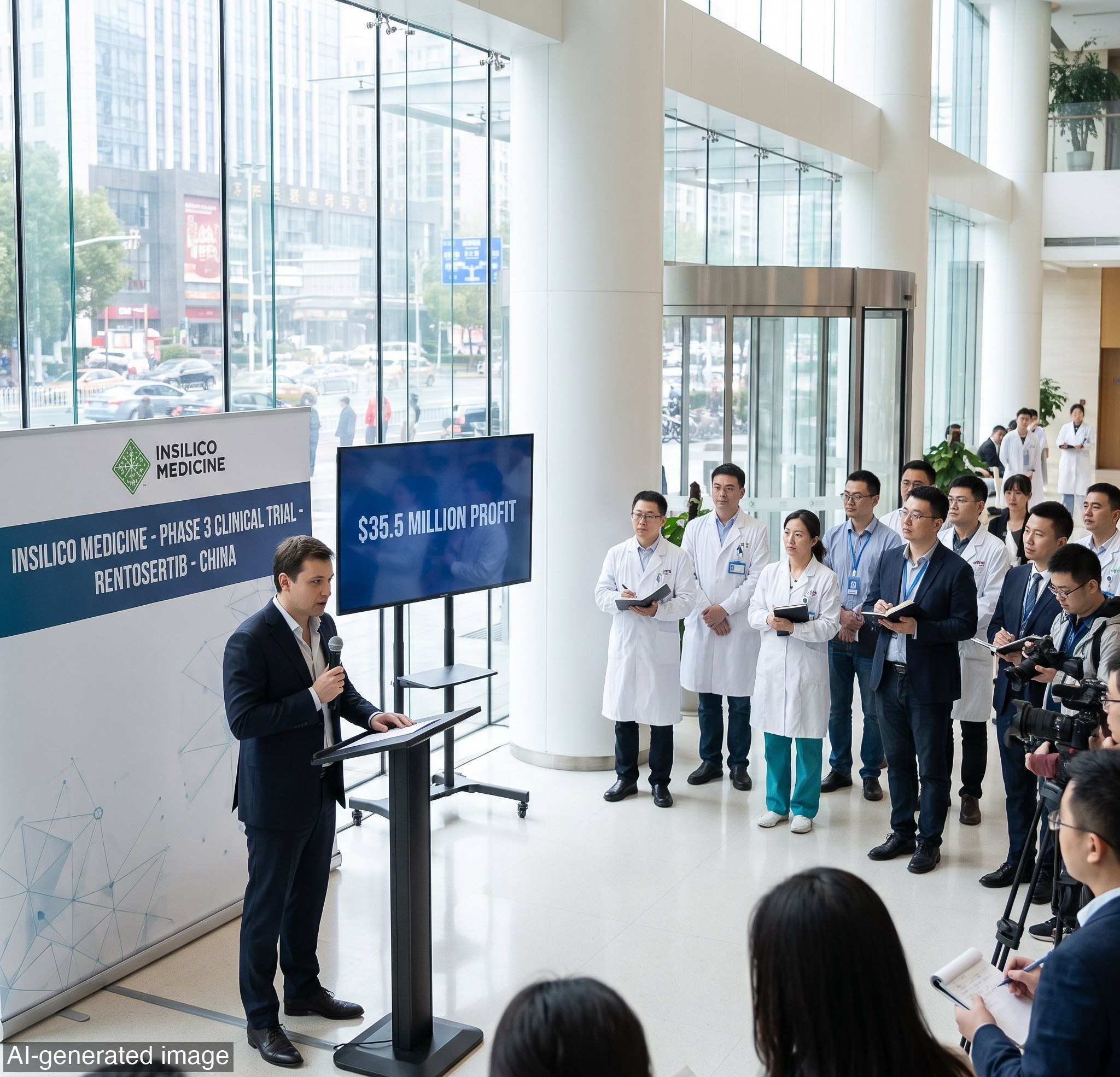
Insilico Medicine says its AI-designed drug rentosertib has entered Phase 3 trials in China, making it the company’s most advanced test yet and a key proof point for AI drug discovery.
The startup says rentosertib targets idiopathic pulmonary fibrosis, a fatal lung-scarring disease that leads to breathlessness and coughing. The first patient in the trial was dosed on Sept. 10. Insilico says it used AI to identify the disease target and develop the molecule, and that this is the first AI-discovered drug to reach large-scale clinical trials.
The company also published a study in Nature Biotechnology on Sept. 7 reporting that some blood samples from 42 rentosertib patients showed signs of reversed biological age. Executives cautioned that the effect was small and may not last over a longer period of time. Co-CEO Feng Ren said at the Fortune Leaders Forum in Macau that aging is related to fibrosis and that stopping fibrosis might offer a chance to stop biological aging.
Insilico is trying to turn that science into a broader platform. On Sept. 17, it launched LongevityBench, a test of large language models’ grasp of aging biology. In a study featured on the cover of Cell, the company said smaller, aging-trained models beat several frontier systems on the new metric.
The broader question is whether AI drug discovery can survive the hard economics of clinical development. Zhavoronkov called that one of the industry’s most consequential experiments, alongside whether China can become a new home of biotech innovation. Insilico was founded in 2014 amid a wave of startups built around using AI to identify disease targets and generate possible molecules.
Much of that early hype faded, and Zhavoronkov said, 'Our cohort is now a graveyard.' He also said he regretted once arguing that 'AI was going to replace medicinal chemists.' But he pointed to a 2019 result in which Insilico’s algorithms designed new molecules and validated them in mice within 46 days.
The company now has rentosertib in Phase 3, another drug for ulcerative colitis in Phase 2, and eight more drugs in Phase 1, mostly for various cancers. It also says it was profitable in the first half of 2026, with $35.5 million in net profit.
China is central to that strategy. Zhavoronkov said Chinese regulators were sophisticated and brought in experts who seemed to know his drug, and other drugs, well. He said regulators focused on measurable improvements in survivability and accepted some uncertainty about safety. The company also noted that China grew its reviewer corps by ten times after 2015, and that average review times fell from 900 days before the reforms to 300 by 2019.
For investors and policymakers, the signal is plain: capital goes where regulation is clear, review times are shorter, and scientific risk is matched by administrative competence. If China can keep that pace, it may win more than a single drug trial. It may win the next chapter of biotech innovation.
The market has already voted on one thing: the old assumption that the U.S. or Europe must lead every frontier no longer holds by default. In life sciences, the race now runs through data, margins, and the willingness of regulators to let productive capital move fast.