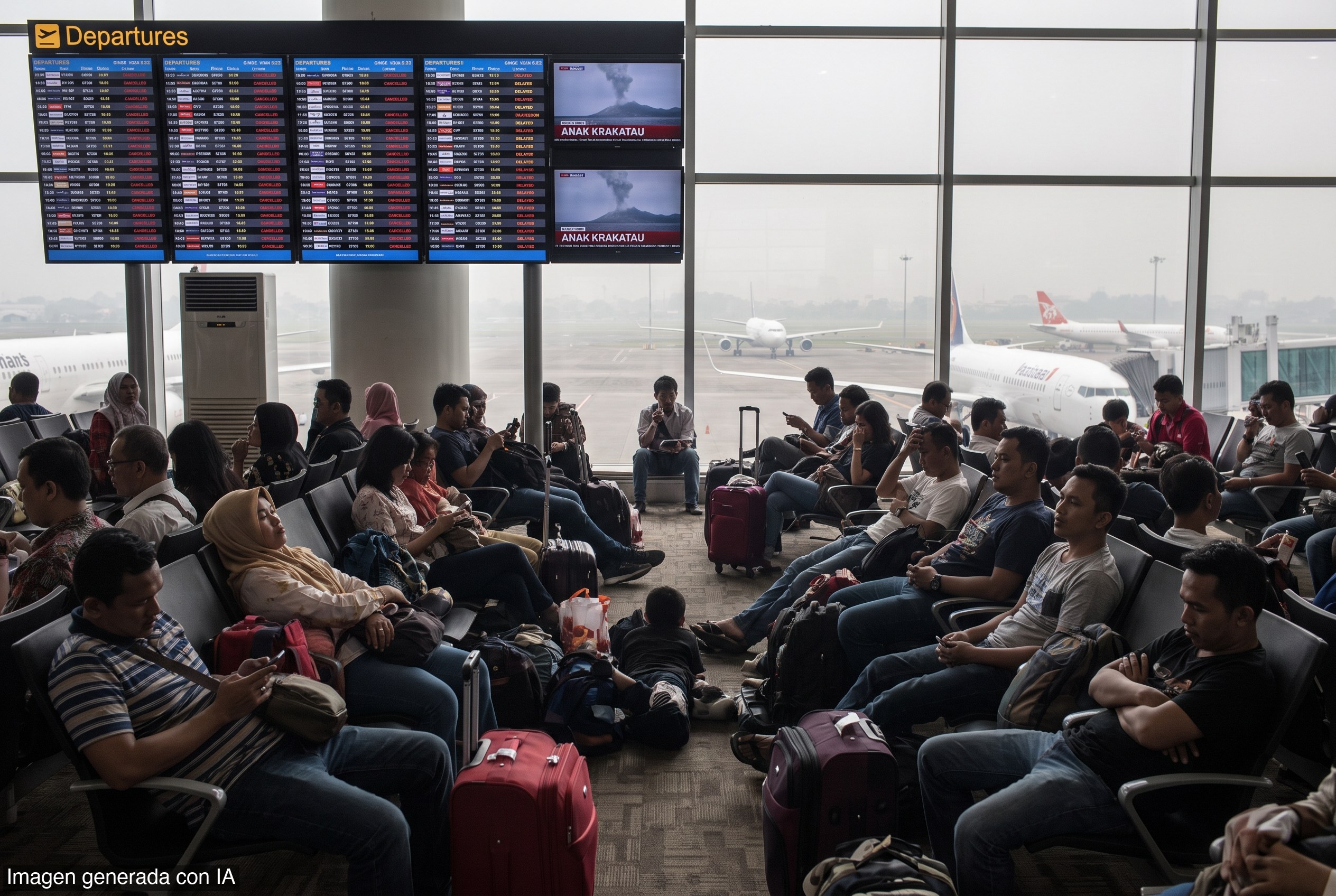
A volcanic eruption in Indonesia's Sunda Strait triggered the cancellation of 1,558 flights and disrupted travel for 170,000 passengers, according to Indonesian aviation authorities.
The volcanic island of Anak Krakatau, sitting between Java and Sumatra, erupted twice early Sunday — first for 30 seconds at 3:53 a.m., then for 16 seconds roughly three hours later, Indonesia's Geological Agency reported. Closed-circuit footage showed lava flares from the crater.
No casualties were reported and no evacuation order was issued. The nearest settlement sits more than 16 kilometers away, though authorities told residents and visitors to stay at least 3 kilometers from the active crater.
AirNav Indonesia closed airspace around eight airports, including Jakarta's Soekarno-Hatta International — where 963 of the canceled flights originated — and Halim Perdanakusuma, along with Radin Inten II in Lampung. All eight were ordered shut until 8:59 a.m. Monday. Services at Bali's I Gusti Ngurah Rai International Airport and Medan were also disrupted.
Satellite imagery from Indonesia's volcanology agency and the Darwin Volcanic Ash Advisory Centre tracked two ash plumes: one rising to 20,000 feet and drifting northeast over Jakarta, Banten and West Java; a second reaching 50,000 feet and spreading over Lampung, Bengkulu, the southern Sunda Strait and waters west of Sumatra.
'It's of course an inconvenience,' said Diego Urdiales, a Spanish tourist stranded en route to Madrid. 'I was supposed to get input from the airline … but so far no news.'
'It's a natural disaster, it's a force majeure, so, what can we do?' said Michele Gouw, an Indonesian passenger. 'We just have to accept it and wait for the airline and airport directions.'
Lukman F. Laisa, the Ministry of Transportation's director general of civil aviation, said in a statement that 'safety remains our top priority in every operational decision,' warning that cascading disruptions to aircraft rotations, fleet availability and terminal capacity could continue as carriers work to restore schedules.
Lana Saria, head of Indonesia's Geological Agency, said activity at Anak Krakatau has intensified since July, with Sunday's eruption the strongest in that stretch. The repeated eruptions point to a continued supply of magma and gas beneath the volcano, she said, though officials cannot forecast whether a larger eruption is coming.
The government also authorized schools in ash-affected areas to shift temporarily to online learning to limit students' exposure.
Anak Krakatau — 'child of Krakatau' — is the offspring of the 1883 eruption that triggered global cooling. A 2018 eruption caused a tsunami that killed at least 430 people after an underwater landslide collapsed part of the island's slope, leaving Anak Krakatau roughly a quarter of its original size.
The numbers come first, and they are stark: nearly 1,600 canceled flights and 170,000 travelers rerouted or stranded in a single day. Yet the response so far has been telling. Indonesian regulators closed the airspace on safety grounds — a legitimate, narrow use of state authority — while the real work of recovery falls to private carriers absorbing rebooking costs, fuel losses and idle aircraft.
That is how force majeure is supposed to work in a functioning market: airlines, insurers and airports bear the shock and restore operations on commercial timelines, not government ones. Capital and logistics, not bureaucratic decree, will determine how fast Jakarta's skies reopen for business.