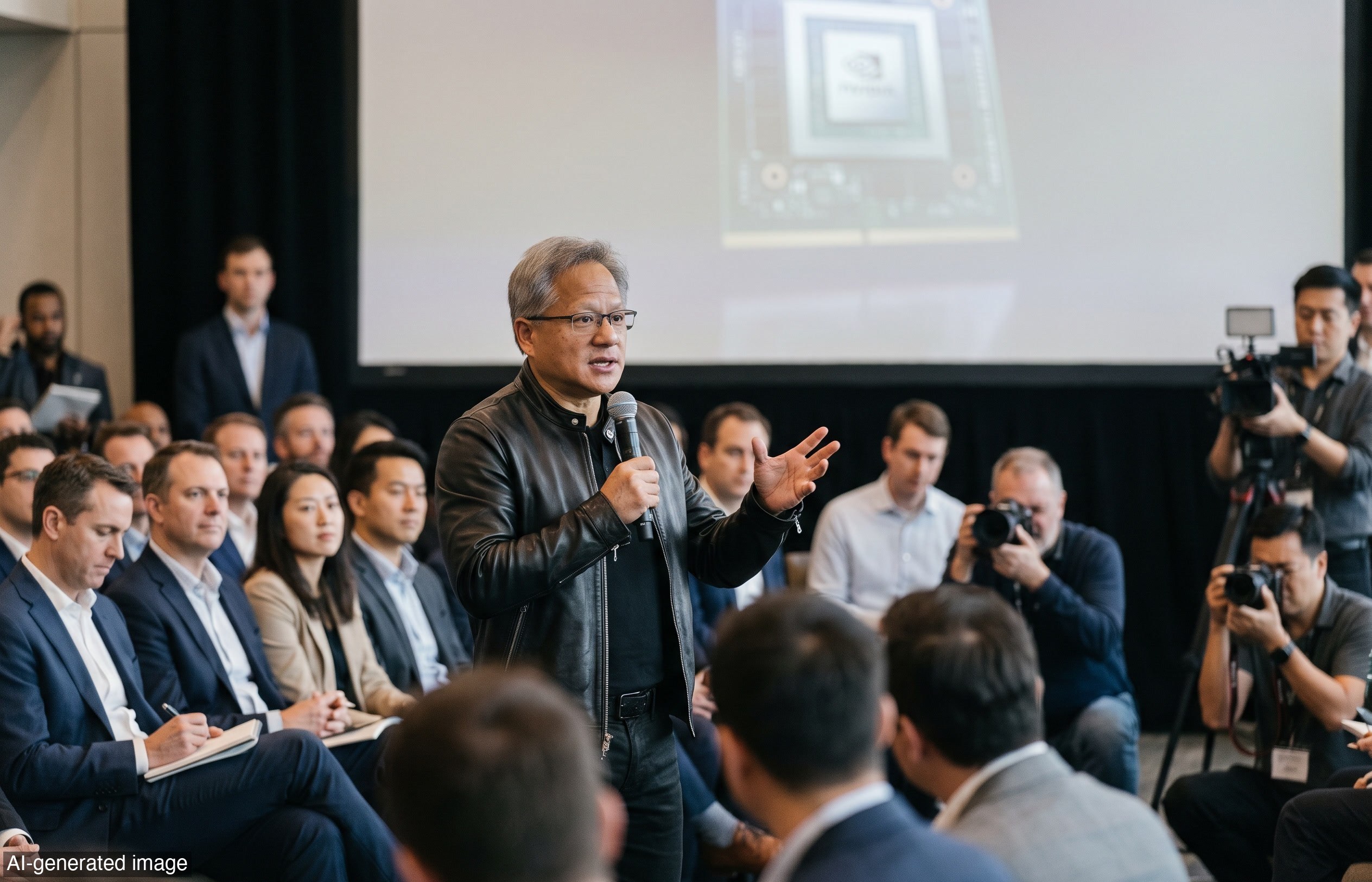
Nvidia CEO Jensen Huang pushed back hard on some of the industry’s loudest warning sirens.
In a CBS Sunday interview, Huang called predictions of an AI catastrophe by 2030 'irresponsible' and said the 'doomsday narratives' are not based in reality. He said, '2030 is not going to be the end of the world' and added, 'There is a 0% chance that’s going to be the end of the world.'
Huang said concerns about AI safety are legitimate, but argued that the industry’s most extreme public warnings are not grounded in 'science.' He said companies should devote engineering resources to safety and verification, while holding AI firms accountable under existing laws and regulations before lawmakers rush to create new rules specifically for AI.
'Go and read between the lines,' Huang said. 'They’re actually not asking for more laws. They’re asking to be relieved of the laws we do have.' He added, 'Don’t let this doomsday narrative cause somebody to relieve them of the laws that currently exist.'
Huang also said, 'I believe the claims of the end of the world, stirring fear across America, and doing it by the people who are doing it makes no sense to me, so they must be doing it for ulterior reasons.' He called that approach 'irresponsible' and said he does not know what the motives are.
The comments land as the AI debate splits some of the industry’s biggest names. Fortune noted that Anthropic CEO Dario Amodei has called for the industry to slow development of capable models and proposed independent safety evaluators. OpenAI CEO Sam Altman has also said society may need time to adapt to new capability levels and the industry should consider ways to slow development.
President Donald Trump has moved in the opposite direction. He rejected calls for increased AI regulation, said existing criminal and civil law can handle AI concerns, and announced an 'AI Force' modeled on Space Force. He also said he would appoint an AI 'czar,' though he named no one and gave no timeline.
For markets, the more immediate fact is that Nvidia sits at the center of the entire boom. The company supplies the chips and processors that serve as infrastructure for advanced AI systems, and its market value has jumped alongside AI demand, making it the most valuable company in the world.
The market has already voted on where this cycle is headed: capital is still chasing compute, not retreating from it. Nvidia’s rise shows how quickly free enterprise rewards the firms that control scarce infrastructure, especially when regulation lags the pace of innovation.
The public debate may continue to revolve around catastrophe scenarios. But the investment case is being written in a different language: earnings power, supply chains, and the ability to scale without the administrative state freezing the field in place.