The numbers come first. Remora says its Syntax document editor is used in classrooms at 40 U.S. colleges and universities, and the company expects four more institutions to start next semester. The founders declined to name any of those schools, arguing that disclosing customers could help larger competitors go after them. Students can also buy the product themselves, starting at $9.99 for three months.
The company's origin is a story about due process. Derin Suzener, now the company's CEO, arrived at Purdue after ChatGPT had been released on Nov. 30, 2022. According to Suzener, he was watching his friends get accused of cheating with AI on their computer science assignments, and 'they would have a pretty hard time proving it, actually.' One friend was called into a half-hour meeting to explain his code. He passed, because he had written the code himself, but the stress lasted longer than the meeting.
Nikita Kravcenko, the company's CFO, said the pitch is simple: 'The guilty are truly proven to be guilty, and then the innocent are exonerated.' Kravcenko, a third-year finance and accounting student, said Turnitin's AI scoring, which reads only the finished text, produced false positives. 'Why not make something that can portray the entire picture of how the work was written instead of just diluting it into a score?' he asked.
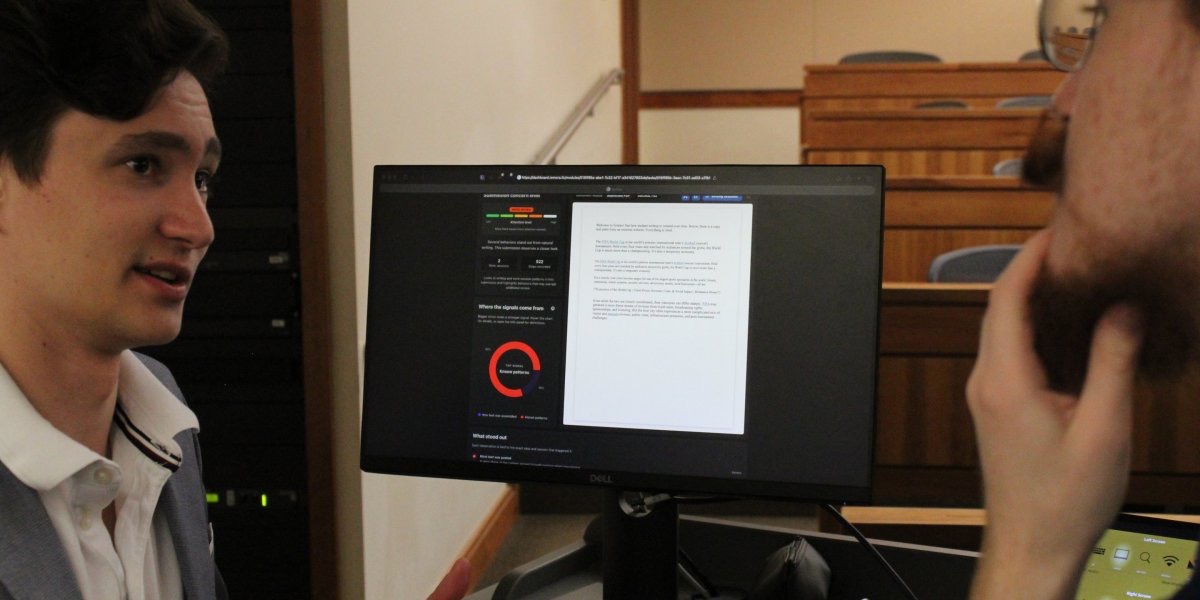
Syntax records typing speed, cursor movement and what gets pasted into a document, then flags anything unusual for a teacher to review. Suzener described the approach through an analogy: text-based detectors such as GPTZero 'train models on human and machine writing and score the finished product,' while Syntax 'look[s] instead to the entire behavioral process that took place to actually arrive at that final text.' He compared it to a CAPTCHA, which checks behavior more than the answer.
The demand is not hypothetical. In a YouGov poll of 2,373 UK students, commissioned by the student-support company Studiosity, 52% named 'being accused of cheating when I did nothing wrong' as one of the things stressing them out, according to a February report in Times Higher Education. The founders say that fear is what their product addresses.
The market has already voted. A four-person team of undergraduates and recent graduates built a product, found paying institutions and set a consumer price low enough for a student to buy it alone. Capital rewards clear rules, and in this case the rule is that a student's own work should be provable.
The editorial reading is straightforward. Schools that rely on opaque detectors carry the cost of false accusations, and so do the students who must spend hours defending honest work. A tool that documents the writing process shifts that burden back toward evidence, and away from suspicion. Free enterprise produced a private answer to a problem that the institutions themselves had not solved, and that is worth noticing.