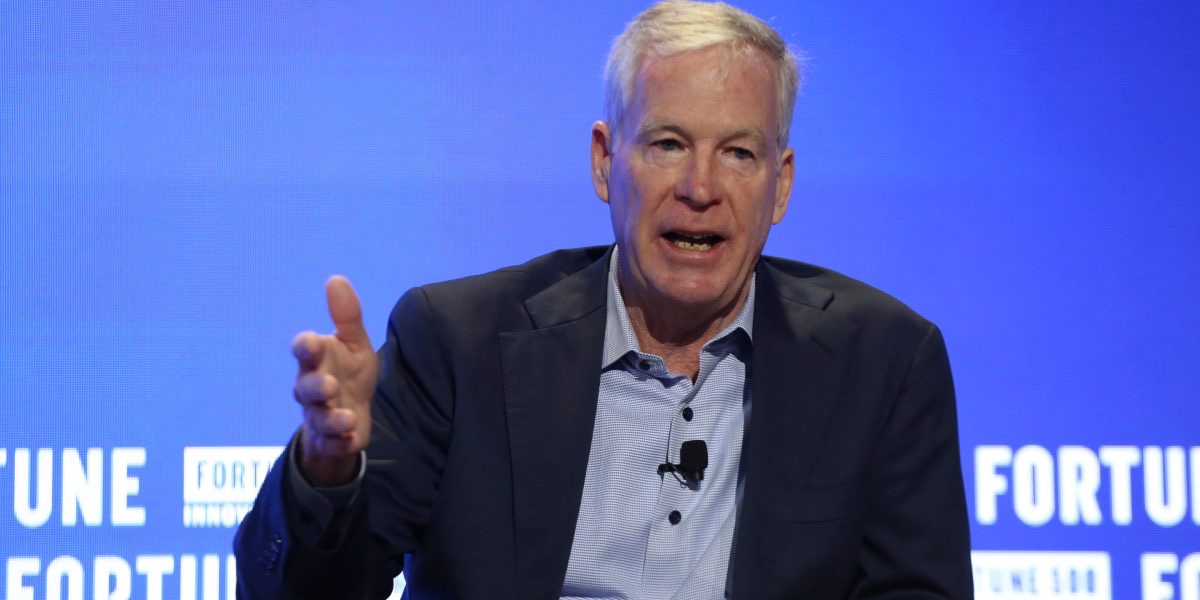
The numbers come first. At the first Fortune 500 Innovation Forum, held in Detroit on Nov. 16–17, Fortune asked a group of the country's top executives a simple question: how many hours do you work a day? The answers clustered tightly. The most common figure was about 12 hours, and no one who gave a daily number reported working fewer than 10.
At the top of the range, Tony Spring, chairman and CEO of Macy's, said he works 15 hours a day. Wendy Anderson, senior vice president of government and global public affairs at Salesforce, said she works '14 to 15 hours a day.' Lynn Martin, president of NYSE Group, put it at '12 hours a day,' while Sherrie Westin, president and CEO of Sesame Workshop, said she works 'a good 12 hours a day.' Ann Fairchild, president and CEO of Siemens USA, described 'probably a 10- or 12-hour workday.' Kraft Heinz CEO Steve Cahillane counted by the week instead: 'Probably 60 to 70 hours a week.'
For John W. Rogers Jr., chairman and co-CEO of Ariel Investments, the day never really ends. 'There's always something to do in the evening,' he said. 'There's always something to do at lunch. There's so much to read in the morning.' Jonathan Mildenhall, chief marketing officer of Rocket Companies, split his 12 hours into 'an hour on my mind, an hour on my body, and 10 hours on my work.' Heather Gerken, president of the Ford Foundation, offered a rare note of candor, saying with a laugh, 'I work way too many hours. It's one of the things I'm working on.'
The advice was equally direct. Several executives suggested keeping your head down. Jason Hoff, CEO of Mercedes-Benz North America, said he tries to stay noticed by 'keeping my head down sometimes and just delivering results.' Martin offered similar counsel: 'Keep your head down and deliver the unexpected.' Others pointed to old-fashioned effort. Ed Bastian, CEO of Delta Air Lines, recommended 'volunteering for those tough assignments that no one else wants to do.' Rogers was blunter still: 'Make sure you show up early, stay late.'
Steelman of Ulta Beauty urged workers to 'work for the job that you want versus the job that you're in.' Fairchild told workers to 'be curious' and 'not be afraid to try new things.' Wendy Tan White, CEO of Intrinsic, tied the whole approach to passion: 'Do great work, and do something you really care about and are passionate about because it will show through.'
The market has already voted on this model. Leadership at the top of American business is not a nine-to-five proposition, and the people running these companies say so plainly. Capital rewards clear goals, measurable results and people who take on the hard assignments nobody else wants. Power leaves a paper trail, and in these accounts the trail runs through long hours, visible delivery and personal accountability rather than through credentials alone.
For the free-enterprise reader, the lesson is less about hours than about incentives. Companies that reward results and let talented people earn their advancement through effort tend to build the productivity that sustains growth. The executives surveyed were not asking for entitlement; they were describing a workplace where merit, not seniority or politics, decides who moves up.