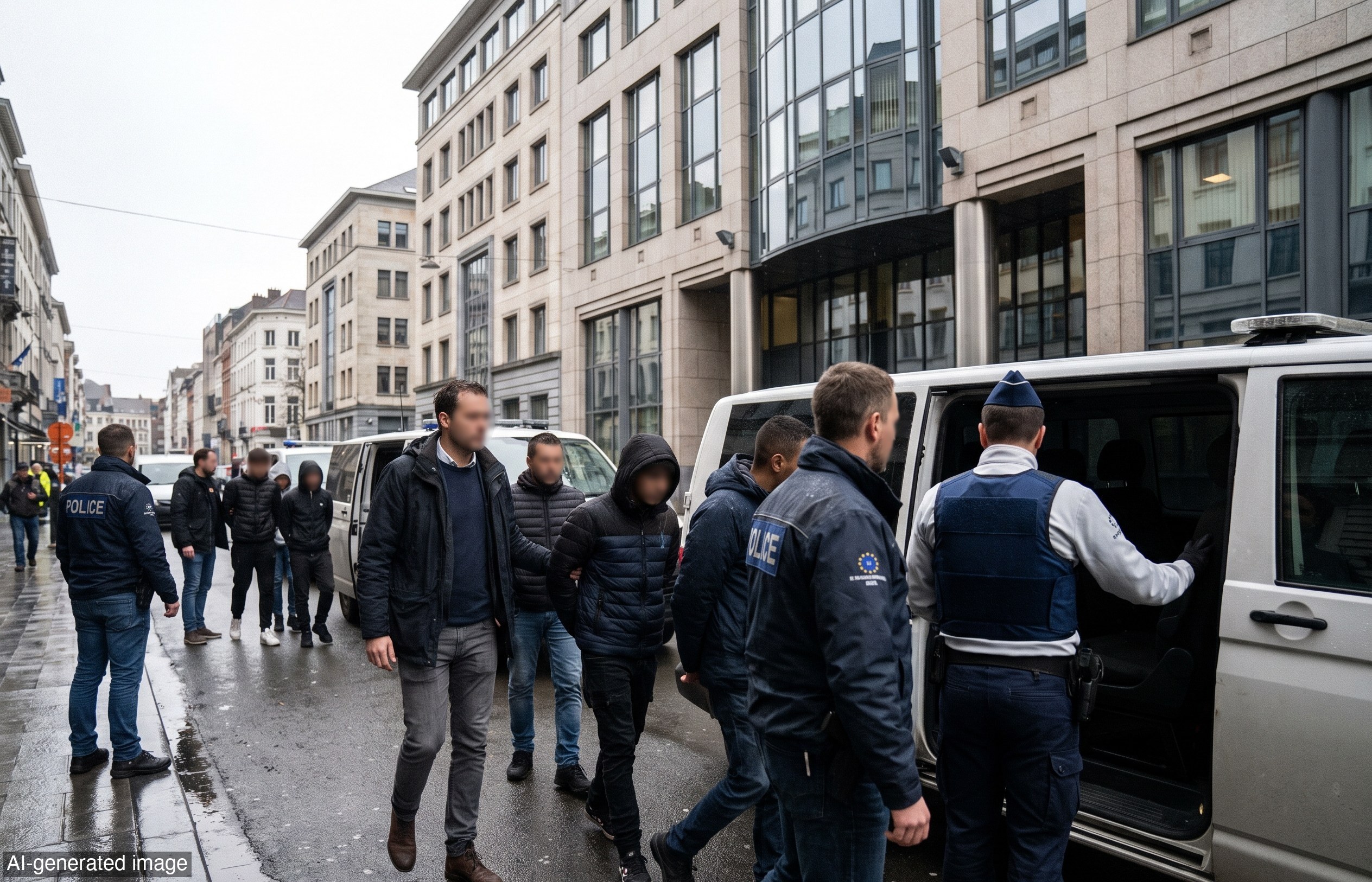
European authorities are warning that the terror threat in Europe is changing shape. The numbers come first: Europol says 486 people suspected of terror links were arrested in 21 EU member countries last year, and around one third were under 18, mostly boys.
The agency also counted 45 terrorist attacks across 10 of the 27 EU countries in 2025, although none were major mass-casualty incidents. About half were foiled or failed, and six people were killed. Jihadist groups, often guided or inspired by networks outside Europe, were behind 24 of the attacks and accounted for more than 70% of the arrests.
But officials say a newer danger is growing online. Police investigators from nine European countries found about 4,340 URL web addresses linked to 'The COM,' the online community behind what authorities call nihilistic violent extremism. Europol does not keep statistics on that category because definitions differ and some acts can fall under ordinary criminality as well as terrorism.
Bartjan Wegter, the EU Counter-Terrorism Coordinator, said the phenomenon is 'violence for the sake of violence.' He told The Associated Press that it is 'very much a fascination with violence' and 'a means of asserting oneself, as a means of gaining status in those online communities.'
The cases cited by authorities show how young offenders can be pulled into digital networks that prize notoriety over ideology. In Finland in 2025, a 16-year-old boy stabbed three female student colleagues. He allegedly shared a 'manifesto' in WhatsApp groups, recorded the attack on Snapchat, and asked on social media for someone to save the video after his release.
In Italy last year, authorities said a 15-year-old boy planned a murder to gain online notoriety. They said he kept images and videos of assaults, murders, school shootings and child pornography on his smartphone.
Wegter said these incidents have been rising for two to three years and are not isolated. He said they are often organized by online networks that are 'often driven by young people, for young people often involving young boys.' He added that they can 'lead to offline violence.'
The threat is also harder to stop because, as Wegter said, many young suspects leave few traces beyond the internet, often behind encrypted walls and communities. He said 85% of investigations take place in the digital environment.
That is the core problem for Europe: the administrative state is chasing a threat that moves faster than its own bureaucracy. A continent built on open systems now faces online networks that exploit that openness, recruit minors, and turn anonymity into leverage.
Capital rewards clear rules, but security does too. When the digital environment becomes too permissive, the cost is paid not by regulators but by families, schools, and ordinary citizens who expect the state to protect public order before violence spills offline.