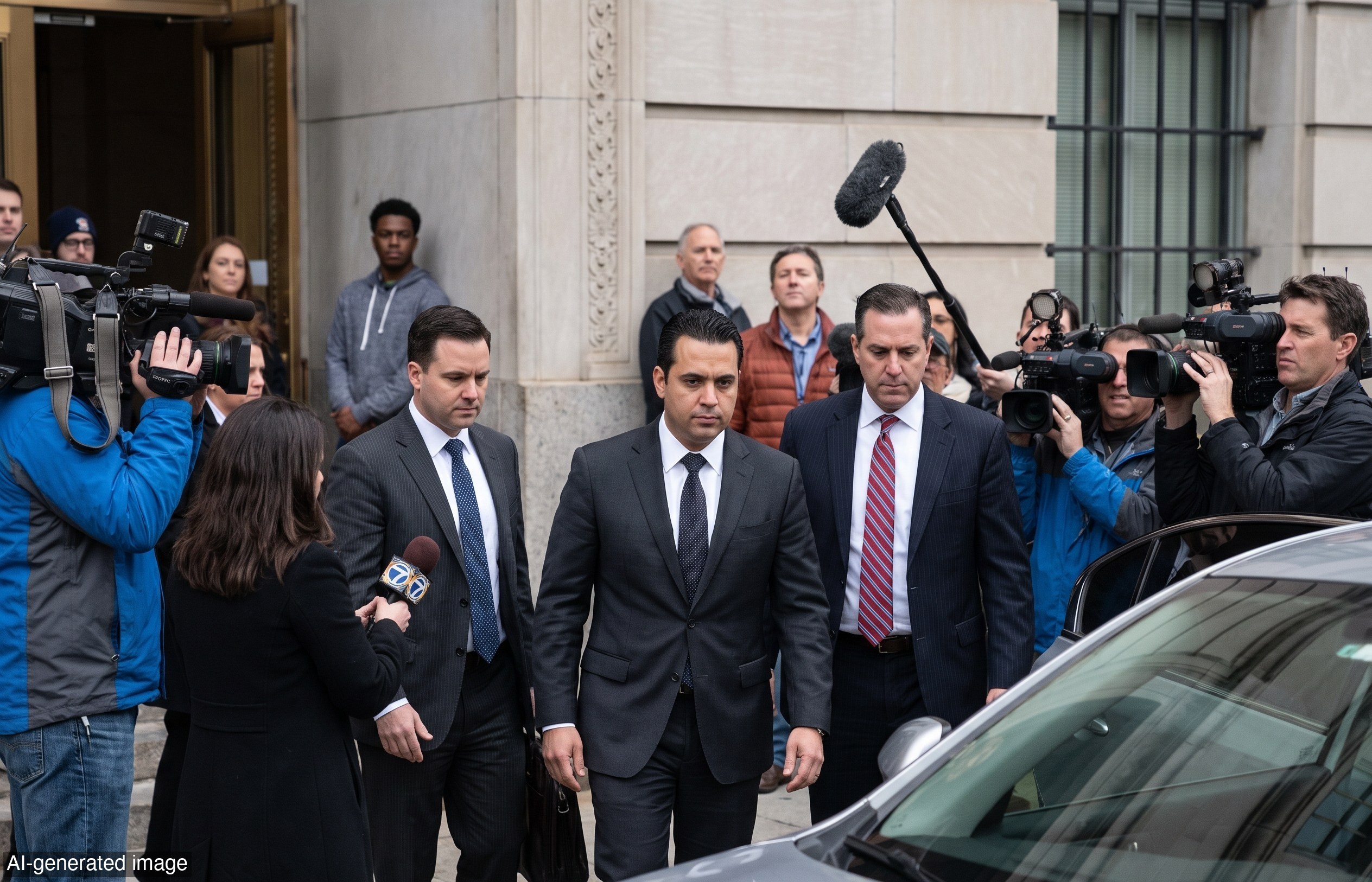
Former U.S. Rep. David Rivera was sentenced Friday to 10 years in prison for concealing a $50 million lobbying campaign tied to Venezuela during the first Trump administration.
Rivera, a former Republican congressman from Miami and longtime friend of Secretary of State Marco Rubio, had been jailed since his conviction in May on conspiracy to commit money laundering and failing to register as a foreign agent for the government of Nicolás Maduro.
Judge Melissa Damian said the case was not about paperwork. She said, 'This is a serious offense. It’s not about not filing a piece of paper.' She also said, 'There’s no dispute this money came from the Maduro regime.'
Assistant U.S. Attorney Roger Cruz told the court, 'The United States and the public were the true victims of this fraud.' He said Rivera 'used his position of trust — and betrayed it consistently and repeatedly.'
Trial evidence showed Rivera created an encrypted chat group called MIA, short for Miami, with his conduit to the Maduro government, Venezuelan media tycoon Raúl Gorrín. According to messages shown to the jury, the group used code words for people and payments: Maduro was the 'bus driver,' Sessions was 'Sombrero,' Rodríguez was 'The Lady in Red,' and payments were called 'La Luz.' Rubio was known as 'Miss Clairol.'
The Associated Press reported that Rivera was tapped by Foreign Minister Delcy Rodríguez to help get the first Trump administration to normalize relations with Venezuela. Prosecutors said Rivera and political consultant Esther Nuhfer sought to manipulate influential friends, including Rubio and Sessions, while failing to disclose the lobbying as required.
Rivera’s lawyers said he believed he was under no disclosure requirement. They argued the three-month, $50 million contract with his one-man consulting firm was focused on luring ExxonMobil back to Venezuela, which they said was commercial work generally exempt from the Foreign Agents Registration Act.
Defense attorney Ed Shohat said, 'David Rivera does not deserve to die in prison because he failed to file a FARA registration.'
The judge rejected that argument. Nuhfer received a five-year sentence. Still pending is the government’s request that Rivera forfeit $20 million in criminal proceeds, and his lawyers have said they plan to appeal and seek a presidential pardon.
The numbers come first. A $50 million foreign influence operation is not a minor disclosure mistake; it is a reminder that capital, lobbying and political access can become a weapon when disclosure rules are treated as optional. Power leaves a paper trail, and this one led straight to prison.
For markets and for the taxpayer, the principle is simple: free enterprise works when the rules are clear and enforced. When a former member of Congress can be accused of hiding foreign money behind consulting contracts, the problem is not just one man’s downfall. It is the corrosion of trust that lets the administrative state, foreign interests and political insiders blur the line between lawful advocacy and paid influence.



