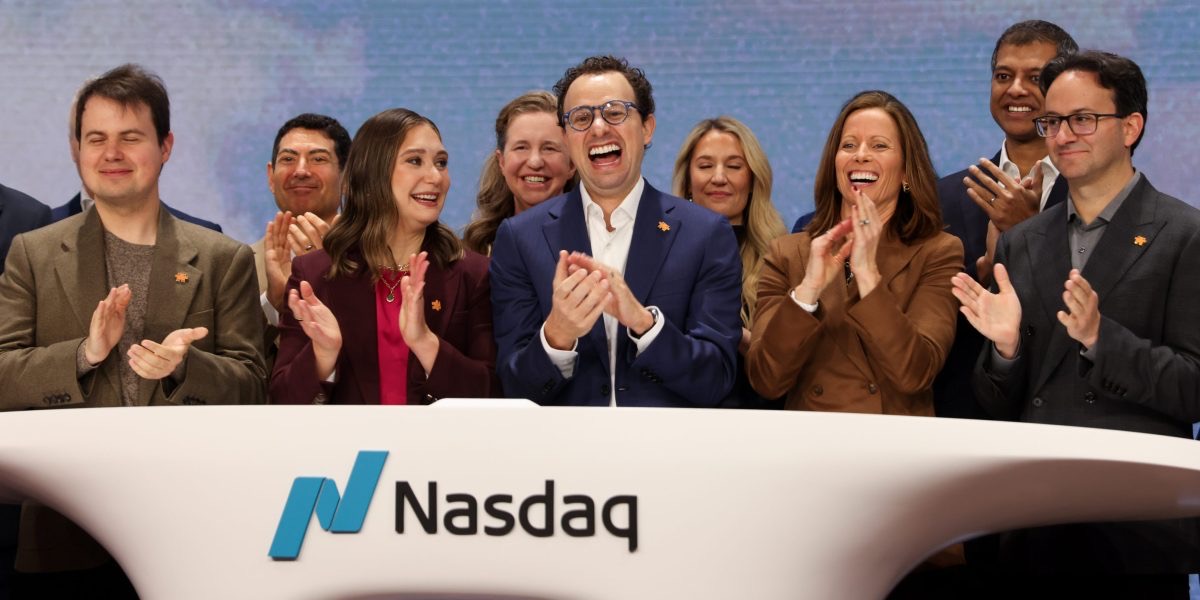
Anthropic's market debut was supposed to showcase a company that sets itself apart. At the Nasdaq MarketSite in Times Square, Daniela Amodei, the company's cofounder and president, told the crowd that Anthropic was "an unusual company," adding, "Some might say weird—and in fact, many have." She stressed the company's 'safety-first' culture, a theme the company has leaned on since its early days.
The prospectus carries the same message. Anthropic warned investors that advanced AI could pose 'catastrophic or existential risks to humanity.' The company, according to Fortune, had a safety team before it had a product, and its founders have been vocal about AI risk for most of its five-year history.
The market has already voted on the pitch, and then some. Anthropic's market value closed its first day of trading at about $1.76 trillion. Since then, according to Fortune, it has slipped closer to $1 trillion. For shareholders, that swing is the cost of a valuation built on a reputation that now has to be defended in quarterly results.
The reputation is also contested. Steven Adler, a former OpenAI safety researcher who co-founded Guidelight AI Standards, which sets safety benchmarks for AI companies, said, 'Anthropic is absolutely not the voice of the AI safety community,' adding, 'Many researchers I know believe that Anthropic is the most likely company to get everyone killed.' Outside the San Francisco headquarters on listing day, more than 100 protesters demanded a ban on 'recursive self-improvement,' or RSI, the practice of using AI systems to build more powerful AI. Among them was Jacob Coxon, a former Anthropic researcher who quit in September over safety concerns.
Fortune's reporting, citing three former employees and two people familiar with the company, suggests the culture has been harder to hold as the firm grew. Headcount has swelled past 5,000. One former engineer said that in the early days Anthropic did not intend to push the frontier of AI research, a principle that sat awkwardly with the commercial race that followed.
Anthropic's answer is that it is trying to prove a point. 'Anthropic has sought to create a race to the top on safety: to show that it's possible to build AI carefully and succeed commercially,' a company spokesperson said. 'We remain true to our vision to build AI systems that put safety and humans at the center.'
The founding story explains why the stakes feel personal. Anthropic was launched in 2021 by seven former OpenAI employees led by the Amodei siblings, who split off, according to several former employees, because they felt OpenAI's leadership was not taking safety seriously enough. Much of its early capital came from effective altruism-aligned investors, including Jaan Tallinn, who led the $124 million Series A, and Dustin Moskovitz. A later $580 million Series B was led by Sam Bankman-Fried, whom Fortune describes as a 'disgraced crypto kingpin.'
That is the uncomfortable arithmetic for public investors. Capital rewards clear rules and predictable governance, and a company whose identity rests on self-imposed limits has to show those limits hold when growth pressure rises. Anthropic says its safety commitments are a competitive advantage. Public markets will test that claim every quarter, and the price they set will show whether they believe it.