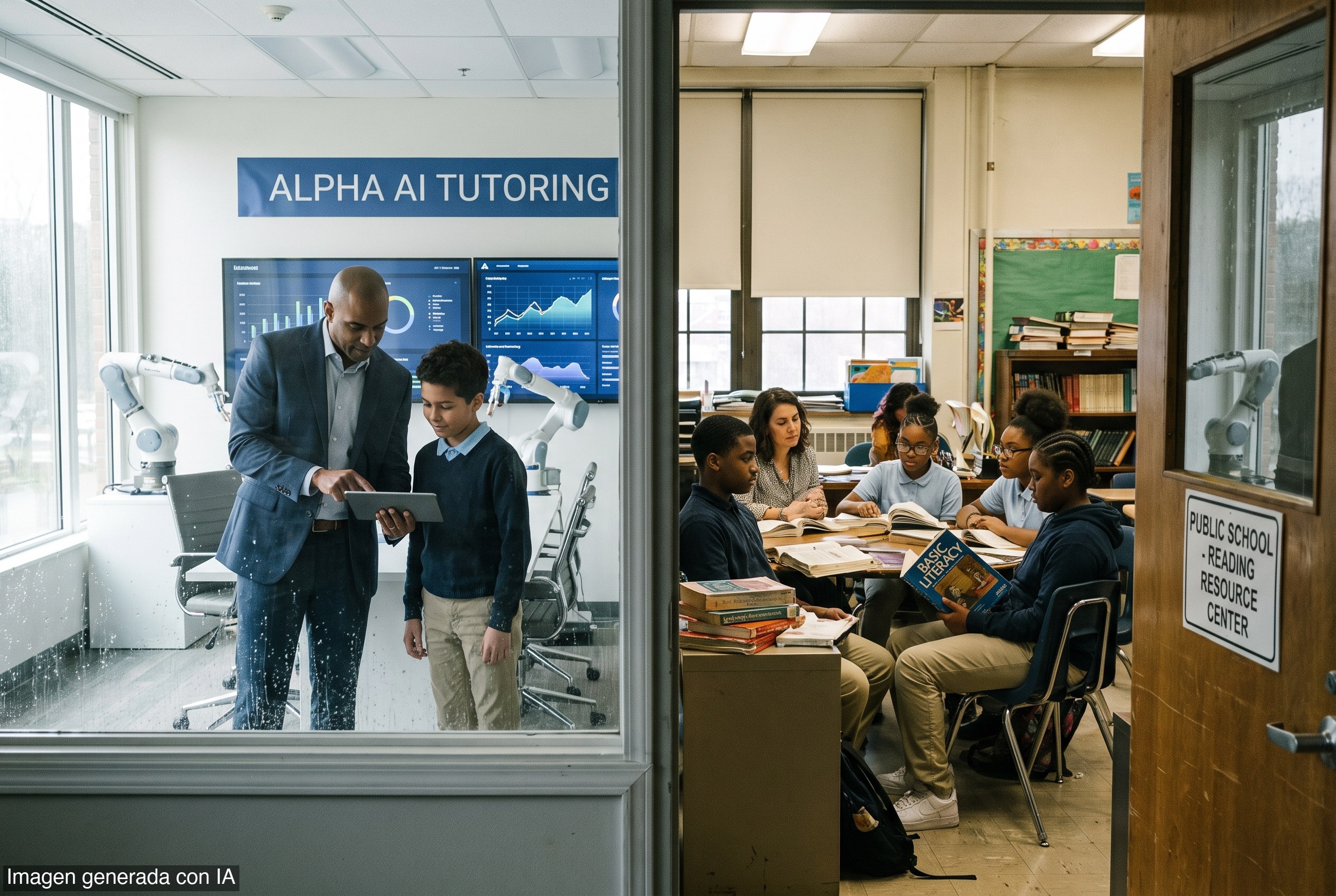
The numbers come first. Alpha School charges up to $75,000 per year per student, has more than 1,200 enrolled, and plans to expand to 50 campuses this year, a spokesperson told Fortune. The model is simple: two hours of daily core instruction with an AI tutor, followed by afternoon workshops on skills like public speaking and relationship building. Human 'Guides' motivate students but do not plan lessons or grade homework.
The families writing those checks are not acting on faith alone. Venture capitalist Sarah Cone, whose 8-year-old daughter attends Alpha School in New York, told Fortune: 'I definitely think using AI well is a skill in the future, if not the skill, so it's kind of a disservice not to have that in school.'
The backdrop for that spending is grim. U.S. students' average reading scores on the Programme for International Student Assessment dropped 14 points to 490 — the lowest since the country began participating in the exam in 2000. Across 38 free-market democracies tracked by the benchmark, scores reached the lowest average ever recorded.
The damage compounds at the college level. Professors have told Fortune that students are arriving unable to process long passages and are leaning on AI summaries instead. Americans between 18 and 25 reported reading an average of 5.8 books in 2025, according to the Fortune source, compared with 12.1 for Americans 65 and older and 8.2 for those between 30 and 44 — a generational gap that carries real cognitive consequences.
The AI policy vacuum in schools is making things worse. According to 2025 surveys cited by College Board, the nonprofit that administers the SAT and AP exams, an estimated 84% of high school students report using AI for homework help, and one in five high schools allow AI use but have no formal policy governing it. A study of 26,811 Chinese students in grades seven through 12 found AI use boosted homework scores by 18% — then tanked exam scores by 20%.
New York City recently announced a one-year ban on student-facing generative AI for children in grades 2-K through eighth grade. Researchers have warned that indiscriminate AI use erodes the cognitive effort required for genuine learning, though intentionally designed tools — such as chatbots that guide students toward answers rather than supplying them — can improve outcomes.
Neuroscientist Jared Cooney Horvath testified to Congress that screen-based learning has distracted students and lowered test scores, stating in the hearing that 'our kids are less cognitively capable than we were at their age.' In separate prepared remarks he added: 'This is not a debate about rejecting technology. It is a question of aligning educational tools with how human learning actually works.'
Huriya Jabbar, a professor of education policy at the University of Southern California, told Fortune that public schools serving low-income students face high teacher turnover and pressure to boost test scores, leaving little bandwidth to build a coherent AI curriculum. 'AI — just like any other tool, technology, curriculum — is going to play out in an already unequal landscape,' she said.
CEO Times view: The $75,000 price tag at Alpha School is not the scandal — it is the market's honest verdict on a public system that has failed to deliver basic literacy while banning or ignoring the tools reshaping the economy. When government schools cannot agree on whether to teach or ban AI, and reading scores fall to historic lows, parents with capital will route around the bureaucracy. The real question is whether policymakers will treat that flight as a warning or double down on the restrictions that caused it. Free enterprise is already answering; the administrative state is still writing its policy memo.