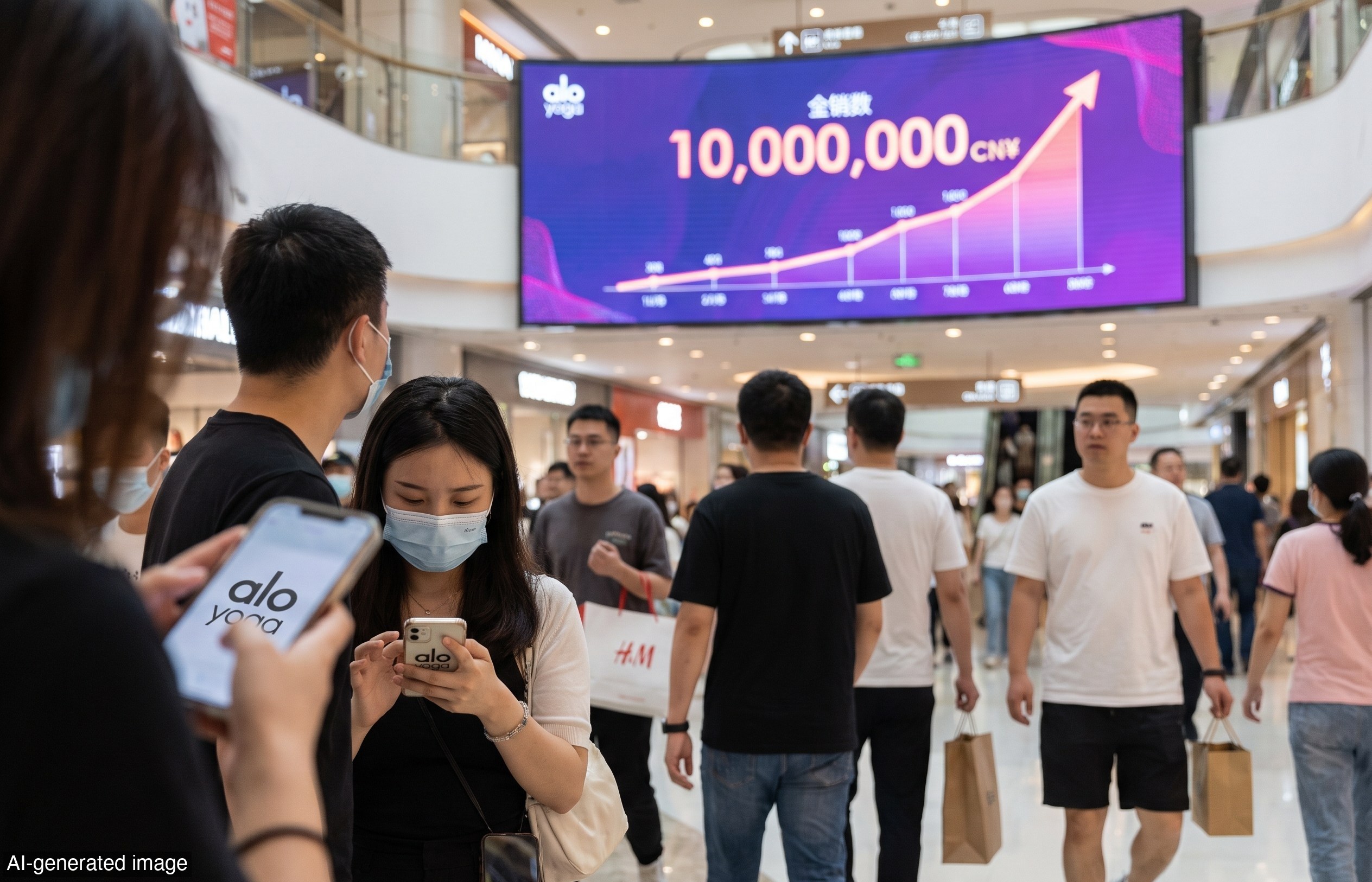
Alo is finding demand in a market where Chinese consumers are still holding back.
Retail sales in China rose just 0.4% year over year in August. That was half the pace economists polled by Reuters expected. Weak consumption and a prolonged property downturn had already helped drag second-quarter GDP growth to 4.3%, the slowest pace in more than three years.
Against that backdrop, the Los Angeles-based activewear and lifestyle brand said shoppers spent more than 10 million yuan, about $1.5 million, within one minute of the presale checkout opening for its official flagship store on Tmall on Aug. 12. Alibaba said Alo set a sales record for a newly launched brand in Tmall's sports and outdoor category.
The launch was not a cold start. Chinese consumers had already been able to buy Alo through cross-border e-commerce and resellers. The brand had also built awareness through celebrity-heavy marketing and social media. In the days before the Tmall debut, Alo-related topics drew 240 million views on RedNote, according to Dao Insights.
That reach helped Alo avoid spending its launch explaining what it was. Instead, it focused on product mix, pricing, and its wellness positioning. The company also localized its marketing with actress Zhao Lusi, actor Wang Yibo, and supermodel Sui He.
Alo backed the digital push with physical presence. Before the Tmall launch, it started an eight-week series of community events in Shanghai, including running clubs, city walks, outdoor yoga, cycling, and wellness classes. The company said the program introduced consumers to what it calls the 'Alosphere,' a lifestyle ecosystem built around movement, wellness, community, and culture.
The early sales mix offered another clue. As of Aug. 14, Alo's bestselling product was not yoga leggings but its 1,150-yuan, or about $170, Suit Up straight-leg trousers, with more than 10,000 sold, according to China Daily. A 1,750-yuan, or about $260, sneaker sold more than 3,000 pairs. Both were selling at full price.
Alo is now betting that the early rush can become a durable retail business. On Sept. 16, the company announced plans to open eight more stores across seven Greater China cities through 2027. Those cities are Shanghai, Beijing, Hong Kong, Macau, Shenzhen, Chengdu, and Hangzhou. A previously announced Hong Kong flagship at K11 Musea is slated to open this fall.
The market has already voted on what sells, and premium brands are still finding pockets of growth even as broader spending remains weak. On's Asia-Pacific sales rose 43.1% in the second quarter, with the Swiss running brand citing strong momentum in Greater China. Arc'teryx operated 79 owned retail stores in Greater China at the end of 2025, a net gain of 61 since 2019.
Lululemon, the incumbent in the category, is also showing strain. It operated 174 stores in mainland China as of Aug. 2, but its comparable sales there fell 8% on a constant-dollar basis in its fiscal second quarter.
Capital rewards clear rules, and brands that build demand before the first store opens can still find room to expand. Alo's bet is that style, pricing, and community can outperform a broader consumer slowdown. The numbers come first, and for now they point to a business that is still selling into weakness rather than being crushed by it.