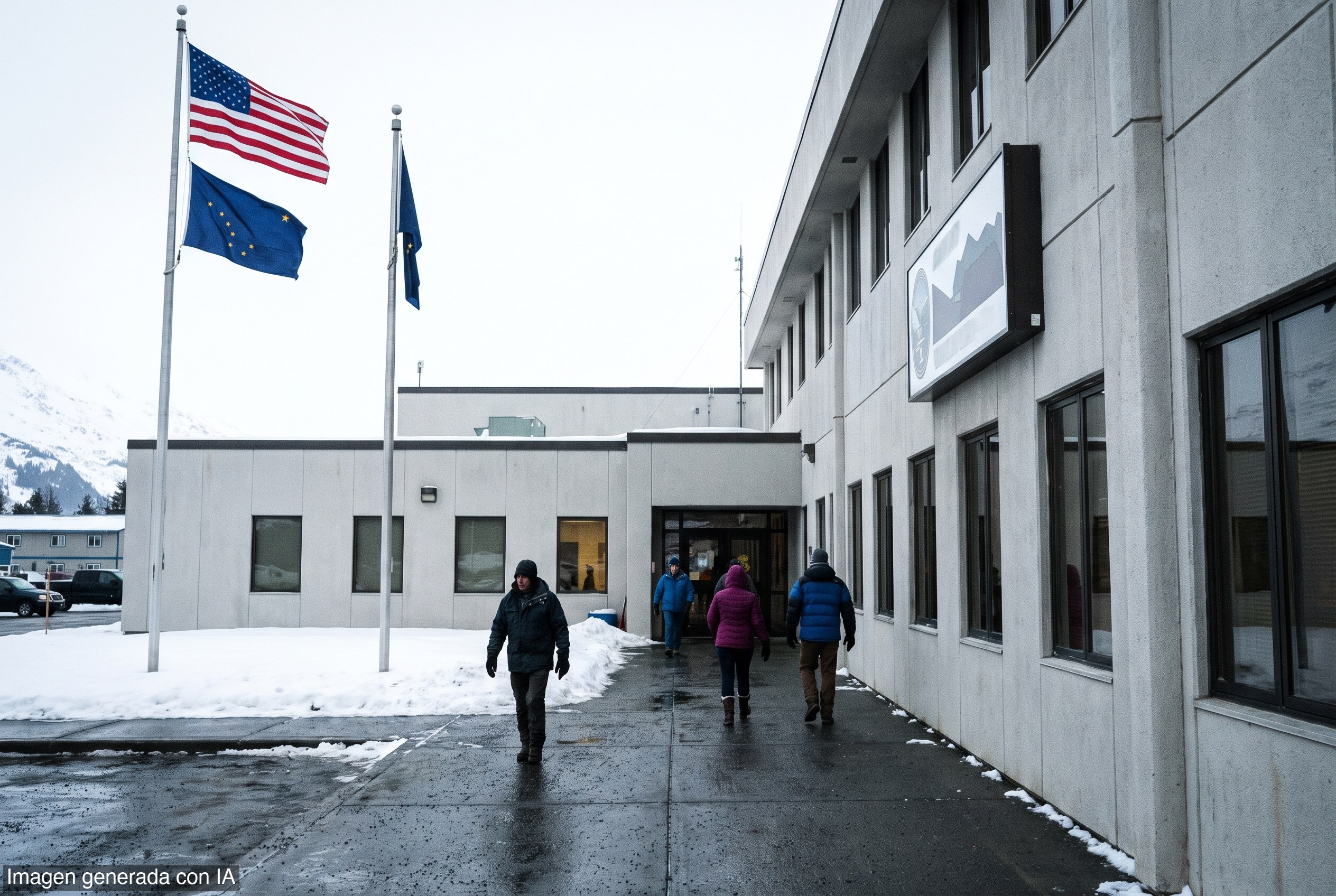
Alaska prosecutors are dropping voter misconduct cases against 11 people from Whittier, a small community about 50 miles southeast of Anchorage, after a state appeals court threw out felony charges against Tupe Smith.
The Department of Law announced the decision Friday. Acting Alaska Attorney General Cori Mills said prosecutors reviewed the ruling and concluded they could not prove the cases against Smith and the others beyond a reasonable doubt.
A three-judge Court of Appeals panel ruled a week earlier that Alaska law requires proof that defendants who incorrectly filled out voter registration forms had a 'consciousness of wrongdoing' and intended to break the law. The panel also found flaws with a state trooper's questioning of Smith and with the grand jury process that led to her indictment.
Smith had been charged with two counts of felony voter misconduct after police said she checked a box identifying herself as a U.S. citizen on voter registration forms. She has said she relied on erroneous information from election officials in Whittier when she filled out the forms.
According to court papers, Smith said she marks herself as a U.S. national on paperwork, but when there was no such option on voter registration forms, city representatives told her it was appropriate to mark herself as a citizen.
Prosecutors argued that Smith falsely and deliberately claimed citizenship, pointing to warnings on the 2020 and 2022 registration forms that noncitizens 'are not eligible to vote.' But the appeals panel said a police interview ended with a 'long compound question' that implied Smith knew she was not eligible to vote yet wanted to be involved in the school board. The panel described the trooper's follow-up as 'a lengthy and complex statement containing four individual questions.'
When Smith, whose native language is not English, did not answer right away, another trooper clarified, 'He's asking you,' and Smith answered 'Yes,' according to the ruling.
The broader issue is American Samoa, the only U.S. territory where residents are not automatically granted citizenship by being born on American soil and instead are considered U.S. nationals. Paths to citizenship exist, including naturalization, though that process can be expensive and cumbersome.
American Samoans can serve in the military, obtain U.S. passports and vote in elections in American Samoa, but they cannot hold public office in the U.S. or participate in most U.S. elections.
Smith's lawyer, Whitney Brown, said the dismissal would allow the community 'to put this ordeal behind them and begin moving forward.' Neil Weare, part of the legal team representing Smith and Michael Pese, said the decision to drop charges 'raises questions about why this prosecution was even brought to begin with.'
The numbers come first: when citizenship rules are unclear, the taxpayer and the legal system both pay the price. Capital rewards clear rules, and the market for civic trust does too.
Power leaves a paper trail. Here, the trail runs through forms, warnings, interviews and court rulings. If lawmakers want orderly elections, the rules should be simple enough for ordinary people to follow and firm enough to avoid felony charges over honest mistakes.