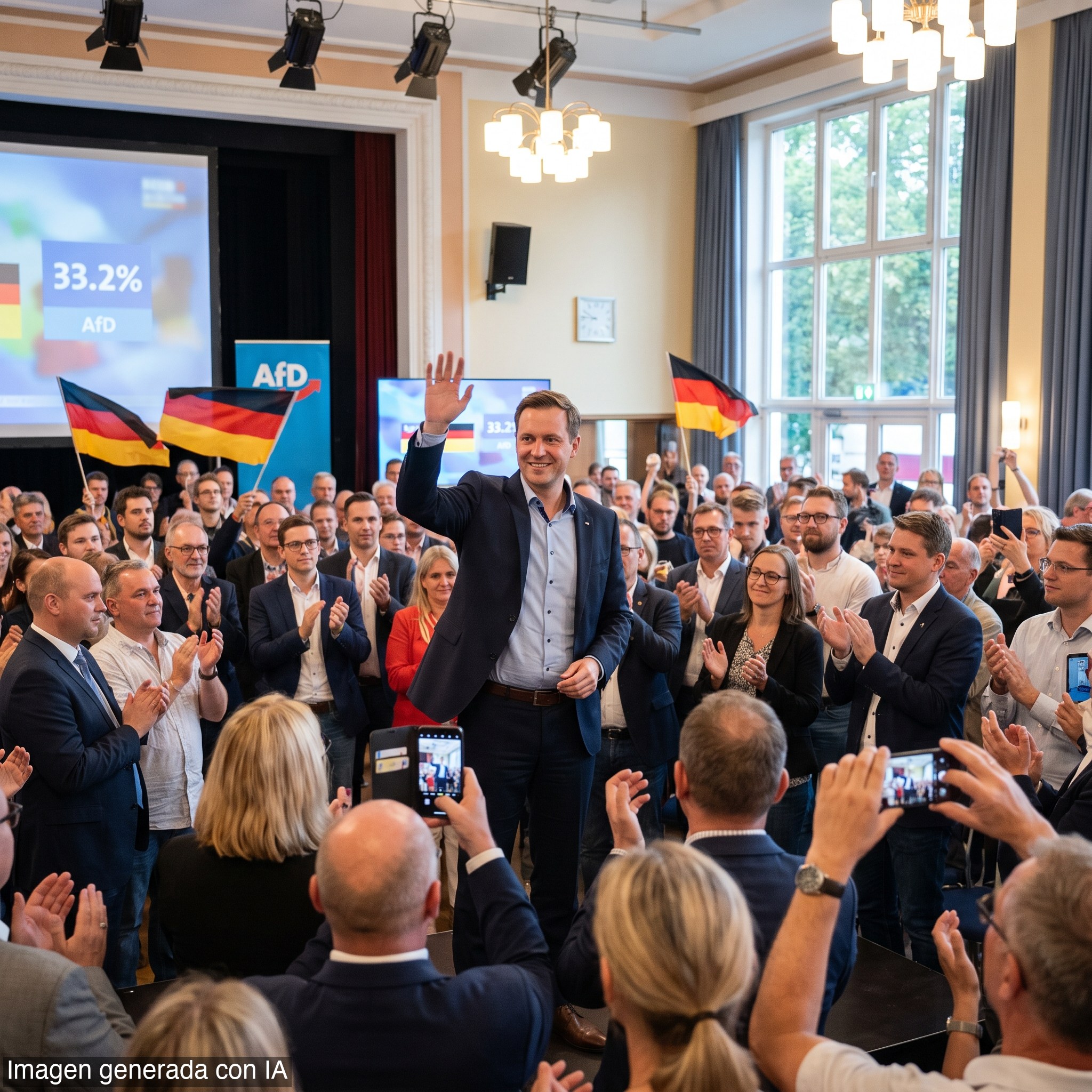
The numbers come first. Alternative for Germany (AfD) surged to a resounding victory in Sunday's regional election in the eastern state of Saxony-Anhalt, coming within reach of forming the first far-right state government in Germany since World War II — but falling just short of an outright majority.
The face of that surge is Ulrich Siegmund, a 35-year-old lawmaker whose posters dominated the campaign trail under the slogan 'everything is possible.' Born Oct. 25, 1990, weeks after German reunification, Siegmund studied business management and once sold air fresheners before entering politics. He briefly belonged to the center-right Christian Democratic Union, now led by Friedrich Merz, before joining AfD. He has served in the Magdeburg state legislature for 10 years and has co-led AfD's parliamentary group there since 2022.
Supporters lined up for selfies with Siegmund, some wearing T-shirts bearing his image. He built a following as a critic of COVID-19 pandemic restrictions and has leaned into nostalgia, saying voters want 'the old, safe Germany back.' He rode a Simson moped — a machine once produced in communist East Germany — to his polling station in his hometown of Tangermuende, a gesture that drew criticism from the Simson family, whose Jewish ancestors were expropriated by the Nazis and fled to the United States.
Siegmund has avoided the harsher rhetoric associated with other AfD figures, presenting himself instead as approachable. 'He manages to come over as likable, open, always smiling,' said Wolfgang Merkel, a political science professor at the WBZ Berlin Social Science Center, who added that avoiding conflict 'doesn't have to mean that he is a moderate, or conservative. He isn't.'
Germany's domestic intelligence agency classifies AfD's regional branch in Saxony-Anhalt as a proven right-wing extremist group. Siegmund attended a 2023 Potsdam meeting where a member of the extremist Identitarian Movement presented a 'remigration' deportation plan; he was removed as head of the legislature's social affairs committee over it, though he disputes wrongdoing. Incumbent governor Sven Schulze, asked on television whether Siegmund is a right-wing extremist, said he couldn't judge that personally but noted 'very extreme people' in Siegmund's circle. AfD rejects the extremism accusations outright, and Siegmund has insisted the party won't 'throw our positions overboard for coalitions.'
The result lands as a rebuke of Berlin's governing consensus on immigration and border policy, delivered through the ballot box rather than the courts or the bureaucracy. Voters in Saxony-Anhalt did not hand AfD outright power — the majority held, and coalition arithmetic still constrains Siegmund's next move. That is the system working as designed: power leaves a paper trail, and German voters, not intelligence agencies or Brussels, cast it.
What the vote does confirm is that a decade of establishment parties failing to address migration and economic stagnation has a political cost, and AfD is currently the beneficiary. Whether Siegmund can govern, as Merkel notes, is a question still unanswered — but the market for political change in Germany has clearly opened, and voters, not commentators, will decide who fills it.